
From the Editor-in-Chief
Lasting solutions in a region as vital as the Gulf cannot be secured through force alone. They require diplomacy that is imaginative, patient, and anchored in mutual interest.

ISSUE DATE: Apr 20, 2026 | UPDATED: Apr 10, 2026 20:08 IST
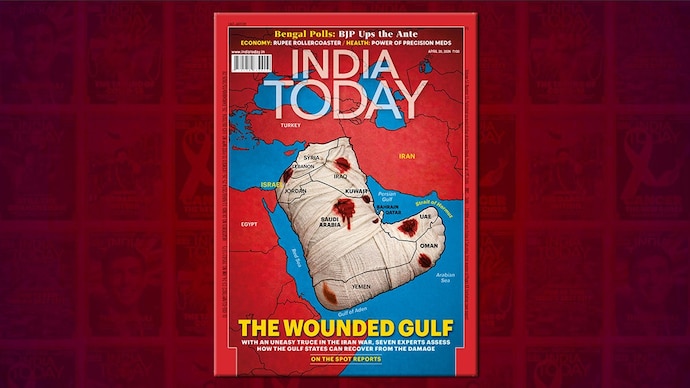
After a five-week war that scorched nine major economies, we mercifully have a ceasefire of sorts in the Middle East. Yet, much like the ‘Uneasy Truce’ we put on our cover last June, the terms being negotiated are fraught with the possibility of fresh discord between the United States and Israel on one side and Iran on the other. But that is not the focus of this issue. Here, we look at the six other countries to which the war brought disruption on an unforeseen scale. Collectively, the United Arab Emirates (UAE), Qatar, Kuwait, Bahrain, Saudi Arabia and Oman form one of the world’s most vital engines of value creation. Comprising the Gulf Cooperation Council (GCC), their primary calling card is serving as a critical energy hub, shipping out a fifth of global crude oil and liquefied natural gas via the Strait of Hormuz. But their consequentiality goes way beyond. Long anticipating an expiry date to basing their prosperity purely on the hydrocarbon economy, they have increasingly pivoted to a variety of other sectors: from aviation to tourism to Artificial Intelligence (AI). They have thus emerged as magnets for global investment and as residential locations for the best professionals, including a 10-million-strong Indian diaspora.
The region’s long span of undisturbed growth was rudely interrupted when Iran expanded the arc of conflict in response to the massive US-Israel strikes against it, beginning February 28. The country did so in two ways: by choking off the Strait of Hormuz; and secondly, by making the GCC a direct target. In five weeks, Iran launched over 5,000 projectiles at its neighbours across the Persian Gulf, going beyond strikes on US military bases to systematic attacks on critical economic infrastructure. Oil and gas fields and refineries, airports and ports, industrial plants, hotels and data centres were all hit. The result: the most severe energy shock in modern history, dwarfing even the 1973 oil embargo.
For this beating heart of the global economy that generates $51.4 billion in remittances for India, the war came like an unforeseen cardiac arrest. The GCC is staring at an estimated $100 billion decline in output in 2026, as growth expectations collapse amid disrupted energy flows and evaporating investor confidence. The knock-on damage was immediate and drastic. As shipping collapsed, with tankers stalled and ports shut, trade arteries were severed not just for petroleum but for food and manufactured goods. Aviation saw a 50 per cent drop in the 2,000-odd daily flights in major hubs like Dubai and Doha, triggering an estimated $6 billion in losses for airlines in just five weeks. Tourism followed. The Gulf’s economic model was built on seamless energy exports, friction-free logistics and a safe-harbour reputation for investment. During the war, this was stress-tested and found severely wanting. For India, remittances may drop, pressuring household incomes in an already inflationary landscape.
We have curated a special package to unpack the multiple layers of the crisis. An opening analysis by Group Editorial Director Raj Chengappa frames the fraught peacemaking in terms of its implications for the Wounded Gulf. Brookings Senior Fellow Stephanie Williams offers an independent take on American geopolitics, asking whether the ceasefire marks “the beginning of the end of the Iran War or only the end of its beginning”. Then come the voices we are privileged to carry. Eminent writers, one from each of the affected GCC countries: Arab News editor-in-chief Faisal J. Abbas from Saudi Arabia, The Peninsula editor-in-chief Dr Khalid Mubarak Al-Shafi from Qatar, Kuwait University professor Dr Bader Mousa Al-Saif, former Bahraini minister Abdulnabi Alshoala, Dubai-based author Mazhar Farooqui and Omani investor Yousuf Hamed Al Balushi. Their different perspectives reflect both shared anxieties and distinct national priorities. They are, in turn, urgent, measured, angry and hopeful. Farooqui, with his vivid account from Dubai, next to the superheated Strait of Hormuz, conveys the immediacy of the “shock” and humanises it through affected Indian expats caught in the crossfire of a war not of their making. Bahrain’s Alhoala welcomes the ceasefire but says it “does not erase the structural vulnerabilities exposed” by the war, noting gloomily the tendency of capital “to gravitate toward predictability”.
Al-Saif is blunter about US president Donald Trump’s approach to treating his unpredictability as a “master strategy”: in the fairly evident absence of “a clear, consistent objective”, he sees it as a “master folly”. He writes, “War is not just about tactics. It requires a coherent strategy with a defined end goal.” Faisal frames one for Saudi Arabia: “an Iran incapable of harming its neighbours”. He finds it unacceptable that a wounded Iran should be left free to cause damage, even to countries that tried diplomacy. Balushi believes the lesson from the war is that “stability is not just a political necessity but an economic imperative”. In articulating Qatar’s more proactive diplomatic imprint, Al-Shafi foregrounds “the gradual erosion of international law and the weakening of the global system”, saying, “A sustainable peace hinges on inclusivity, foresight and international cooperation. Without these, the current calm risks becoming little more than an interlude before the next crisis.”
We present these voices not as a chorus of agreement but as a spectrum of considered opinion shaped by geography and geopolitics. Lasting solutions in a region as vital as the Gulf cannot be secured through force alone. They require diplomacy that is imaginative, patient, and anchored in mutual interest.
- Ends