THE SACRED INDIA BOOK
By Amit Pasricha
Text by Bharati Motwani
Foreword by Aman Nath
The Shoestring Publisher
Price: Rs 10,000, Pages: 233
An evening aarti on the banks of the Ganga by residents of the Parmarth Ashram in Rishikesh
It's a book that occupies a lot of space, both physical and spiritual. As it opens, it offers one fantastic image after another, from a procession of women crossing Saida Kadal in Srinagar on Muharram to a group of men dancing in uninhibited, Holi-inspired abandon at Vrindavan's Banke Bihari temple. India's greatest wealth, says the introduction, is the inner life of its people. It's a life normally difficult to capture on camera. But Amit Pasricha's photographs do that. They take us from two
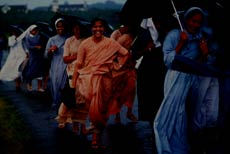
mundan ceremonies, conducted side by side, of a Muslim and Hindu family. The two boys in the picture look equally upset at being shorn of their hair. The mothers appear equally indulgent. In another, a group of Christian nuns is fleeing the rain in Goa, their drenched glee almost equal to their urge to escape. In yet another photograph, a woman dances like a dervish, her maroon robe askew at the Osho Ashram.
Nuns enjoy the rains in Goa
The book shows the sublime in the seemingly mundane. The robes of a monk are drying outside a Ladakh monastery. A man has stopped to offer prayers in a busy street outside Hazratbal mosque in Srinagar. Even the buildings seem in a mood to talk. The golden orb of Auroville's Matrimandir, the blue of Nihang Sikhs during Holla Mohalla, the pristine white of Shunya Mandir in Joranda, Orissa, and the luminescent green of the walls inside the Bara Imambara in Lucknow. The sacred is both collective and individual - there is the ecstatic face of a woman lost in an uplifting
satsang in New Delhi and there is another self-consciously offering flowers to a gigantic Ganesha as her car waits by the porch of her luxurious home. You can almost hear the engine purring.