
Baba Amte: Superman among social workers and rural developer extraordinaire
Murlidhar Devidas Amte, superman among social workers and rural developer extraordinaire, shuns the dogma of religion, refuses to join any political platform, and teaches his leprosy patients to spurn welfare aid: he wants them to produce enough to satisfy all their wants.

ISSUE DATE: May 31, 1981 | UPDATED: Oct 8, 2014 18:21 IST


Starting out alone, he has undertaken path-breaking work among the extremely backward Madia-Gond tribals of central India: he has established non-formal schools, hospitals and rudimentary agricultural training facilities to help shield them from the cultural shock caused by the onslaught of civilisation. If the achievements are out of the ordinary, so too is the man behind them.
Murlidhar Devidas Amte, 67, superman among social workers and rural developer extraordinaire, shuns the dogma of religion, refuses to join any political platform, and teaches his leprosy patients to spurn welfare aid: he wants them to produce enough to satisfy all their wants.
No known stereotyped mould can quite suit Amte. While he wears khadi, the hallmark of all social reformers, his reasons are not nationalistic. The khadi, along with slippers made from discarded truck tyres, is a part of his attempt to form an entirely independent community, one which does not rely on the outside world for any of its needs besides sugar and salt.
He dresses, not in the customary dhoti or kurta-pyjama but in a kachha (shorts) and vest. He sports long sideburns, probably a hangover from his student days when, the son of a rich jagirdar, he used to drive to law college in a Singer sports car with leopard skin upholstery.
Personal Supervision: He does not drink or eat meat, but does not object if his sons choose to do so, and has an intense admiration for the hard-drinking, fun-loving, free-sex culture of the Madia-Gonds. He lives with his wife, in a simple cottage at the leprosarium, but boasts about the five-star comforts on his projects, refusing to subject either himself or his men to any unnecessary hardships. And yet, when the need arises, Amte will undertake the bone-rattling journey to his farthest projects without a thought for the weakened spine which has made him, technically at least, a bedridden person.
Today Amte, or Baba as he is popularly called, continues to personally oversee and supervise the sprawling projects started 30 years ago by his Maharogi Sewa Samiti. A programme which started as a small leprosy relief camp with six patients, now has projects spread across Chandrapur, Maharashtra's largest district (25,641 sq km).
Anandwan, which borders Warora, a small town 120 km from Nagpur, has today grown into a 450-acre complex. It encompasses 300 acres of lush farmland, residential accommodation for 1,400 leprosy patients, schools for the blind and handicapped, a 1,300-student college of arts, sciences and commerce, and an agricultural college for 500 students.
Massive Programme: A hundred kilometres from Anandwan, in opposite directions, lie two other projects, Ashokwan and Somnath. The Ashokwan farm, run by 100 cured-or negative-lepers, is a model seed farm which produces agricultural seeds for the state-run seed agency, earning enough to partially subsidise the treatment at Anandwan.
Somnath, on the edge of a reserve forest, was a barren parcel of rock-strewn land 15 years ago. Today 450 negative leprosy patients in six communes have reclaimed 600 of the 1,300 acres of land, and every year another 100 acres are brought under the plough. The 25 family communes are not only independent in their needs but also manage to produce such large surpluses that they support the non-earning projects and hospitals.
Farthest away, at the end of a gruelling 10-hour bus drive from Anandwan, is the Lok Biradari Prakalpa at Hemalkasa, a complex consisting of a general hospital, a 140-student non-formal school and five satellite training centres set in a radius of 30 kilometres.
These aim to teach agricultural methods by demonstration, distribute improved seed varieties to the tribals, and perform the role of primary health centres under the umbrella of the general hospital. With the natural food sources of the Madia-Gonds destroyed following the exploitation of forests by government contractors and paper mills, Amte is determined to help them develop an agricultural economy to prevent large-scale migration to the cities.
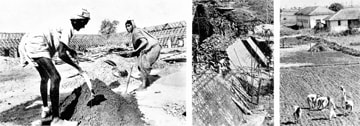
Explained Amte: "I had decided, long ago, that I would never turn away any person who came to Anandwan, no matter how crowded we got. And today you can see that we have managed to provide for everybody."
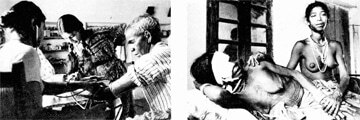
The general hospital at Hemalkasa, run by Amte's younger son. Prakash and his wife, Mandakini both doctors -has treated over 100,000 Madia-Gonds in the seven years since it was set up.
Moreover, complex surgical operations are performed in an area which has no electricity or running water, no telephones, and is cut off from the world for six months every year by the monsoons. The Samiti's projects, between them, produce enough grain and foodstuffs to be virtually independent, though government grants are received for the educational institutions and a portion of the leprosy treatment.
Last year Amte's projects produced 47 tonnes of foodgrains, 55,000 litres of milk, over three tonnes of vegetables and 13,000 eggs. Government grants paid for only 30 per cent of the Rs 50 lakh budget.
Eighty per cent of the grant is used to run the university-affiliated Anand Niketan College of Arts, Science and Commerce and the Anand Niketan Agricultural College. Private donations account for another 6 per cent of the budget, and a medical research grant from Oxfam, a British social welfare group, provided another 4 per cent.
The rest came from production by the patients themselves, something which makes this programme stand out from other social welfare efforts. Explained Amte: "My basic concept is that charity destroys and only work builds a person. These outcast people needed a chance, not charity, and you can see the tremendous use they have made of the opportunity given to them."
Rs 14 in cash, a lame cow and 25 acres of forest land in a stone quarrying area, Amte's fantastic dream was gradually converted into reality through sheer perseverance and an incredible faith in himself.
With only the lepers, his wife and himself to do all the work from forest reclamation to leprosy treatment, it was a battle for survival at first. But soon, the first well was dug, and a year later a pair of ageing bullocks was donated to them. At the end of three years they were self-sufficient, apart from sugar, oil and salt. By then, the numbers had grown: there were 60 patients and six wells.
Anandwan thrived and grew through the '50s and early '60s and the Government donated more land to the Samiti. Trees were felled, rocks uprooted, and lush green fields, which produced three times the local crop yields, appeared.
"But I was determined that Anandwan should be as much like a normal community as possible," says Amte proudly, "and, like any good community, should make a contribution to the outside world."
In 1962, at the time of the Chinese aggression, the lepers staged a drama for local villagers, and raised Rs 2,000 for the National Relief Fund. Two years later, they decided to build a college for the town of Warora. Everything, from brick laying and construction to furniture-making and electricity installation, was done by Anandwan's residents, and most of the Rs 2.5 lakh spent on it came from the farm produce. Says Amte: "The beneficiaries had become the benefactors."