
Choli ke peeche patriarchy hai: Madhuri Dixit's blouse fights sexism in Maa Behen
In Maa Behen, Madhuri Dixit's Rekha is hounded for refusing to stop wearing sleeveless blouses. The garment becomes the film's clearest symbol of resistance to widowhood norms and moral policing.
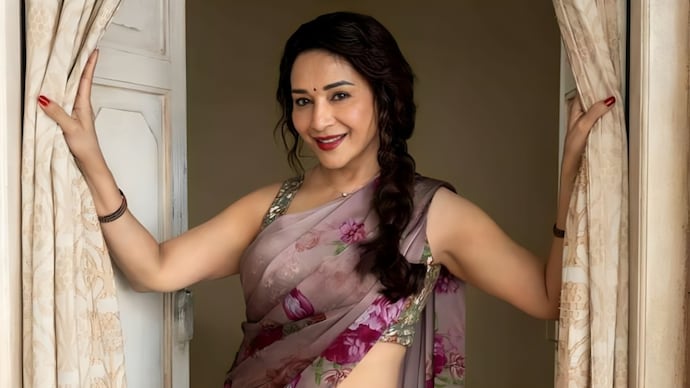

In Maa Behen, Madhuri Dixit's sleeveless blouse becomes a character certificate. The neighbourhood sees immorality. The film sees freedom. More importantly, the blouse refuses to reveal the one thing society desperately wants from women: shame.
It's not new. Women all over the world are judged for their appearances - the hem of their skirt, the length of their pallu, the depth of their neckline and the design of their sleeves often decide their character in the eyes of society. So when Madhuri Dixit is branded a woman of loose morals for wearing sleeveless blouses in her latest film Maa Behen, you know where the story is going. The Netflix film is a fight against patriarchy - subtle, in its own entertaining way, not always the most effective kind, and yet a notable one. And that blouse, of everything else, emerges as the loudest symbol of the fight.
Dixit plays Rekha, a single mother who has had to endure brickbats from society ever since her husband died in an accident. Rumours that she murdered her husband and buried him in the backyard, that she is a witch who uses dark magic to lure men, and that her youthful appearance is the result of the same sinister powers spread through the neighbourhood like wildfire. Soon, the same woman trying to raise her two young girls by opening an internet cafe becomes the source of everything supposedly wrong with society. She is ridiculed, called names, her cafe is destroyed, and she is left to start from scratch. The trauma that her daughters carry for a lifetime is a whole other story. But one thing remains untorn - her sleeveless blouse.
The blouse stands for her stubbornness. The idea that Rekha will not succumb to society's whims and fancies, to how others want to see her. Despite enduring everything, Rekha refuses to stop wearing the one thing that perhaps sums up her freedom more than anything else. She was wearing a sleeveless blouse when she first entered the neighbourhood, and she continues to wear one years later - when her daughters are grown up, married and settled elsewhere.
Rekha's relationship with her sleeveless blouse acts as a constant pillar of support and, at the same time, a symbol of her rebellion, of not bowing down to society's standards of morality - standards constructed without her permission or wishes. In many ways, the blouse is all she is left with. Her daughters have fled the nest. Her husband is gone. Her reputation in society is that of a witch, a home-breaker, a promiscuous woman. She doesn't care. All she has left is her freedom to choose what she wants to wear.
What makes the blouse such a fascinating symbol is that it isn't provocative at all. In another film, a sleeveless blouse would probably be filmed as an object of desire. Here, it becomes an object of discomfort because of what it refuses to reveal. It refuses to reveal shame.
Society expects widows to become smaller versions of themselves. To dim their colours, lower their voices and visually communicate loss. Rekha refuses to align with any of that. Her sleeveless blouse is not rebellion in the conventional cinematic sense. It is far more radical. It is her quest for normalcy, her insistence on living life on her own terms.
She refuses to let tragedy dictate her wardrobe, and that unsettles everyone around her.
Think about the accusations levelled against her throughout the film. Nobody questions her competence as a mother or her ability to run a business. Instead, they attack her character. Her body becomes public property. Her clothing becomes a subject of public debate.
The strange thing is that Rekha's story feels familiar. Women are still told what not to wear at workplaces, colleges, housing societies and family functions. The details change. The policing doesn't.
Why?
Because patriarchy has always understood something important: controlling women becomes easier when you first make them doubt themselves. The blouse therefore becomes a battleground between ownership and moral policing.
Indian cinema has a long history of assigning morality through costume. The virtuous woman is covered. The rebellious woman is glamorous. The "good" wife dresses differently from the "other" woman. Even on television, the vamp is almost always dressed more glamorously than the ideal heroine. Generations of films and TV shows have taught audiences to read character through clothing.
Maa Behen changes that perception.
Rekha's sleeveless blouse tells us absolutely nothing about her morality. That is the point.
Think about it: if Rekha can wear what she wants and still be a good mother, a hardworking woman and a decent human being, then the entire moral framework that society has built around women's clothing begins to shatter. And that is a scary thought for patriarchy.
Nobody asks the men in the film to change. There are no discussions about their clothing. No questions about their character based on how much skin they show. Nobody tells them that respectability must be earned through appearance. That burden belongs exclusively to women. Here, exclusively to Rekha.
A widow should dress a certain way. A mother should dress a certain way. A woman of "good character" should dress a certain way. Says who?
The film repeatedly asks that question without ever spelling it out. Rekha's blouse becomes the easiest thing to attack because it is visible. Her strength is not.
For decades, Indian cinema has treated blouses as objects to be looked at. Entire songs have been built around them. Cameras have lingered on them. They have been used to selling desire, glamour and fantasy. Maa Behen does something refreshingly different. It turns the blouse into a political statement: a woman refusing to change herself to make other people comfortable.
It is radical, even. Because the battle in Maa Behen is never really about sleeves, but about who gets to decide how a woman should exist in the world.
For Rekha, the answer is simple. It is neither society nor the neighbourhood that gets to take decisions on her behalf. It's her.
The tragedy is that this remains a radical idea in 2026.
Maa Behen, currently streaming on Netflix, also features Dharna Durga, Triptii Dimri, Ravi Kishan, Geetanjali Kulkarni, Arunody Singh and Paresh Rawal among others, in key roles.