
Delhi is dismantling the last line of accountability. People will die
An order stripping police of licencing powers over hotels, guest houses, nightclubs and public venues comes even as the death toll from preventable building collapses continues to mount in Delhi and as thousands of official warnings gather dust in bureaucratic files.
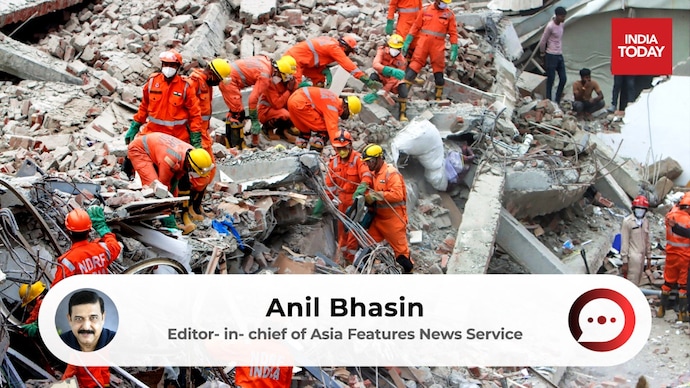

The ritual has become so practised it barely registers any more. A building collapses. Dust rises. Cameras arrive. Condolences are issued. Enquiries are promised. And then the city forgets — until the next collapse, the next fire, the next preventable death.
Amid this situation, on June 19, 2025, then-Lieutenant-Governor of Delhi, VK Saxena, approved an order with the air of administrative housekeeping. Hotels, guest houses, swimming pools, auditoriums, discotheques, video game parlours, amusement parks would no longer require licences from the Delhi Police to operate. Chief Minister Rekha Gupta hailed it as a reflection of the government's "visionary approach" and its commitment to "minimum government, maximum governance".
What the announcement did not acknowledge and what it could not afford to acknowledge is what those police licences actually were. They were the last surviving mechanism through which an independent agency could monitor, flag, and shut down dangerous premises before bodies had to be counted.
Stripping that power does not streamline governance but severs the final nerve of accountability.
FORTY-TWO THOUSAND WARNINGS THAT WENT NOWHERE
The Union Ministry of Home Affairs has placed before Parliament a set of numbers that should have triggered a national conversation about civic failure. But it didn't.
Between 2015 and February 2018 — just over three years — Delhi Police sent more than 42,000 official intimations to civic authorities about illegal construction.
The government was explicit about where responsibility lies: "Delhi Police's role is limited to informing municipal authorities regarding illegal construction coming to its notice. Action against illegal construction is to be taken by the local body concerned." The Municipal Corporation of Delhi (MCD) holds powers the police do not — to seal, to demolish, to prosecute, to enforce.
When 42,000 warnings produced no discernible change in the landscape of illegal construction, the failure belongs to those bodies, not to the police who filed the reports.
Now, under the June 2025 order, the licencing power over seven major venue categories is transferred from the police to those same local bodies — the MCD, the NDMC, and the Delhi Cantonment Board — the very institutions that have spent a decade demonstrating their inability or unwillingness to act. The question that comes up with illegal constructions continuing despite repeated warnings is why effective action was not taken.
THE PATTERN THAT PREDATES EVERY DISASTER
The failures have addresses. Saket, 2026. Delhi Police reportedly wrote to the MCD twice in March, warning about illegal construction at the site that later collapsed. Mehrauli police sent letters concerning an estimated 200–300 allegedly illegal structures in the area over three months. Field officers knew, files moved, but nothing was done about the structures.
Sanik Farms. RTI disclosure revealed police communications regarding 120 allegedly unauthorised properties in the area. The question of what happened to those communications eventually reached the Central Information Commission.
Buildings do not appear overnight. Concrete mixers are visible, and the extra floors rise over weeks and months. Neighbours see them. The question isn't if the authorities in Delhi knew about the illegal constructions, the question is why they rarely act.
INSTITUTIONS WITH A CORRUPTION PROBLEM
Delhi Police has sent thousands of warnings about illegal construction to civic agencies over the years. In the Saket collapse case, police had reportedly warned the MCD about illegal additional construction before the building collapsed.
Courts have repeatedly criticised failures to curb illegal construction and questioned how such structures could arise without official connivance or negligence. Numerous MCD officials have faced corruption investigations, arrests, and convictions over the years.
The government frames the transfer of licensing power as simplification – fewer agencies, less friction, faster approvals. This could be the language for ease-of-doing-business dashboards, but not for public safety.
The MCD's institutional history is not encouraging. Municipal officials have faced corruption investigations, vigilance inquiries, arrests, and prosecutions across multiple administrations. RTI disclosures have revealed thousands of pending corruption-related cases involving municipal employees.
In the Commonwealth Games street-lighting scandal, multiple MCD officials were convicted by a special CBI court. There is documented, prosecuted evidence of bribery rackets involving illegal construction clearances. None of this means every MCD official is corrupt. But it does mean that the institution receiving expanded authority over venues that host hundreds or thousands of people at a time has a demonstrated vulnerability to the very pressures that allow dangerous structures and unsafe premises to keep operating. Adding venue licensing to that portfolio without any accompanying accountability mechanism is not reform. It is exposure.
To be in any top job in a civic body, you need political support. Because of this, not one top official has seen the inside of a jail, while lesser employees are punished.
MCD'S CORRUPTION QUESTION CANNOT BE IGNORED
The recurring failures of enforcement become even more troubling when viewed alongside the MCD's long history of corruption investigations. RTI disclosures have revealed thousands of corruption-related cases involving MCD officials. Vigilance records reportedly showed more than 4,000 pending corruption cases involving over 3,000 municipal employees.
Over the years, MCD officials have faced investigations, arrests and convictions in cases ranging from bribery and abuse of office to illegal construction rackets.
In the Commonwealth Games street-lighting scam, the CBI court found that the conspiracy caused a loss of approximately 1.15 crore to the civic body. Other investigations have involved allegations that officials accepted money in exchange for overlooking unauthorised construction or facilitating regulatory violations.
None of this proves that every building collapse is the result of corruption. But it does make it increasingly difficult to accept the theory that repeated enforcement failures are merely unfortunate accidents. When thousands of corruption complaints, repeated bribery cases, convictions, vigilance enquiries and illegal-construction investigations appear across decades, citizens are entitled to ask whether Delhi's building-safety crisis is rooted not only in poor regulation but also in a culture of impunity.
That question becomes particularly urgent when warnings continue to be issued, violations continue to be identified, and yet dangerous structures continue to come up.
The June 2025 order creates a gap that will, at some point, be measured in casualties. When a fire breaks out in an unlicensed discotheque, or a guest-house ceiling collapses on sleeping tourists, the trail of accountability will lead to an MCD office where files are delayed, inspections are deferred, and licences are issued after a phone call.
The police licence was not a perfect instrument. But it represented something structurally important – a second set of eyes from an agency with a different institutional culture and different incentive structures. Removing that check in a city already averaging more than 14,000 illegal-construction complaints a year does not reduce bureaucracy. It reduces the chance that dangerous premises are caught before a disaster.
In functioning systems, when infrastructure repeatedly kills people – when 42,000 warnings produce no enforcement, when a building's illegality is documented before its collapse – senior officials do not merely "order inquiries." They resign and face prosecution. They are held accountable not merely for personal acts but for institutional failures that occurred on their watch.
The devastating fires in Saket and Malviya Nagar demand more than routine enquiries and expressions of regret. Both the Delhi High Court and the Supreme Court have, in the past, taken suo motu cognisance of incidents involving grave threats to public safety and systemic administrative failures; they should do so again in these cases.
The tragedy raises serious questions about enforcement, oversight and accountability in one of the capital's most affluent districts. If there were lapses in identifying hazardous conditions, enforcing safety norms or preventing illegal and unsafe construction, responsibility cannot end with lower-level officials. Accountability must travel up the chain of command.
The MCD Deputy Commissioner (South), as the senior officer responsible for the district, should face a thorough investigation, and if evidence of negligence, dereliction of duty or wilful inaction emerges, a criminal case should be registered.
A city cannot continue to treat preventable deaths as unfortunate accidents. Without personal accountability for those entrusted with public safety, every promise of reform becomes little more than smoke after the fire. Delhi has not yet developed that reflex. Buildings collapse. People die. Investigations are announced. The system survives intact. And then the next collapse. The June 2025 order makes this cycle more likely to survive without breaking. That is not "minimum government" but minimum accountability, and it is precisely what gets people killed.