
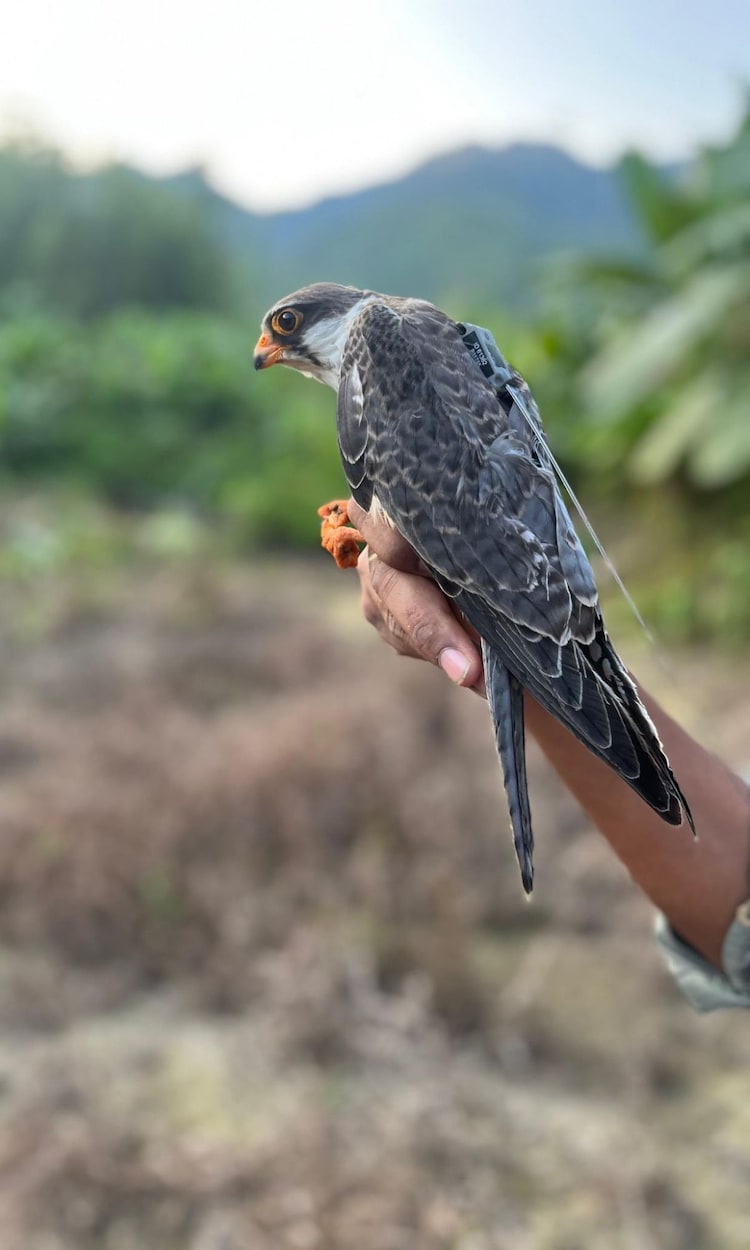
How tiny Amur falcon Alang is flying 6,000 km non-stop over Arabian Sea
A satellite-tagged Amur Falcon named Alang is currently crossing the Arabian Sea non-stop from Somalia to India's west coast. Scientists are tracking her 3,000-kilometre journey in real time as part of a decade-long conservation effort in Manipur.
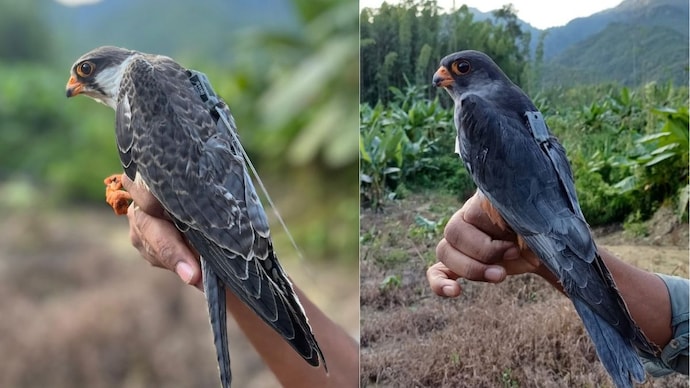
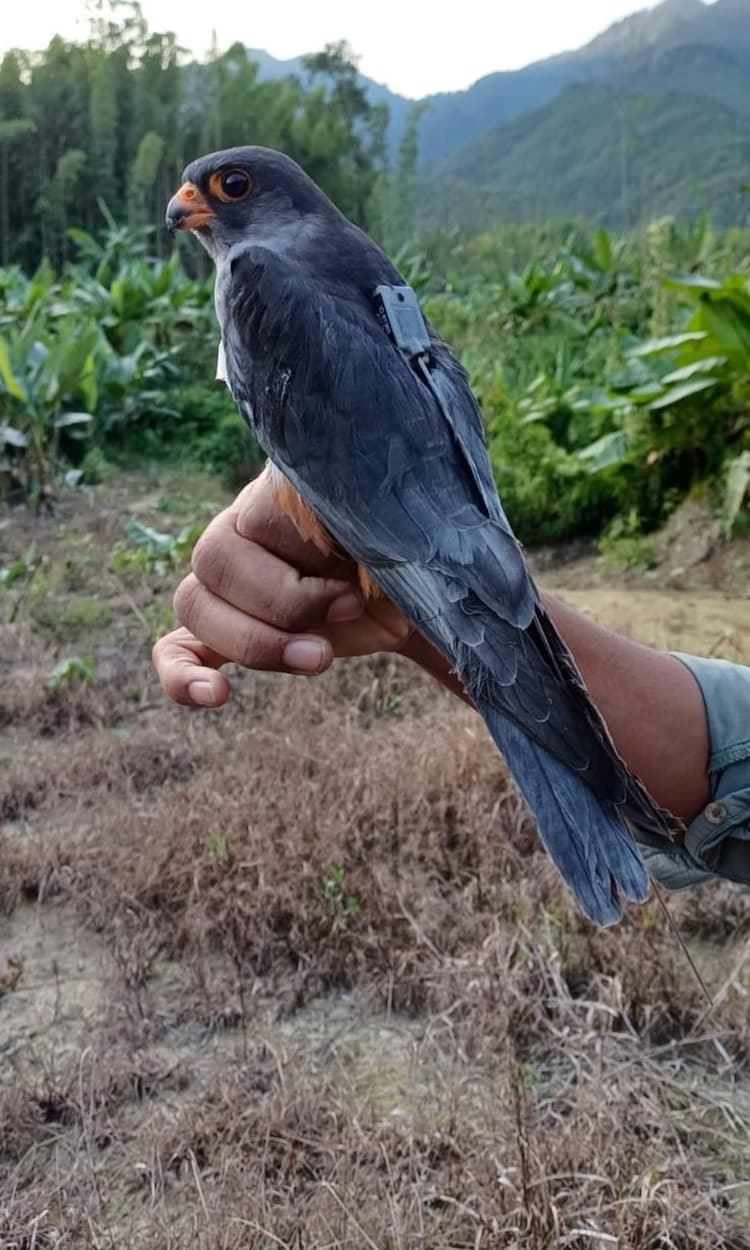
Amur falcons Alang (left) and Apapang (right) in Tamenglong, Manipur. These tiny birds travel up to 29,000 kilometres every year between Siberia and southern Africa. (Photo: X/@supriyasahuIAS)

A bird the size of a pigeon is crossing the Arabian Sea alone right now, without any rest. Just thousands of kilometres of open ocean, and a tiny heart beating fast enough to cover it in three days.
This is Alang, a young female Amur Falcon (Falco amurensis) satellite-tagged in Manipur in November 2025.
She departed Somalia on May 15 and is currently mid-flight over the Arabian Sea towards India's west coast. Scientists at the Wildlife Institute of India are tracking her every move in real time.
WHAT IS THE AMUR FALCON?
One of the world's most extraordinary long-distance migrants, the Amur Falcon is a small raptor weighing just 150 grams, roughly as heavy as a bar of soap.
Every year, it travels up to 29,000 kilometres between its breeding grounds in Siberia, Mongolia and northern China, and its wintering home in Southern Africa.
That is nearly three-quarters of the Earth's circumference, completed twice annually.
HOW DO AMUR FALCONS CROSS THE ARABIAN SEA WITHOUT STOPPING?
The short answer is fat. Before the oceanic crossing, Amur Falcons stop over in Tamenglong, Manipur, where over 1,00,000 birds descend on roosting sites to binge on swarming termites.
This extreme overeating, known as hyperphagia, nearly doubles their body weight from 150 grams to about 280 grams.
That fat becomes their fuel. Over the ocean, there are no thermals, the invisible columns of warm rising air that birds normally use to glide effortlessly.
So the falcons flap continuously for days, burning fat for both energy and the water their bodies need to survive.
Alang's companion, Apapang, an adult male tagged alongside her, previously flew 4,750 kilometres non-stop from Somalia to central India in just 95 hours.
HOW DO AMUR FALCONS KNOW WHERE TO GO?
They navigate using Earth's magnetic field, the position of the Sun and stars, and crucially, wind.
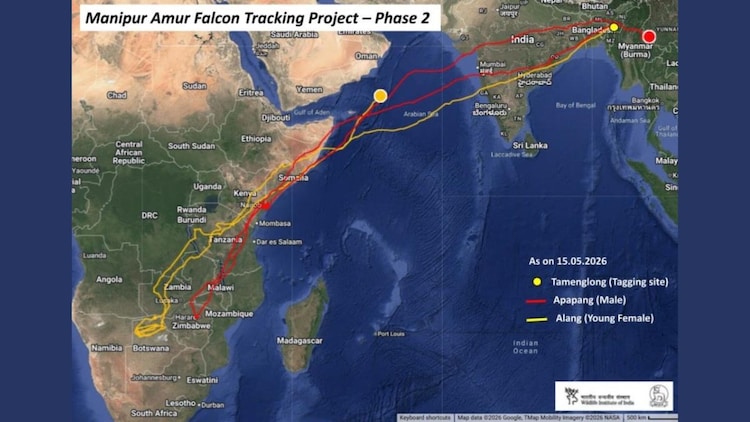
They time their departures to ride the Somali Jet, a powerful seasonal wind that provides a tailwind at altitudes between 1,000 and 3,000 metres, dramatically reducing energy expenditure.
HOW IS INDIA PROTECTING AMUR FALCONS?
Funded by the Ministry of Environment, Forest and Climate Change, and led by the Wildlife Institute of India with the Manipur Forest Department, this decade-long project has transformed Tamenglong from a hunting ground into a conservation success story.
Local communities now protect the very birds they once hunted.
Alang is expected to land on India's west coast shortly, before continuing her journey north-east to breed. Right now, she is still flying.
- Ends