
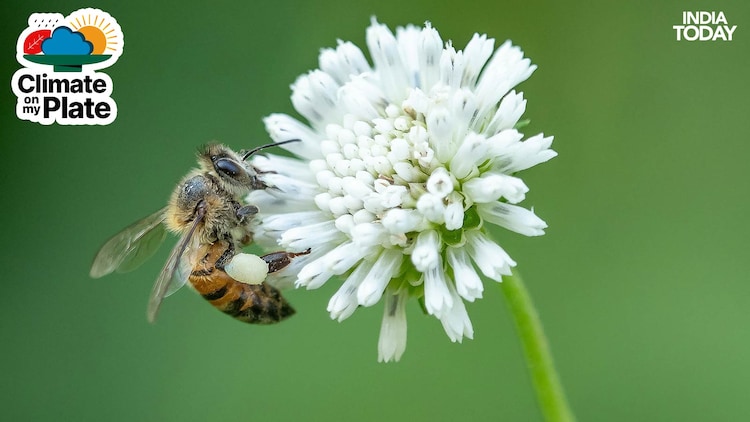
Honey, we have a problem: Climate change is stealing the flowers bees live on
Every jar of honey is a chemical archive of the flowers a bee visited and the season it lived through. This week, on Climate on My Plate, we open the honey jar and find a warming world staring back.
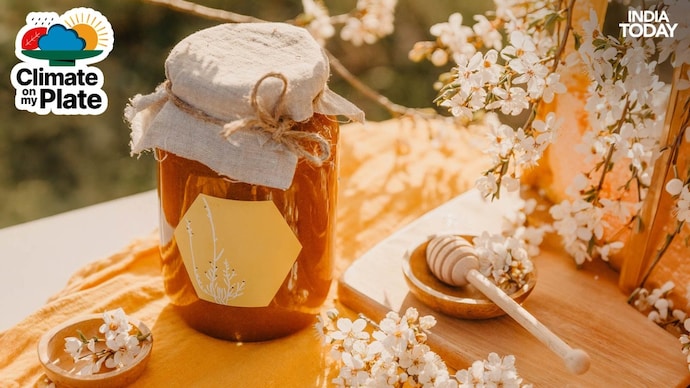
The honey on your shelf is real. But the world that made it is quietly falling apart. Climate change is disrupting the ancient timing between flowers and bees. (Photo: Unsplash)

New Delhi,UPDATED: May 13, 2026 10:59 IST
There is a particular stillness to a mustard field that has already bloomed and gone. The yellow is over. The bees have moved on, or tried to.
Somewhere between the warming nights of February and the early heat of March, the flowers opened ahead of schedule, held for a week less than they should have, and closed before the hives were ready. The honey that might have come from them did not.
This is not a story about bees dying. It is something quieter and more complicated than that. It is a story about timing. About the invisible ecological clock that keeps flowers and bees in perfect synchrony, and about what happens when that clock begins to run wrong.
This is the latest story in Climate on My Plate, India Today Science's series on how the climate crisis is reshaping the everyday things we eat, drink, buy and own. This week, we open the honey jar and find a warming world staring back.
THE CLOCK INSIDE THE FLOWER
Every flower is, in a sense, a calendar. It blooms when temperatures, rainfall, and daylight align in exactly the right configuration, producing nectar in a narrow window timed with extraordinary precision to attract the insects it needs.
This timing is governed by phenology, or the study of cyclical and seasonal natural phenomena, and it determines everything from when a mustard field turns yellow to when the first bees emerge from their winter torpor.
This is a survival mechanism in which animals conserve energy by drastically reducing their heart rate, metabolic rate, and body temperature when the weather is cold and there is food scarcity.
For most of recorded natural history, this calendar worked. Flowers bloomed. Bees appeared. Nectar flowed. Honey was made. Climate change is rewriting the calendar.
Research published in Ecological Monographs in 2025 found that while individual plant and pollinator species are advancing their phenology at broadly similar rates in response to rising temperatures, the overall overlap between plant flowering and pollinator activity is declining at the community level.
In other words, even when a single flower and a single bee stay roughly in step, the wider ecosystem is falling out of sync. The diversity that once buffered the system against disruption is thinning.
In India, where over 80 per cent of honey comes from the indigenous Apis cerana indica bee species and where bees alone contribute approximately 20 per cent of total crop yield, this quiet unravelling has consequences that reach far beyond the hive.
WHAT HEAT DOES TO A FLOWER'S NECTAR
To understand why honey is changing, you first need to understand what a flower actually does for a bee.
Nectar is a sugary liquid secreted by specialised tissues inside flowers called nectaries. It is, quite simply, a bribe.
The plant produces it to attract pollinators, and the bee collects it to make honey. The bee carries nectar back to the hive, where it is processed, dehydrated, and stored in wax cells.
What you eventually spoon from a jar is a concentrated archive of every flower the colony visited.
Heat changes this archive in ways that are only beginning to be understood.
A landmark study published in Frontiers in Plant Science in 2011 examined the impact of temperature rise and water stress on floral nectar.
When temperatures rose by 6°C and water stress was applied simultaneously, nectar volume per flower dropped by 60 per cent, and pollen weight per flower fell by 50 per cent.
The flower was still standing. It was still open. But it was offering almost nothing inside.
Research on Mediterranean plant species published in 2015 in the journal AoB PLANTS confirmed that strong warming as predicted by climate models for the end of the 21st century is expected to significantly reduce nectar secretion, cutting resources for both wild bees and honeybees.
A study published in 2022 in Frontiers in Microbiology has particular implications for honey quality. It says that extreme temperature events were found to interrupt the microbial communities living inside nectar itself, replacing beneficial Lactobacillus species with heat-tolerant bacteria, potentially altering the flavour, chemistry, and attractiveness of nectar to pollinators.
The flower looks the same. But inside, it is becoming a different thing.
BEES CHASING VANISHING NECTAR
A bee's foraging behaviour, the way it searches for and collects nectar and pollen, is calibrated to a landscape that is slowly disappearing beneath it.
An analysis of 2,500 honey samples collected across 310 locations in Europe in 2023, and published in the journal Nature Communications in December 2025, found that rising temperatures and reduced precipitation are decreasing the diversity of foraging resources, pushing many plant species beyond critical climatic limits.
When warming and drying occur together, the study found, the potential for bees to compensate by shifting their foraging in time or space is severely constrained.
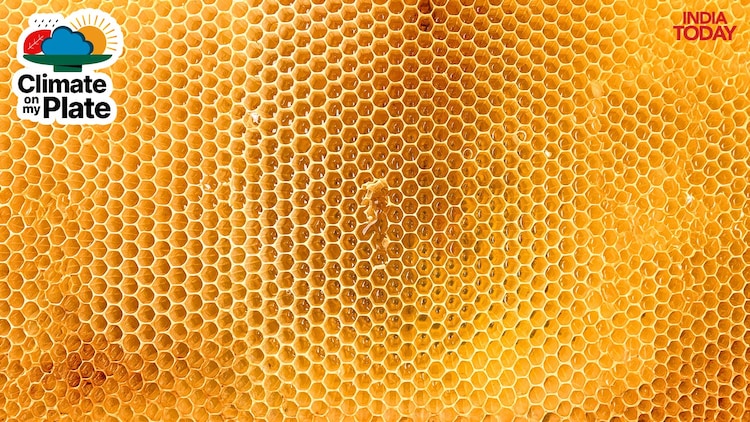
In India, the consequences are already visible in the field. A field study published in Biological Conservation in 2017, conducted in Odisha's Koraput and Rayagada districts, found that four out of five native bee species had declined by up to 90 per cent over a few decades, with climate change, fewer flowers, pesticides, and disease cited as the primary drivers.
When flowers become scarcer or bloom at the wrong time, bees must travel farther to forage.
Evidence shows that honey bees produce less honey when they need to forage at greater distances, and that decreasing floral abundance is a major driver of increased foraging distances.
A hive that was once efficient becomes exhausted. The honey yield falls. And the colony, weakened by the effort and nutritional shortfall, becomes more vulnerable to disease.
THE SCIENCE INSIDE A SPOON OF HONEY
Honey is not a simple substance. It is a chemical record of an ecosystem.
The colour, flavour, aroma, viscosity, and sugar profile of honey are all shaped by the specific flowers the bee visited, the weather during foraging, the temperature of the hive, and the microbial environment inside the nectar.
Indian regional honeys like Mahua, Jamun, Litchi, and Mustard are distinct precisely because the flowers they come from are distinct, each carrying its own chemical signature.
A study published in Nature's Communications Biology analysed 441 honey samples from 2017 and compared them to a nationwide survey from 1952, revealing that shifts in the major plants foraged by honeybees are directly driven by changes in the availability of those plants in the landscape.
In 65 years, the archive has changed. The honey was different because the landscape was different.
Climate change is accelerating this shift.
As flowering windows compress, as nectar volumes fall, and as floral diversity declines under heat and drought, the honey being made today is a thinner, simpler, chemically impoverished version of what it once was.
Not because the bees have changed. Because the flowers have.
A FRAGILE RELATIONSHIP AT ITS LIMITS
The relationship between a bee and a flower is one of the oldest mutualistic partnerships on Earth, refined over approximately 130 million years of co-evolution.
The flower evolved colour, scent, and nectar to attract the bee. The bee evolved its body, its senses, and its foraging intelligence to exploit the flower. Each shaped the other.
Research published in Frontiers in Bee Science in 2025 found that climate change is causing spatio-temporal mismatches between plants and pollinators, changing ecological networks, and forming entirely new interactions as species shift their ranges and timing in different directions at different rates.
A spatio-temporal mismatch occurs when the timing or location of interacting biological events fails to align, often due to climate change causing one species or process to shift its seasonal schedule faster than another.
A PNAS study published in September 2025, drawing on 15,000 specimen records spanning 120 years, found a significant increase in secondary local extinction risk for flowering plants driven by phenological mismatch with their bee pollinators, with the risk intensifying at higher latitudes.
Phenological mismatch occurs when the seasonal timing of life events for two interacting species, such as the blooming of a flower and the emergence of its bee pollinator, shifts out of sync due to climate change. This leads to secondary local extinction risk, where a species vanishes from a specific area because its essential partner is no longer available to support it.
A plant that loses its pollinator does not simply fail to reproduce. It eventually disappears. And when it disappears, the bee that depended on it loses a food source. The system does not collapse dramatically. It unravels, slowly, quietly, one missed flowering season at a time.
India has yet to establish a comprehensive national pollinator monitoring programme. The full extent of the decline, the true scale of the mismatch, remains undocumented.
What is visible is the result.
The honey on your shelf is real. But the world that made it is getting harder to sustain.
- Ends