
Astronomers de-fog alien planet's cloudy skies using Webb Telescope. Know more
Scientists have used the James Webb Space Telescope to detect a daily cloud cycle on a Hot Jupiter exoplanet called WASP-94A b, located nearly 700 light years from Earth. The discovery clears decades of atmospheric fog and gives the most accurate picture yet of the planet's composition.
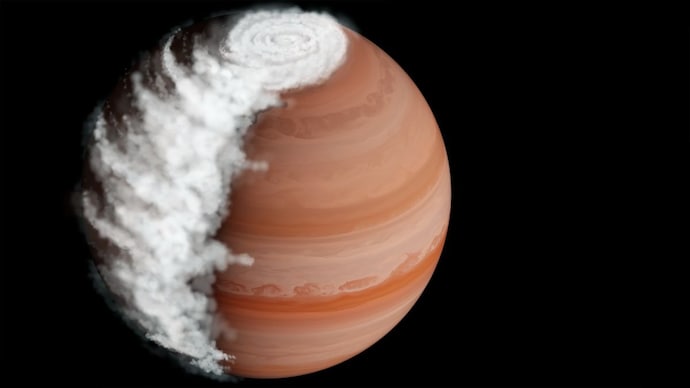
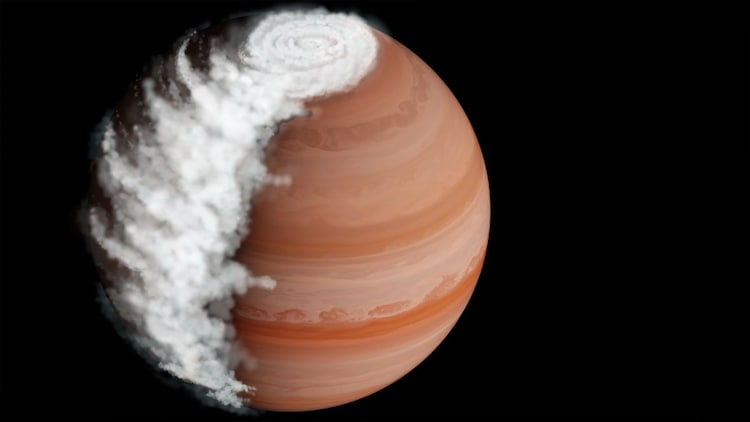
An artist's impression of WASP-94A b, a Hot Jupiter exoplanet. New JWST data reveals the planet experiences dramatic cloud cycles, with cloudy mornings and clear evenings. (Credit: Hannah Robbins/Johns Hopkins University)

Every morning on a planet nearly 700 light years away, clouds roll in. By evening, the sky clears. It sounds like a weather report from home, but it is actually the most detailed picture yet of an alien world’s atmosphere, made possible by the James Webb Space Telescope (JWST).
A new study published in the journal Science on May 21 has detected a daily cloud cycle on a distant gas giant called WASP-94A b, giving scientists a powerful new tool to study what exoplanets, or planets outside our solar system, are actually made of.
WHAT ARE HOT JUPITERS?
WASP-94A b belongs to a class of planets called Hot Jupiters. These are massive gas giants, like our own Jupiter, but they orbit extremely close to their parent stars, far closer than Mercury is to the Sun.
That makes them scorching hot and whipped by fierce radiation. Studying their atmospheres has long been a headache for astronomers, because clouds get in the way, blurring the signal like a foggy window.
HOW JWST CRACKED THE CLOUD PROBLEM
The Johns Hopkins University team used JWST to observe WASP-94A b as it transited, or passed in front of, its host star.
As starlight filters through the planet's atmosphere during a transit, scientists can study what the atmosphere contains.
But here is where this study does something new: instead of averaging data from the whole planet, the team took separate readings from the planet's morning side (its leading edge as it crosses the star) and its evening side (the trailing edge).
The difference was stark. Mornings were thick with clouds made of magnesium silicate, a common rocky mineral. Evenings were clear.
A ROCKY MORNING, A CLEAR NIGHT
Why the difference? The researchers have two ideas. Powerful winds may lift clouds on the cooler night side of the planet and then drag them deep into the hotter interior on the day side, effectively burying them before evening.
Alternatively, the clouds may simply vaporise in the extreme heat, much like morning fog burns off on Earth, but on a scale that would be unimaginable here. Temperatures on the day side exceed 1,000 degrees Celsius.
Because the evenings were cloud-free, scientists could peer through the clear atmosphere and get a clean chemical reading of the planet.
When clouds were averaged in using older Hubble telescope data, WASP-94A b appeared to have hundreds of times more oxygen and carbon than Jupiter.
With JWST's sharper, cloud-resolved view, that figure dropped to just five times more, which finally makes sense given what planet formation theory predicts.
The same cloud cycle was then detected on two other Hot Jupiter planets, WASP-39 b and WASP-17 b, suggesting this is not a one-off finding but a widespread phenomenon across this type of planet.
- Ends