
Nasa to slingshot Psyche probe around Mars at 20,000 kmph, collect data
It sounds like science fiction, but on May 15, Nasa's Psyche probe will use Mars' own gravity as a cosmic catapult, in one of the most elegant manoeuvres in modern space exploration.
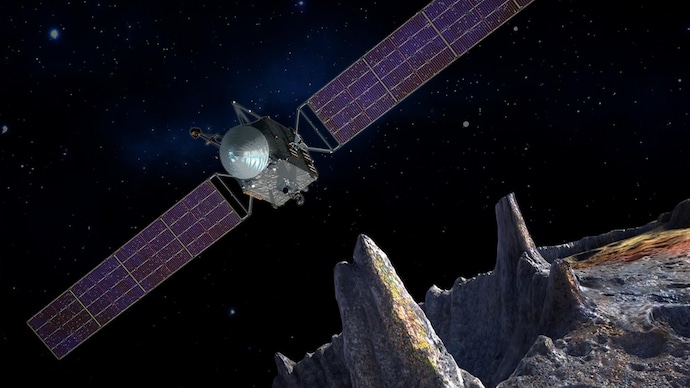

Nasa's Psyche spacecraft is days away from one of the most dramatic moments of its three-year journey through the solar system.
On Friday, May 15, the probe will skim just 4,500 kilometres above the surface of Mars, which is closer than many satellites that orbit Earth.
The probe will do so while travelling at approximately 19,848 kilometres per hour. Mars's gravitational pull will grab the spacecraft, bend its path, and fling it deeper into the solar system, saving precious fuel for the long voyage ahead.
The destination of the probe is an asteroid, also named Psyche, orbiting the Sun in the asteroid belt between Mars and Jupiter, where the probe is expected to arrive in 2029.
SHORTCUT IN SPACE
Launched on October 13, 2023, the Psyche spacecraft runs on a solar-electric propulsion system that uses xenon gas, the same element found in camera flashes, as fuel.
Rather than burning through that fuel to accelerate, mission planners designed the flight path to borrow energy from Mars itself.
This gravitational assist, sometimes called a gravity slingshot, is a well-established technique Nasa has used since the 1970s to send probes across vast distances without carrying impossible amounts of propellant.
"We are now exactly on target for the flyby, and we've programmed the flight computer with everything that the spacecraft will do throughout May," Sarah Bairstow, Psyche's mission planning lead at Nasa's Jet Propulsion Laboratory told Science News.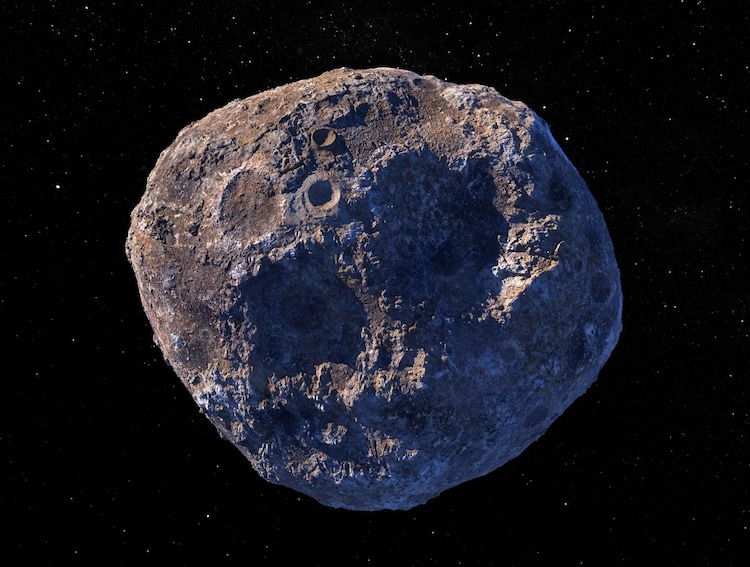
NOT JUST A SHORTCUT
The Mars flyby, however, is not purely a navigational manoeuvre.
With all its instruments switched on, the spacecraft will spend the encounter gathering a wealth of scientific data by capturing thousands of images of Mars, searching for faint dust rings around the planet, measuring its magnetic field, and studying cosmic ray behaviour as it passes by.
The view from Psyche will be unlike anything seen from Mars orbiters before.
Because the spacecraft approaches from the planet's night side, Mars will first appear as a thin, glowing crescent.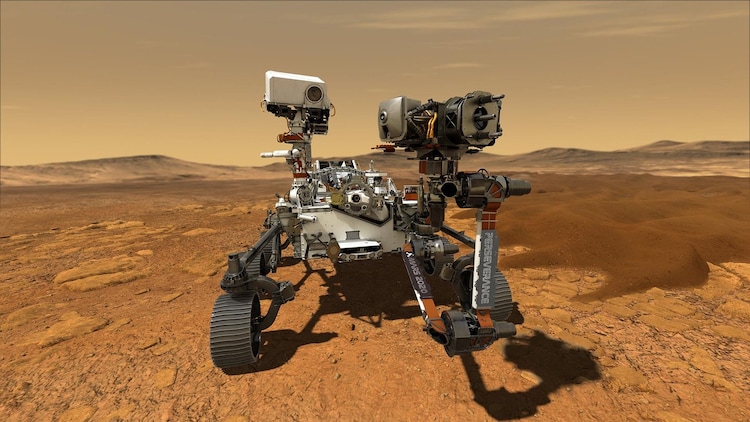
Several spacecraft already on Mars, including Nasa's Curiosity and Perseverance rovers and the Mars Reconnaissance Orbiter, will also assist in tracking and coordinating observations during the encounter.
The ultimate prize, however, remains the asteroid waiting nearly three years away. Scientists believe asteroid Psyche may be the core of an ancient planet that was stripped of its outer layers by violent collisions billions of years ago, making it a rare window into the building blocks of rocky planets like Earth.
"Ultimately, though, the only reason for this flyby is to get a little help from Mars to speed us up and tilt our trajectory in the direction of the asteroid Psyche," said Lindy Elkins-Tanton, the mission's principal investigator at the University of California, Berkeley. "But if all our instruments are powered up, and we can do important testing and calibration, that would be the icing on the cake."