
Watch: Tsunami waves hit Philippines coast after powerful 7.8 earthquake
A powerful 7.8-magnitude earthquake struck Mindanao in the Philippines, triggering tsunami warnings, evacuations, and widespread damage. Here's what happened and how earthquakes generate tsunamis.
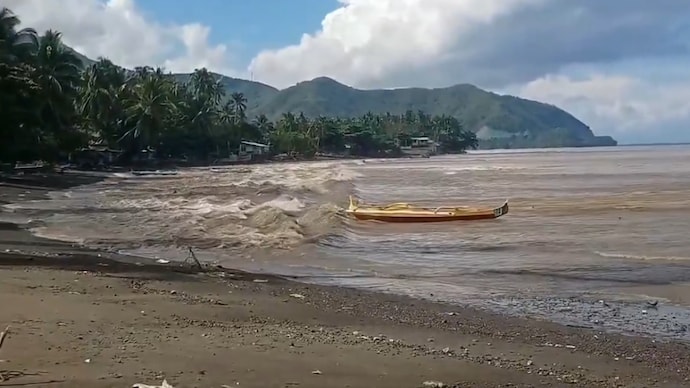

Coastal residents in southern Mindanao in the Philippines watched with alarm as ocean waves rose higher than normal, surging onto beaches and sending spray across shorelines on Monday, June 8.
The unusual activity in the ocean came after a powerful 7.8 magnitude earthquake shook the region, triggering evacuations and tsunami warnings, as roads rattled and buildings collapsed, killing at least 20 people, and injuring more than 200 others, according to news agency Associated Press (AP).
A SUDDEN DISASTER
The earthquake struck at approximately 5 am IST on Monday, June 8, 2026.
The center of the earthquake lay offshore near Sarangani province in the Mindanao region, not far from General Santos City. Philippine authorities and the United States Geological Survey described it as a shallow quake, a factor that often produces intense shaking and increases the risk of tsunamis.
General Santos City, a bustling commercial hub of about 7,00,000 people, took some of the hardest hits.
Buildings collapsed, power outages darkened neighbourhoods, streets filled with debris, and people rushed to check on family and neighbours amid the dust and damage.
HOW ARE EARTHQUAKES AND TSUNAMIS CONNECTED?
The strong quake eventually led to officials issuing a tsunami warning, highlighting the link between shaking ground and rising waves.
When a strong earthquake shifts the sea floor, especially in shallow water, it can displace huge amounts of ocean water, creating waves that travel outward and become more noticeable as they approach land.
Authorities issued tsunami warnings for southern Mindanao coast, and also advised people in low-lying areas to move immediately to higher ground.
Waves of about one meter, which is roughly three feet, reached certain spots. Videos shared online showed water rising and rushing onto beaches near General Santos.
Rescue teams continued working through aftershocks, including one measured at magnitude 6.5. People have been warned to stay out of damaged buildings because of collapse risks.
The Philippines lies along the Pacific Ring of Fire, where Earth's tectonic plates meet and frequently shift, producing regular earthquakes and volcanic activity, making preparedness and fast action essential for safety.
Communities now turn toward recovery while staying watchful. Meanwhile, officials have urged everyone in the affected zones to heed updates from local authorities, avoid coastlines until cleared, and support one another.