
Titan at Caltech, forgotten in India: The science genius who made architecture cool
G S Ramaswamy applied physics to architecture and transformed shell roof design. His work made large structures lighter, cheaper and stronger, even as he stayed little known in India.
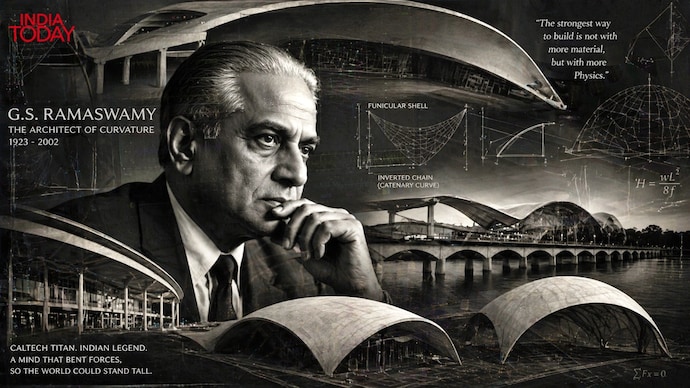
GS Ramaswamy became the founding director of the Structural Engineering Research Centre. (Photo: Generative AI by India Today)

New Delhi,UPDATED: Apr 30, 2026 16:00 IST
In the grand story of modern engineering, some names echo loudly while others quietly shape the world from behind the scenes.
Guruvayur Subramanian Ramaswamy belongs firmly to the latter. A pioneer who fused physics with architecture, Ramaswamy redefined how large structures are built, yet remains largely unknown outside academic circles in India.
Born in 1923, Ramaswamy approached buildings not as stacks of bricks or steel, but as systems governed by invisible forces. His intellectual journey took him to California Institute of Technology (Caltech) during its golden era, where he trained under some of the world’s leading minds in structural and fluid mechanics.
It was here that he began to see design through the lens of physics, especially the power of curvature.
HOW DID GS RAMASWAMY CHANGE ENGINEERING?
Inspired by something as simple as an eggshell, Ramaswamy asked a radical question: why do we rely on heavy materials when nature achieves strength through shape? His answer transformed engineering.
He pioneered the concept of funicular shell structures, using principles like the catenary curve, the natural shape formed by a hanging chain, to design roofs that were astonishingly thin yet incredibly strong.
A funicular shell structure is a thin, curved roof or surface designed so that forces flow naturally through it, mainly as compression. Inspired by shapes like a hanging chain turned upside down, it uses minimal material yet remains very strong because the shape carries the load efficiently rather than relying on thickness.
Instead of fighting gravity with bulk, Ramaswamy’s designs worked with it. By aligning structures along the natural flow of forces, he proved that strength could come from geometry rather than sheer mass.
The result: vast industrial roofs, domes, and hangars that used far less material without compromising stability.
Back in India, he became the founding director of the Structural Engineering Research Centre, helping establish the country as a global leader in shell structures decades before such ideas became mainstream in the West. His work enabled cost-effective construction, a critical need for developing nations.
Yet, Ramaswamy occupied an unusual intellectual space. To engineers, his work seemed too theoretical; to physicists, too applied.
This made him a ghost figure, influential, but not widely celebrated. His seminal book, Design and Construction of Concrete Shell Roofs, became a global reference text, shaping projects from the United States to Russia.
He was awarded the Shanti Swarup Bhatnagar Prize, one of India’s highest scientific honours, and served as a consultant to the United Nations, advising countries on low-cost, high-efficiency construction. Yet his recognition largely remained confined to professional circles.
To his family, he was a disciplined academic. To the world, he was a quiet revolutionary. Today, the sweeping roofs of factories, warehouses, and public spaces, structures that seem to float effortlessly, owe much to his ideas.
And yet, there are no statues, no public memory, no widespread recognition of his name in India.
Ramaswamy’s legacy is not carved in stone, but embedded in it. Every thin shell that stands strong against gravity is a testament to his belief: that the smartest structures are not the heaviest, but the most intelligent.
- Ends