
Forests across Uttarakhand are burning: The reason is not just dry weather
2026 has added to the problem by ending an already dry winter early and instead bringing rising heat to the state, marking the arrival of what could be another worrying chapter.
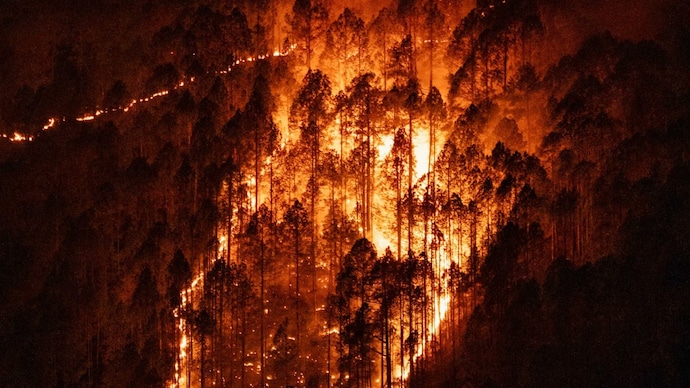

Uttarakhand’s forests are burning.
The Uttarakhand Forest Department in Rudraprayag has reported 20 forest fire incidents across the district so far this season, affecting nearly 15 hectares of land.
But that’s not even the most troubling part. The real concern is that when it comes to battling raging forest fires, Rudraprayag is far from alone.
In recent weeks, fire alerts have been sounded across Garhwal and Kumaon regions as April brought extreme heat across the country, including the hilly regions.
At the same time, forest fires are not new to Uttarakhand. The destructive fires have caused problems in the past too, reaching some of Uttarakhand’s most ecologically sensitive areas.
Earlier this year, a fire raged for five days inside the Valley of Flowers National Park, a UNESCO World Heritage Site in Chamoli district. The fire forced the state to seek help from the Indian Air Force to douse the fire.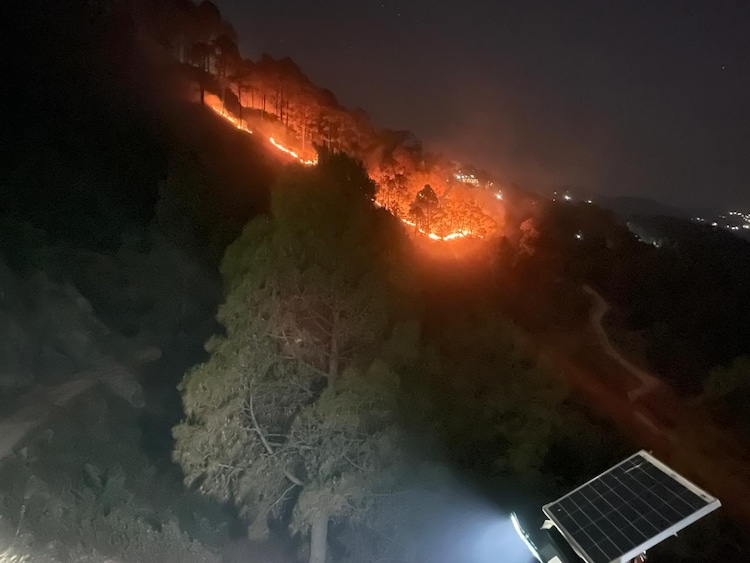
The state has over 45 per cent forest cover, and these fires occur annually between November and May, driven by the accumulation of dry leaves, twigs, and pine needles.
But the frequency and intensity of the flames have been increasing. Analysis has shown that fire events in the state increased from 922 in 2002 to 41,600 in 2019. That's an over 44% increase.
2026 is adding to that pressure by ending an already dry winter early and instead bringing rising heat to the state, marking the arrival of what could be another worrying chapter.
WHAT'S CAUSING THE FIRES?
Officials point to a dangerous mix of prolonged dry weather, human negligence, and in several cases, deliberate arson.
Rudraprayag’s Divisional Forest Officer (DFO) Rajat Suman told ANI that many of the fires are being deliberately set. Some accused individuals have already been apprehended, with investigations underway.
Offenders in such cases face financial penalties and jail terms of up to two years under the Disaster Management Act, along with action under the Indian Forest Act.
But it's not just arson.
Beneath the mischief, lies other factors that also contribute to the problem. One such factor is something the forest itself grows.
Uttarakhand’s forests are dominated by the chir pine, whose resin-rich needles accumulate in vast quantities on the forest floor.
According to the International Journal of Ecology and Environmental Sciences, about four lakh tonnes of these pine needles and twigs fall annually, sharply raising the inflammability of the forest floor during the summer heat.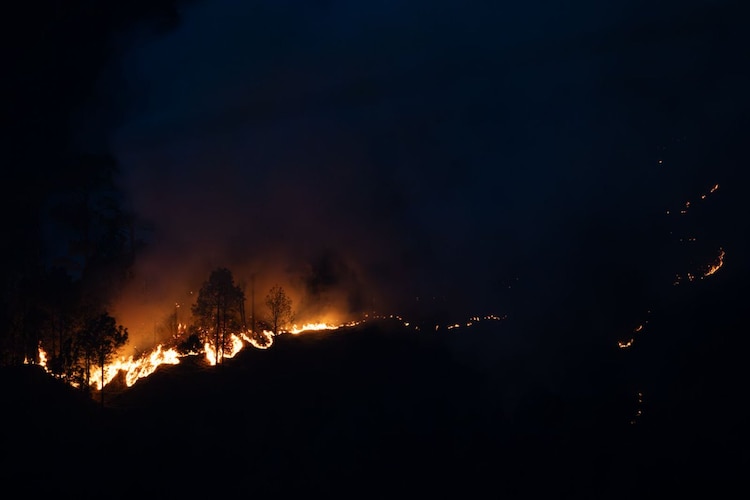
Locals deliberately set fire to these pine needle beds to revitalise grazing land, encourage fresh grass growth, and to stimulate the growth of an edible fungus that fetches high prices in local markets.
In a dry year, these small burns can rapidly spiral out of control, causing cascading problems of unsolvable scale.
Then there's the ever present issue of climate change.
Climate change is amplifying all of these pressures. Published research has found a strong positive correlation between rising temperatures and the number of forest fire incidents in Uttarakhand.
A drier, hotter Himalayan region means more combustible forest floors and fewer natural checks on the spread of fire. And that makes sense in 2026 as extreme heat wreaks havoc all over, even in the mountains.
HILLS ARE NO LONGER COOL
The fires are being fed by a broader climate reality, which is that India’s mountains are no longer the cool retreat they once were.
IMD says temperatures have risen sharply across Himachal Pradesh, parts of Jammu and Kashmir, and the higher reaches of Uttarakhand.
On April 26, the department issued a yellow alert for heatwave conditions across several Himachal districts.
Meanwhile, popular hill stations like Mussoorie and Nainital recorded temperatures around 30°C, while Shimla crossed 27°C, which might not sound a lot compared to the plains but is way above the normal temperatures.
In early March, maximum temperatures across Himachal Pradesh were 8–12°C above normal, marking the earliest such spike in five years. The IMD’s has also warned that mountains will see little relief from heat.
The hills, it turns out, are no longer a sanctuary from the very heat that feeds the fires.