
Sreejesh was insulted: Former captain Jude Felix tears into Hockey India
Jude Felix has accused Hockey India of insulting PR Sreejesh by removing him from the junior men's team job. The former India captain also questioned the federation's decision to appoint Sreejesh and then not give him the required time in the role.
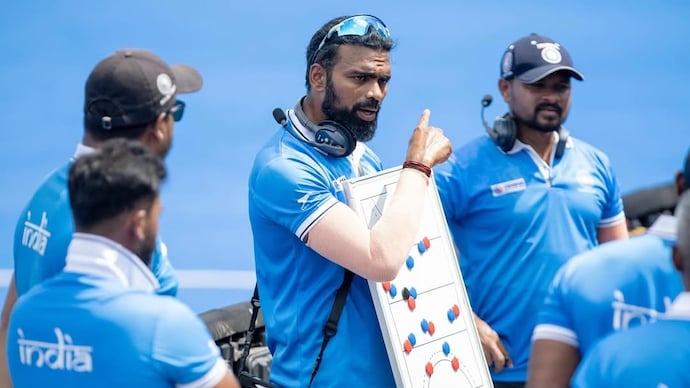

It was March 27 at the Hockey India Awards. Every Indian team and coaching staff member was present under one roof. It was a day of celebration, with players and coaches freely interacting with the media. Yet one man seemed detached from it all, unusually withdrawn for someone known for his warmth and energy around the media.
The often talkative PR Sreejesh stayed away from the spotlight, avoiding questions throughout the evening. When we finally got a brief chance to speak to him, the legendary goalkeeper politely said he did not wish to interact with the media that day. There was a quiet sense that something was simmering beneath the surface. But the event moved on, and so did everyone else.
And then May 13 arrived. The storm that had been building inside Sreejesh finally broke over Indian hockey.
In an explosive social media post, the 38-year-old revealed that he was no longer the head coach of the Indian junior men’s hockey team — a role he had taken up immediately after India’s emotional bronze medal triumph at the Paris Olympics. Despite delivering five medals, including a podium finish at the FIH Junior Men’s Hockey World Cup, Sreejesh was suddenly out.
He slammed Hockey India, claiming the federation had removed him in favour of a foreign coach, later revealed to be Frederic Soyez. Hockey India quickly attempted damage control, insisting Sreejesh had not been “sacked” and had instead been offered the role of coaching the development squad — a position they described as crucial to preparations for the Los Angeles Olympics in 2028. Sreejesh explained his reasons behind not accepting the role in another explosive tweet.
The federation also argued that it was time for greater experience to come into the junior setup, suggesting Sreejesh still needed more exposure as a coach.
Another point Hockey India highlighted was their focus on fostering grassroots and homegrown coaches, claiming they already had over 600 such talents within their coaching pathway system.
But the explanation only raised even more questions.
If Sreejesh was not experienced enough, why hand him the role in the first place? If the federation truly wanted to back homegrown coaches, then wasn’t Sreejesh exactly the kind of figure they should have persisted with?
And if an experienced foreign coach was always part of the long-term plan, shouldn’t that appointment have been made immediately after the Paris Olympics itself?
These were questions that needed answers — and perhaps only someone who had worked within the system could truly understand them.
That is where Jude Felix enters the story.
A maverick captain in his playing days and a deeply respected tactician after retirement, Felix remains one of the most outspoken voices in Indian hockey. His Arjuna Award and Dronacharya Award stand as proof of both his playing pedigree and coaching credentials.
More importantly, he understood exactly what Sreejesh was going through.
Felix himself had faced a similar fate in 2019. After being appointed coach of the junior side in 2017, he too was removed in abrupt fashion.
What was supposed to be a short phone call soon turned into an emotional outpouring, as Felix opened up on why he believes Hockey India continues to repeat the same mistakes over and over again.
HOCKEY INDIA'S BIG MISTAKE
While speaking to India Today, Felix admitted he was surprised when Sreejesh was appointed coach of the junior men’s team in the first place. According to him, greatness as a player does not automatically translate into success as a coach.
“For me, Sreejesh is a fantastic player. And I would attribute India winning the first bronze medal in Tokyo to almost 50 percent because of his contribution. He was a phenomenal goalkeeper. He's worked very hard. I've also worked with him while I was in the senior training camp.”
“But for me, his appointment came as a surprise. The reason why I'm saying that is because being a player and a coach are two different things altogether,” said Felix.
However, Felix insisted that if Hockey India had decided Sreejesh was the right person for the role, then the federation should also have clearly communicated its expectations from the very beginning.
“Keep the standards and say in this tournament, we need to finish first, in this one second and so on. So I don't know what the federation expected from Sreejesh,” said Felix.
“Results were there. But did they want a gold medal? Then, he has fallen short. Did they want a silver medal? He has fallen short again. Did they want the bronze medal? Yes, he has achieved that result,” he added.
Felix said Sreejesh’s removal was something he personally related to, calling himself one of many victims of Hockey India’s constant chopping and changing when it comes to coaches.
“I'm against Hockey India. They have done this to so many coaches. I'm one of the victims, and it's an absolute disgrace when it comes to how they treat the former coaches and how they are removed. So I can fully understand what he has been going through when they have removed him,” said Felix.
Which naturally raised another question: was Sreejesh’s appointment itself an emotional decision? A reward handed out in the glow of the Paris Olympics high?
Felix did not hesitate.
For him, this was simply another example of poor decision-making from a federation that, in his eyes, has been trapped in the same cycle for years.
FOREIGN COACH OBSESSION
One of the standout points from Sreejesh’s public response was his criticism of Hockey India’s continued obsession with foreign coaches. He openly questioned why Indian coaches were repeatedly overlooked when it came to shaping the future of Indian hockey.
Felix agreed.
Having worked alongside several foreign coaches during his career — including Terry Walsh — Felix questioned where the tangible success from these appointments had actually been.
India has experimented with names like Walsh, Sjoerd Marijne, Roelant Oltmans and others over the years, but truly transformative results have largely remained elusive.
Felix pointed to India’s fifth-place finish at the 1994 World Cup — achieved during his captaincy alongside coach Cedric D’Souza — as proof that Indian voices within the setup could work just as effectively.
“Coming to the point of foreign coaches for me, it has not worked in India. In 1994 World Cup, I was captain of the team, and no one knows this, but I was, I was the captain of the team and my coach at that time was Cedric, and we had a fantastic relationship where I could, I was allowed to even coach the team, right. So no one knew this, but I coached the team and played.
“We got a very, very decent 5th place in the World Cup. We just missed the Olympic semi-final.”
“You had so many foreign coaches here? We have not gone past that 5th. Well, I captained the team in 1994, and I'm still sitting here and talking to you. We've not gone past the 5th place since then. That's the biggest shame, having all the foreign coaches,” said Felix.
Felix also questioned the sheer amount of resources provided to foreign coaches in India compared to other nations.
“The foreign coach has the highest number of training hours compared to all the countries in the world.”
“He has got the highest budget compared to all the countries in the world and given a free hand to do everything. Then we should be winning a gold medal in every tournament.”
“But is that the case? No, that is not, it's not the case, right? That's not the case,” said Felix.
ARE INDIAN COACHES NOT GOOD ENOUGH?
While Hockey India proudly pointed to its pathway programme of more than 600 homegrown coaches, Felix remained unconvinced.
For him, quantity without quality means little.
“We do not have coaches in India. Hockey India can write in this article, we've got pathway for 600 coaches. You can even have 1600 coaches. The quality of 10 coaches will be better than 600 or 1600 coaches,” said Felix.
He also highlighted how coaches who showed promise were often discarded before they were given a fair chance to grow.
One such example, according to him, was Shanmugham Pandurangan, whom Felix personally mentored and who later worked with the Indian women’s setup before being removed after Sjoerd Marijne’s return.
“Shanmugam is one of the best coaches in India. He was appointed by Hockey India when Harinder Singh was the chief coach. He was appointed as assistant coach for the women's team. He has worked there for about 3 or 4 months,” said Felix.
“Now they have removed him. If this is the case, how will Indian coaches improve?”
GIVE PEOPLE TIME
The core of Felix’s argument, however, centred around one thing: time. If Hockey India truly believed Sreejesh was someone worth investing in, then they needed to back him for longer than just 18 months.
“The whole crux of the problem is their decision-making is absolutely zero. If they decided that I want a guy like Sree, if they think he's so good, it just can't be for one and a half years.”
“According to me, it takes 2 years to know the player.”
Felix insisted that coaching development cannot happen overnight and that throwing out a promising coach so quickly only reflected poor planning from the federation.
“If you have understood that he's a brilliant coach to be developed, you can't throw them out in 1.5 years. Simple as that. So they're wrong again,” said Felix.
The former Indian captain believes Sreejesh has ultimately been insulted by the federation’s handling of the situation.
“They've definitely insulted him because in the first place you should realise, is he good enough to be the coach. But then you decide within 1.5 years he isn't good enough.”
“It means you've not done your work properly and that has created all these issues,” concluded Felix.
In the end, it feels like yet another hard reset for Hockey India and the junior men’s setup. But for Sreejesh, it leaves behind a far more personal feeling — that the work he had only just begun was brought to a sudden halt.
And perhaps that feeling is not unique to him alone.