
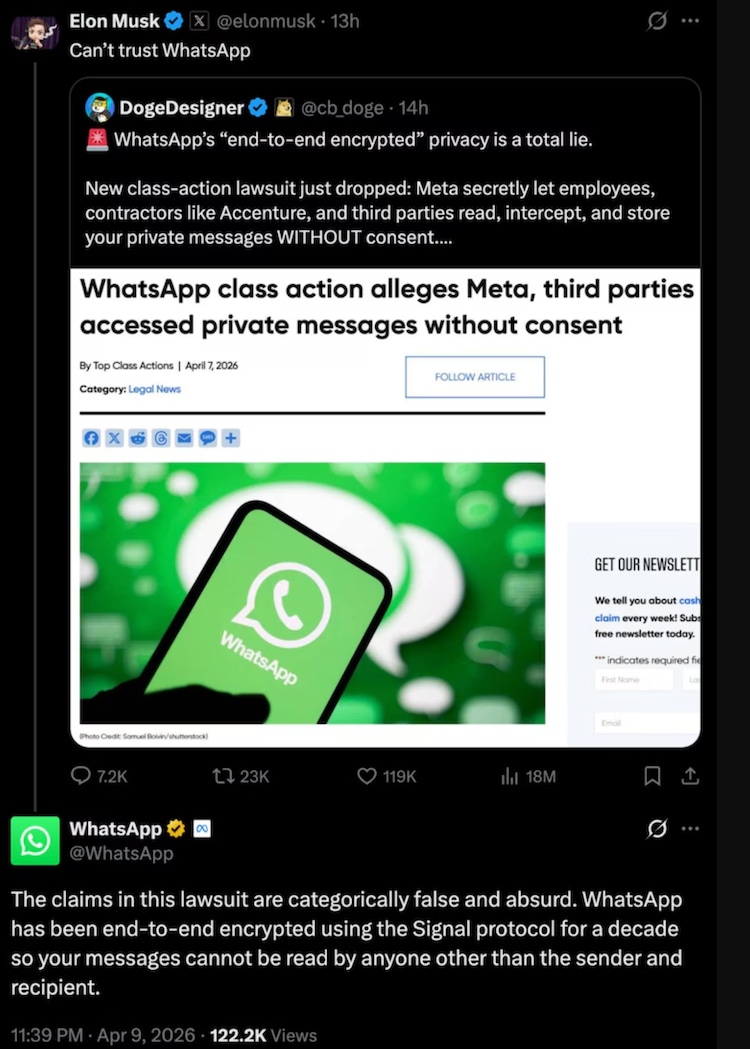
WhatsApp reading your messages? US govt agent found some evidence, then probe was shut down
This is a question that refuses to die: is WhatsApp reading private messages despite its end-to-end encryption? To find an answer, a US government team started an investigation. That investigation, however, was killed suddenly when one agent reportedly found something.
Representational image created using AI

New Delhi,UPDATED: Apr 30, 2026 18:34 IST
It all started months ago when WhatsApp landed on the US federal radar over a serious allegation. The allegation: that it was secretly accessing the private, encrypted conversations of its users. For a platform hosting over 3 billion people globally and for people who rely on the absolute promise of end-to-end encryption for everything from personal chats to sensitive business exchanges, the claims were deeply concerning and explosive. A probe then started, but suddenly it ended, raising fresh questions.
The allegations that WhatsApp was reading everyone’s messages was levelled by an anonymous whistleblower in 2024. In 2025, given the nature of allegations, a quiet probe was started by the US government. A Federal agent spent nearly 10 months trying to uncover the truth about WhatsApp's biggest promise. He got some evidence, people started whispering something internally, and now, according to a Bloomberg report, the investigation has been abruptly and completely shut down.
So, is WhatsApp reading everyone’s messages, even the private ones? The answer remains elusive. Meta, the company that owns WhatsApp continues to categorically deny it. The technology used for encryption, which is end-to-end seems solid. Yet, WhatsApp users continue to “feel” that somewhat they see ads on things they talk about in their private messages. And despite assurances from WhatsApp, the app continues to be treated as a major op-sec risk by countries as varied as Iran and Russia. Even in the US it has been banned on all official devices used by the House of Representatives.
But let’s zoom out a little and look at what the probe was all about before it was suddenly killed.
Allegations on Meta by whistleblower
It's worth noting that the allegations in 2024 didn't emerge on social media or in some fringe corner of the internet. They quietly landed inside the US government, to the US Securities and Exchange Commission (SEC), more specific. They were levelled by a whistleblower. The complaint suggested that Meta could, in some way, access WhatsApp messages despite its end-to-end encryption promise.
Following those claims, the US government launched a low-profile but intense investigation.
A secret investigation by BIS agent
A special agent inside the Commerce Department's Bureau of Industry and Security (BIS), specifically its Office of Export Enforcement, picked up the case. Over nearly 10 months, in an inquiry dubbed "Operation Sourced Encryption," he dug deep: interviewing people, reviewing internal systems, and trying to find answers to the allegation whether anyone at Meta can actually read your WhatsApp messages?
\Meta, after all, has long maintained that its encryption ensures no one, not even the company itself, can read your chats.
But the agent's findings began to suggest otherwise.
By January 2026, according to the Bloomberg report, the agent was convinced. He sent a memo to other federal agencies (including the FTC and SEC) claiming that Meta stores and can view WhatsApp messages, including texts, photos, videos, and audio.
He also warned that this conduct by the company likely violated federal laws, and that there was effectively no limit to what Meta could potentially see on the app. The agent also pointed to what he described as a "tiered permissions system". It is apparently an internal structure that could allow certain employees, and even Meta contractors, access to user content.
The agent wrote that this system had reportedly been in place in Meta since at least 2019, and that access had been granted to contractors as well as a significant number of overseas workers based in India.
Some people interviewed by the Agent during the investigation reportedly described having broad access to WhatsApp messages while doing content moderation work through Accenture, the consulting firm. Shortly after these findings from the Agent reportedly began to circulate internally, and senior leadership at the US Commerce Department ordered shutdown of the probe. It was sudden, the probe was killed.
In their explanation, the officials who closed the probe reportedly called the agent’s findings "unsubstantiated and outside the scope of his authority as an export enforcement agent."
Meta says the allegations are all false
Meta, for its part, has strongly denied everything. Repeatedly. And again. "The claim that WhatsApp can access people's encrypted communications is patently false," spokesperson Andy Stone said in a statement to Bloomberg.
India Today Tech reached out to Meta for a statement and clarification, and here is what their spokesperson has to say: "What these individuals claim is not possible because WhatsApp, its employees, and its contractors, cannot access people's encrypted communications. The Bureau of Industry and Security has disavowed this purported investigation, calling its own employee’s allegations unsubstantiated. We'll continue to push back on false claims, including those shopped by the high-priced plaintiffs' firm who has filed suit against WhatsApp."
- Ends