
Elon Musk says everyone should get free money from government because robots will work
Elon Musk says governments should provide direct income support as AI threatens large-scale job losses. He argues that rising automation could boost production enough to prevent inflation despite a higher money supply.
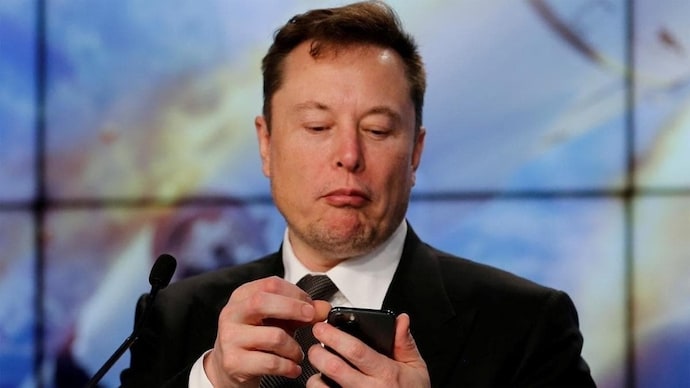
Elon Musk says everyone should get free money from government because robots will work (Photo: Reuters)

New Delhi,UPDATED: Apr 17, 2026 11:38 IST
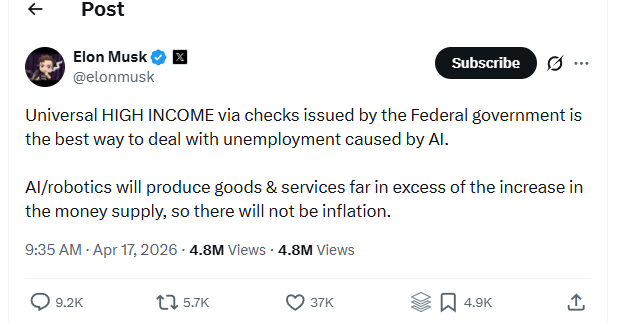
Elon Musk has once again stirred debate around the future of jobs and income, suggesting that governments will need to start giving people "free money" as AI begins to replace human work at scale. In a recent post on X, Elon Musk argued that a system of "universal high income" funded by governments could be the most practical way to deal with job losses caused by AI and robotics.
Sharing his view on X, Musk wrote, "Universal HIGH INCOME via checks issued by the Federal government is the best way to deal with unemployment caused by AI." He added that fears around inflation may not hold in such a scenario, as robots would significantly increase the supply of goods and services, keeping prices in check even if more money enters the system.
Musk flags fast AI growth, says direct cash support will become unavoidable as jobs decline
But, this is not the first time Musk has spoken about such an idea. In a recent podcast conversation with Peter H. Diamandis, he expanded on how quickly AI is evolving and why governments may struggle to keep up. According to Musk, the pace of AI development is far ahead of traditional policymaking, which tends to be slow and layered. He claimed that AI could be advancing “10 times faster than government, maybe more,” making it difficult for authorities to respond effectively. The discussion also featured Dave Blundin, who echoed similar concerns. He pointed out that no government system today is fully equipped to handle the speed of change AI is bringing, and that even regulation may not be enough to manage the broader economic impact.
In this context, Musk suggested that direct financial support from governments could act as a fallback solution. Instead of trying to fully control or slow down AI development, authorities could focus on maintaining economic stability by sending money directly to citizens. He referenced past examples like COVID-era stimulus payments and even a $1,776 payout to US military personnel during the tenure of Donald Trump, indicating that such measures are not entirely new.
At the same time, Musk acknowledged that implementing such a system would not be simple. Questions around eligibility, payment amounts, and long-term sustainability remain unanswered. Still, he maintained that in a rapidly shifting AI-driven economy, such direct interventions could become one of the few workable options.
Beyond jobs and income, Musk also spoke about how AI could transform entire industries, especially healthcare. He highlighted the current shortage of highly skilled doctors and surgeons, noting that training them takes years and comes at a high cost. In comparison, Musk believes AI-powered humanoid robots, such as Tesla’s Optimus, could eventually outperform even top surgeons within the next few years, potentially making high-quality healthcare more accessible worldwide.
He explained that this rapid progress is being driven by multiple factors coming together at once - from improvements in AI models to faster chips and better mechanical systems. Together, these advancements could push robotics development forward at a pace rarely seen before.
Musk also dismissed the idea of a single, all-powerful AI system dominating the future. Instead, he suggested that multiple AI systems will likely operate simultaneously due to physical limitations like the speed of information transfer, creating a distributed network of intelligence rather than one central entity.
- Ends