
No personal phones, no laptops: From Musk to Cook, Trump entourage is into a digital lockdown in China
As Donald Trump visits China, CEOs and US officials part of his entourage are carrying temporary devices instead of personal smartphones to avoid Chinese surveillance. This is due to the concerns about Chinese hacking and peering into personal devices of the mighty and powerful.
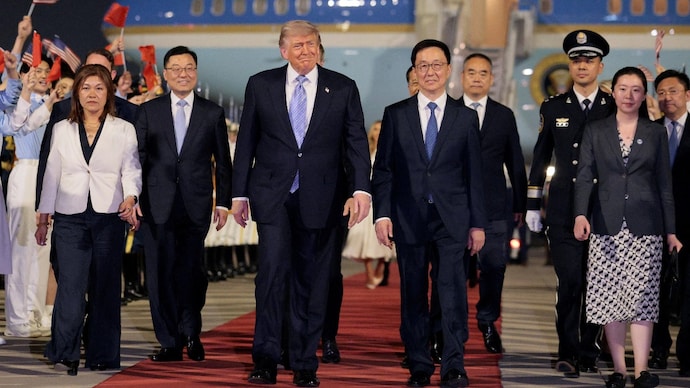

As President Donald Trump, CEOs such as Elon Musk and Tim Cook, hundreds of aides, security personnel and officials travel to China, many are leaving behind one of the most basic tools of their life: their everyday smartphone. Why? Fear of surveillance and digital snooping. The extraordinary digital precautions surrounding the trip highlights something that visitors to China have often wondered about — the constant digital surveillance.
According to a report by Fox News, the Trump entourage has been told not to bring personal devices on the trip. US officials have long viewed China as one of the world’s most advanced and aggressive cyber-surveillance environments. As a result, American delegations travelling to the country often avoid carrying personal phones, laptops or devices containing sensitive information, fearing they could be monitored, copied, hacked or compromised.
No personal devices, but clean devices are okay
Instead, many officials are travelling with temporary or “clean” devices that contain minimal data and limited access to government systems. These stripped-down phones and laptops are designed specifically for the trip and can later be wiped or discarded entirely.
Security agencies also discourage officials from using local charging infrastructure because even something as routine as charging a phone can create cybersecurity risks. Compromised USB charging stations, charging cables or ports can potentially be used to steal data or install malicious software onto a device.
To reduce those risks, the US officials and people part of a high-profile presidential visit often carry pre-approved charging equipment, external battery packs and government-issued accessories that have already been tested by security teams. Some executives and officials are also issued temporary “loaner phones” loaded with what cybersecurity experts call a “golden image” — a carefully monitored and pre-approved software setup.
After the trip, security teams compare the device with its original configuration to detect whether any files, software or settings were secretly altered during travel.
Fear of Chinese digital snooping
The precautions reflect years of growing American concern over alleged Chinese cyber espionage campaigns targeting government agencies, corporations and critical infrastructure. US intelligence and cybersecurity officials have repeatedly accused Beijing-linked hackers of attempting to infiltrate federal systems, as well as power grids, water utilities and telecommunications networks.
Washington has argued that such operations are aimed not only at gathering intelligence but also at gaining potential access to systems critical to national security.
Although snooping delegates during high-profile diplomatic visits is not a unique phenomenon, or even a Chinese speciality. The US has been accused in the past of snooping on delegates visiting to attend UN summits. At the same time, revelations by Edward Snowden in 2013 showed that the NSA, a US government agency, monitored calls and phones of 35 world leaders after acquiring their private numbers.
Essentially, it seems everyone does it. And essentially it also means that it is never a good idea to carry personal devices when you are on a visit as part of the presidential entourage, a lesson that CEOs like Elon Musk and Tim Cook seem to know well.
China, on its part, has consistently denied allegations of state-backed cyber espionage. Chinese officials have argued that China protects data privacy and security in accordance with the law and have accused Washington of politicising cybersecurity issues while overlooking America’s own global intelligence operations.
“The Chinese government places a high priority on protecting data privacy and security in accordance with the law. It has never required — and will never require — enterprises or individuals to collect or store data in violation of the law,” Chinese Embassy spokesperson Liu Pengyu told Fox News Digital in response to the website’s news report.