
Sridhar Vembu issues AI warning for students, says it can make them dumb fast
Zoho founder Sridhar Vembu has warned students against relying too heavily on AI tools, saying they can weaken independent thinking and learning. His comments come as rising failure rates at UC Berkeley have sparked fresh debate about AI's impact on education.
Sridhar Vembu issues AI warning for students, says it can make them dumb fast

New Delhi,UPDATED: Jun 4, 2026 18:33 IST
Artificial intelligence is helping students solve problems, write assignments and prepare for exams faster than ever before. But according to Zoho founder Sridhar Vembu, that convenience could come with a hidden cost. Reacting to reports of rising failure rates in computer science courses at UC Berkeley, Vembu warned that students who depend too much on AI may end up weakening the very skills they are trying to develop. His comments come at a time when AI tools such as ChatGPT, Gemini and Claude are becoming increasingly common in classrooms and study routines. While these platforms can provide instant answers and explanations, Vembu believes students should first build strong fundamentals before relying on them extensively.
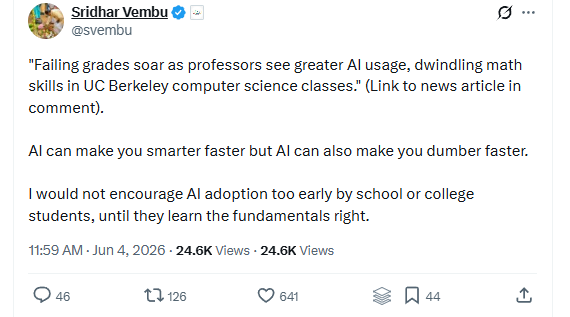
"AI can make you smarter faster but AI can also make you dumber faster," Vembu wrote on X.
He added that he would not encourage AI adoption too early among school and college students until they have learned the basics properly. Vembu's remarks followed a report by The Daily Californian, which showed unusually high failure rates in several computer science courses at UC Berkeley during the Spring 2026 semester. According to the report, 35.3 per cent of students in CS 10 and 10.6 per cent of students in CS 61A received failing grades. These figures were significantly higher than in previous years, when failure rates generally remained below 10 per cent.
Several professors linked the trend to growing reliance on AI tools. Teaching professor Dan Garcia said some students were caught using AI in ways that violated academic integrity rules, while others appeared to depend so heavily on chatbots that they struggled when required to solve problems independently during exams. Garcia reportedly said nearly 30 students in one of his classes were caught cheating on take-home exams. He also suggested that many students had become accustomed to letting AI do much of the thinking for them, leaving them underprepared when those tools were unavailable. The Berkeley report also pointed to declining mathematical preparedness among students, reduced staffing levels and lower classroom engagement as contributing factors. However, the discussion around AI has attracted particular attention because it mirrors concerns raised by educators around the world.
Vembu has previously cited research suggesting that while AI can improve short-term performance, it may hurt long-term learning. Referring to a study involving nearly 1,000 high school students, he argued that students using AI often become dependent on it rather than developing a genuine understanding of the subject matter.
Careers Vembu believes can survive the AI era
Interestingly, while Vembu is warning students about becoming too dependent on AI, he has also spoken about a different question many young people are asking - which careers will remain relevant as AI becomes more capable?
According to Vembu, the safest paths may not necessarily be the highest-paying technology jobs. Instead, he believes roles driven by purpose, human connection and personal commitment are likely to remain valuable even in an AI-powered future. He has pointed to activities such as raising children, teaching, caring for the elderly, practising classical music, protecting forests, serving as temple priests and pursuing agriculture out of passion as examples of work that AI is unlikely to replace in any meaningful way.
Vembu argues that these roles are not defined purely by efficiency or productivity. Their value comes from human relationships, cultural traditions, responsibility and purpose—qualities that machines cannot easily replicate.
He has also raised concerns about what happens when AI dramatically increases productivity but reduces the need for human labour. In his view, technology could create enormous abundance in terms of goods and services, but societies will eventually need to decide how the benefits of that abundance are shared if traditional employment opportunities become harder to find.
- Ends