
UC Berkeley School of Law bans AI use in test material, students cannot use it to draft or rewrite essays
UC Berkeley School of Law has changed its AI policy for students. Now, students can no longer use AI tools to outline or rewrite essays. Here is everything you need to know.
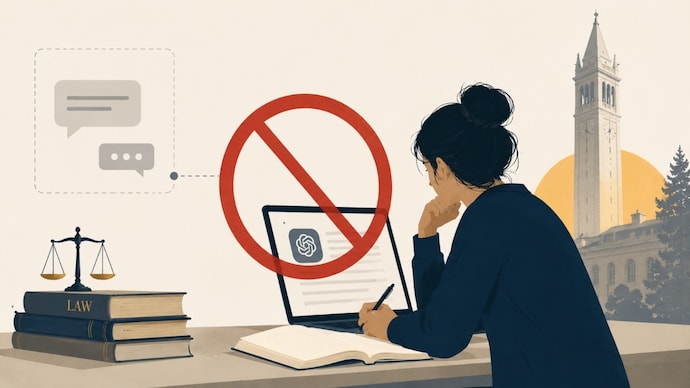

AI is changing the world. From coding to even making a PPT, AI tools are almost everywhere, and they are making it easier for us to do a lot of things. And most people are now increasingly using AI, not just for work, but even to study. But now, the University of California, Berkeley School of Law (UC Berkeley) has adopted a stricter policy on how students can use AI, banning AI for doing things like drafting an essay.
The updated policy will take effect from this summer, and replaces a more lenient rule introduced in 2023. This change comes at a time when tools like Claude for Legal have recently been released.
What is the UC Berkeley AI ban?
Under the new ruling, law students will not be allowed to use “conceptualising, outlining, drafting, revising, translating, or editing any work submitted for credit.” Apart from assignments and drafts, students will not be allowed to use AI “for any use for any purpose in any exam situation.”
That is, a student can no longer ask a chatbot like ChatGPT to rewrite a draft or even give a structure for their assignment.
Students are also not allowed to upload “any course materials – such as assignments, readings, slides, class recordings, or other class content – into generative AI systems.”
However, the university is not banning AI entirely. The policy states that AI may still be used in paper research, but only for the limited purpose of identifying sources such as cases, statutes or secondary material.
The school has also kept exceptions for courses designed to teach AI fluency. Instructors may allow other uses, but only if they do so in writing, give notice and require disclosure of the authorised use. Students who are unsure whether a particular use is allowed must seek written clarification from their instructor before using the technology.
Why did UC Berkeley change stance on AI use?
On X, Chris Hoofnagle, Faculty Director of the Berkeley Center for Law and Technology, said that the new policy does not discourage the use of AI. Rather, the university wants students to understand the basics of law.
He wrote, “When it comes to the basics, particularly in 1L (first year students), we need students to do the work, lest they never develop the ability to judge for themselves.”
Chris claimed that it was important for a lawyer to be able to analyse documents themselves, particularly in the age of AI. He told Business Insider, “Of course, the question becomes, what is the value add of the lawyer?" Hoofnagle explained,"And if that lawyer cannot use their own analytical judgment to assess an AI output, that lawyer has very little value. And so, this is what our policy is about."
Hoofnagle said the school’s aim was not to have students submit the best possible paper in absolute terms, but the best paper each student could produce on their own.
Though the change in policy has received mixed responses as it comes at a time when legal firms are increasingly using AI. University of Houston law professor Seth Chandler wrote on his blog that this approach was an “institutional attempt to recover the world of 2018” – back when AI tools were not as advanced or widely accessible.
Keep in mind that there have been cases where lawyers have used AI to draft legal documents. Earlier this month, the Georgia Supreme Court disciplined a prosecutor after it found that her use of AI tools led to fake and misleading case citations in a murder case ruling.