
Interviewer's anti-cheating namaste trick for candidate leaves Reddit stunned
A candidate said a virtual panel interview asked him to keep his hands visible in a 'Namaste' pose and answer with his eyes closed. This sparked debate over AI monitoring in hiring and how far such checks should go.


A candidate shared how a virtual interview after seven years in the job market left him stunned, after he was asked to keep his hands visible on camera, answer questions with his eyes closed, and was eventually flagged for using AI despite complying with every instruction.
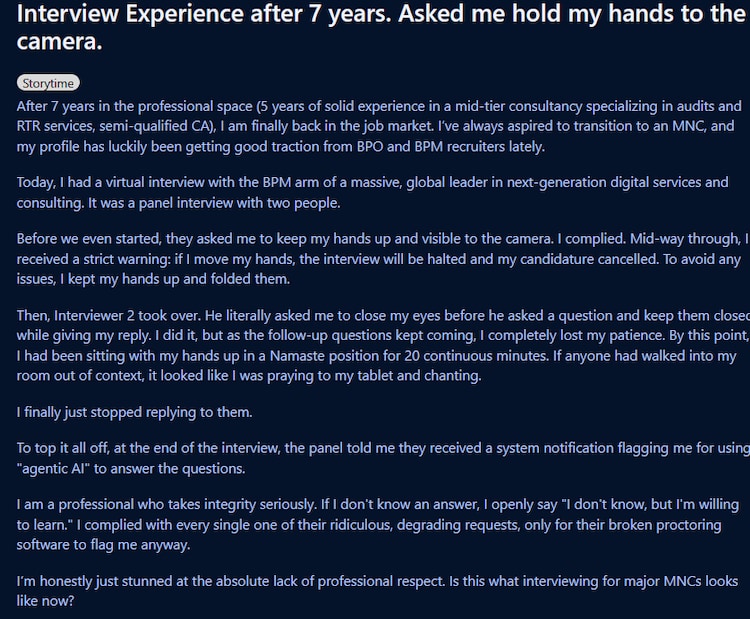
The candidate shared his experience on Reddit’s r/IndianWorkplace forum in a post titled, “Interview Experience after 7 years. Asked me to hold my hands to the camera.”
In the detailed post, he explained that after spending seven years in the professional space, including five years working in audits and Record to Report (RTR) services at a mid-tier consultancy as a semi-qualified Chartered Accountant, he had recently begun searching for new opportunities, hoping to transition into an MNC role.
According to the candidate, things took an unexpected turn during a virtual panel interview with the BPM arm of a “massive, global leader in next-generation digital services and consulting.”
Before the actual questioning even began, he claimed the interviewers instructed him to keep his hands visible on camera at all times.
“Before we even started, they asked me to keep my hands up and visible to the camera. I complied,” he wrote, adding that midway through the interview, he received a stern warning that moving his hands could result in the interview being halted and his candidature cancelled.
To avoid any issues, he said he kept his hands folded and visible throughout the session. However, things became even stranger when the second interviewer allegedly introduced another unusual instruction.
“He literally asked me to close my eyes before he asked a question and keep them closed while giving my reply,” the candidate wrote, explaining that he initially followed the request despite finding it odd.
As the interview continued with follow-up questions, frustration began to set in. He recalled sitting with his hands raised in what he jokingly described as a “Namaste position” for nearly 20 uninterrupted minutes.
“If anyone had walked into my room out of context, it looked like I was praying to my tablet and chanting,” he remarked, adding that he eventually stopped responding to the panel altogether.
What left him even more frustrated was what happened at the end of the interaction. According to the candidate, the interview panel informed him that the system had flagged him for allegedly using “agentic AI” to answer questions.
“I am a professional who takes integrity seriously. If I don't know an answer, I openly say ‘I don't know, but I'm willing to learn,’” he wrote, saying he felt disheartened after complying with every request only to be accused by what he called “broken proctoring software.”
Take a look at the post here:
The post sparked discussion online, with many users debating whether stricter AI-monitoring measures in interviews were becoming excessive.
One user suggested that the company may have been trying too hard to ensure candidates were not using AI assistance during virtual interviews, but said there were far more professional ways to verify that than imposing what they described as “nonsense” restrictions.
Another commenter pointed out that while cheating in interviews has become increasingly common, especially among experienced professionals, the measures described by the candidate felt unnecessarily extreme and degrading.
Others argued that AI itself should not automatically be viewed negatively in recruitment. One user wrote that if a candidate could use AI tools effectively and demonstrate productivity through them, that could actually be considered a valuable workplace skill rather than a red flag.
The unusual interview experience has since prompted broader conversations online about how companies are adapting to the growing use of AI in hiring, and where the line should be drawn between ensuring fairness and making candidates feel distrusted.