
As Islamabad talks loom, US military planes tracked in Pakistan's airspace
India Today identified at least four C-17 Globemasters and one C-40 Clipper arriving at PAF Base Nur Khan in Chaklala, one of the air bases targeted by India during Operation Sindoor last May, which sustained damage severe enough to remain non-operational for months.



With uncertainty surrounding the proposed Islamabad talks, expected within hours, recent air activity over Pakistani airspace points to preparations tied to the arrival of US VVIPs. The delegation is expected to be led by JD Vance, accompanied by Steve Witkoff and Jared Kushner.
On the other side, Iran has yet to signal full commitment, maintaining that any engagement hinges on Israel halting its offensive in Lebanon.
India Today’s Open Source Intelligence (OSINT) team tracked Pakistani airspace using flight tracking platforms over the past 24 hours to assess the scale and pattern of US aircraft movement, covering Islamabad as well as other parts of the country.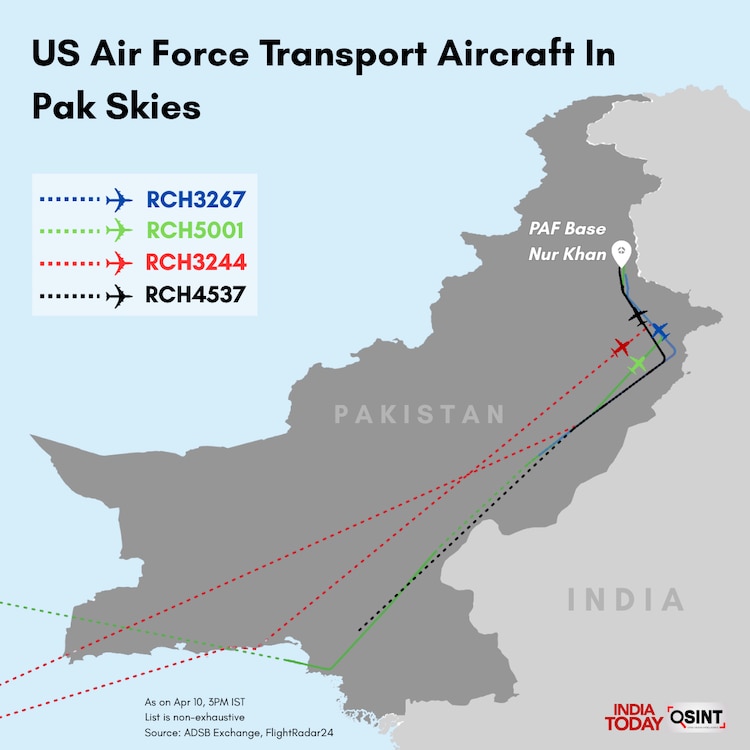
During this period, at least four C-17 Globemasters and one C-40 Clipper were identified arriving at PAF Base Nur Khan in Chaklala, one of the air bases targeted by India during Operation Sindoor last May, which sustained damage severe enough to remain non-operational for months.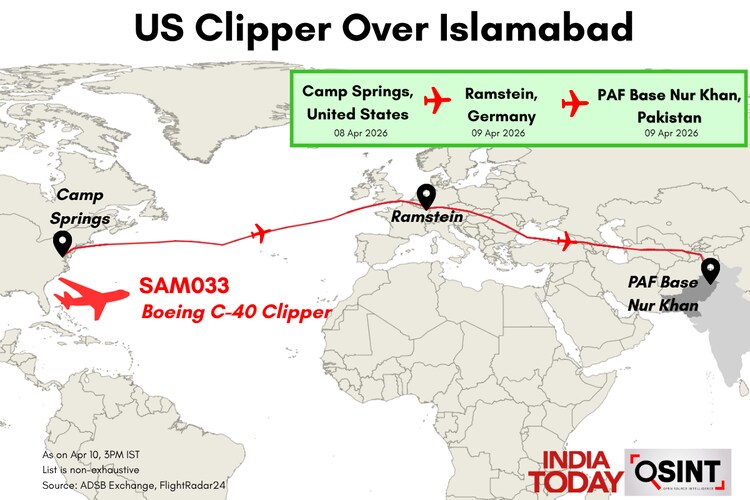
In addition, one ISR-linked aircraft was also seen hovering over Islamabad-Rawalpindi airspace, suggesting a coordinated mix of logistics and real-time monitoring.
Why do these aircraft matter?
This combination of airlift and surveillance assets aligns with how the US typically prepares for high-level overseas visits. It reflects a layered approach in which logistics, movement of senior officials, and situational awareness are established in advance, especially in the context of sensitive diplomatic engagements.
RCH Callsigns: C-17 Globemaster III - strategic airlift
The C-17 Globemaster III acts as the logistical backbone for high-level visits by US leadership. The arrival of at least four RCH-tagged aircraft, including RCH3267, RCH5001, RCH3244, and RCH4537 at the PAF base, is in line with established US protocols for Vice President JD Vance’s high-stakes visit to Islamabad, where he is expected to lead a delegation for the proposed peace talks with Iran.
Deployed ahead of the delegation, this heavy airlifter transports specialised vehicles and critical equipment required to secure a high-level visit in a sensitive environment. While the $1.5 million Cadillac One is reserved for the President, the Vice President uses a similarly armoured and heavily fortified limousine, often referred to as a Beast-like vehicle, drawn from the same protective motorcade framework.
According to official US Air Force specifications, the C-17 is uniquely capable of transporting these 9-ton armoured vehicles due to its massive cargo bay, measuring 88 feet in length, 18 feet in width, and over 12 feet in height. With a maximum payload of 170,900 pounds and the ability to operate from runways as short as 3,500 feet, the aircraft enables direct deployment of security assets.
Beyond the primary motorcade, the C-17 can carry a wide range of support assets. These include up to 102 paratroopers or 134 passengers in side wall seating, as well as heavy equipment such as a CH-47 Chinook helicopter, three Stryker armoured vehicles, or even an M1 Abrams main battle tank, ensuring a comprehensive on-site military and medical response capability.
N8145M - an Intelligence, Surveillance, and Reconnaissance platform
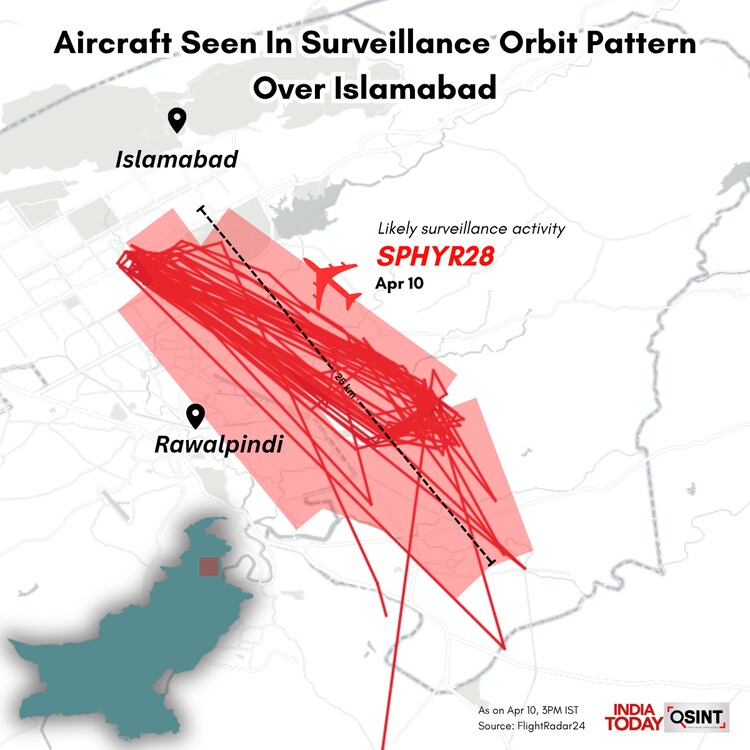
Operating as SPHYR28 over the Islamabad–Rawalpindi corridor, this aircraft indicates an ISR “eye in the sky” supporting security operations. By utilising sophisticated electro-optical infrared sensors and signals intelligence gear, the aircraft provides real-time overwatch, monitoring critical areas surrounding diplomatic buildings and travel routes.
Path tracking data from flight tracking platforms shows the aircraft maintaining a steady altitude while executing repeated orbits over the area, rather than following a transit route. This pattern indicates focused surveillance and continuous coverage ahead of the expected arrival of JD Vance's lead delegation.
Why the uncertainty?
The US has not denied its participation in the proposed Islamabad talks, even as signals from Washington remain mixed. Donald Trump warned of escalation if Iran fails to comply with the April 8 ceasefire, writing that Iran is doing a “very poor job” in allowing oil transit through the Strait of Hormuz, adding that if the agreement is not honoured, “the shootin’ starts.”
Tehran, however, is holding firm and linking its participation to developments on the ground. Iran has made it clear that Israel must halt its offensive against Hezbollah in Lebanon. Mohammad Bagher Ghalibaf signalled urgency, posting that “time is running out,” a line echoed by Abbas Araghchi, as both indicate that failure to meet Iran’s demands could derail the talks.
Meanwhile, hostilities continue. Israel and Hezbollah remain engaged, which Iran, backed by Shehbaz Sharif, has framed as an “explicit” part of the deal dynamics. On the Israeli side, Chairman of the Foreign Affairs and Defence Committee Boaz Bismuth hinted that the pause may be temporary, stating there is a “possibility that the campaign will resume in the coming days.”