
f(f(O))>f(O): What does Iran's mathematical warning to US over Hormuz mean?
In a post on X, Iran's Parliament Speaker Mohammad Bagher Ghalibaf mocked the US's warning of a naval blockade on ships linked to Iranian ports, suggesting the move could ultimately rebound on American consumers by driving up fuel costs.
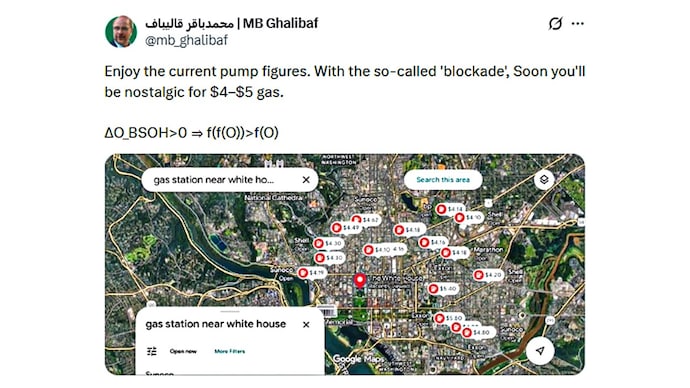

As tensions escalate over the Strait of Hormuz, Iran’s Parliament Speaker Mohammad Bagher Ghalibaf has turned to an unusual weapon — mathematics — to deliver a pointed warning to US President Donald Trump over his new threat to choke off the Islamic Republic's maritime access.
Following the collapse of the US-Iran ceasefire talks, Trump on Sunday announced that the US will move ahead with a sweeping naval blockade targeting Iranian-linked maritime traffic.
Acting on his directive, the US Central Command (CENTCOM) said it would begin enforcing the blockade from 10 am ET today (7.30 pm IST).
In response to the latest US threat, Ghalibaf shared a mathematical formula on X suggesting that even a small disruption in oil flows could trigger disproportionately large economic consequences.
Social media users have interpreted the formula — “O_BSOH > 0 f(f(O)) > f(O)” — as an engineering-style taunt, reflecting the Speaker's technical background.
While “BSOH” refers to a blockade of the Strait of Hormuz, “O_BSOH > 0” suggests any increase in the blockade’s impact on oil supply and prices.
The equation essentially argues that any increase in pressure on the Strait of Hormuz would not just raise oil prices, but amplify them through cascading market reactions.
At its core, the idea is simple: an initial shock to oil supply leads to a price spike, but that spike then triggers secondary effects — panic buying, supply chain disruptions, speculative trading — which push prices even higher. In effect, the economic impact compounds on itself.
Ghalibaf’s equation came alongside a broader taunt aimed at Washington’s latest move.
In his post, he mocked the decision by pointing to petrol prices near the White House — warning Americans they may soon look back at current rates with nostalgia.
“Enjoy the current pump figures,” he wrote, cautioning that Americans could soon grow “nostalgic” for $4–$5 per gallon fuel if tensions escalate.