
Iran claims US strikes hit 2 reservoirs, coastal town left without drinking water
Tehran alleged that US strikes disrupted essential services in Sirik, with local authorities reporting a loss of drinking water access. The Iranian Consulate in Mumbai condemned the attack and called it a breach of humanitarian norms.
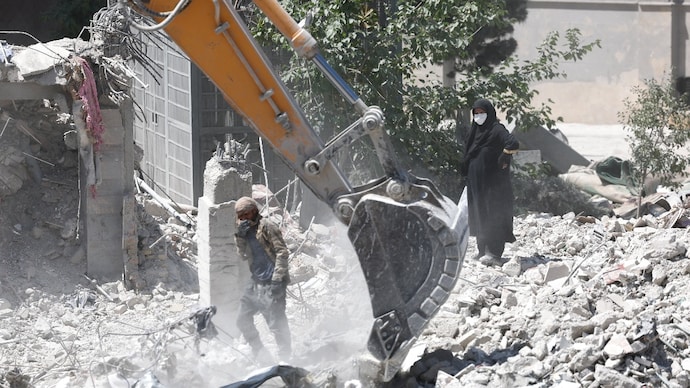

Iran on Wednesday said that overnight US attacks on its territory hit two water storage tanks in Sirik, disrupting water access for residents across the coastal city.
Condemning the strike as a violation of human rights, the Iranian Consulate in Mumbai wrote, "US terrorist strikes on Sirik have hit two water storage tanks, cutting off access to drinking water for local residents. Targeting civilian water infrastructure raises serious humanitarian concerns."
Iranian state media also reported that the US strikes in Sirik hit two water tanks, disrupting the city's drinking water supply.
"In the enemy's attack on Sirik tonight, two water tanks in the Bamani district were hit and drinking water has been cut off," the report said, according to Iran International.
Iran's Revolutionary Guards said on Wednesday that they had fired long-range missiles at four locations inside the US al-Azraq base in Jordan, according to Iranian media reports. The Guards said the sites they had aimed at included hangars used for F-35 fighter aircraft and a command-and-control facility, and said they were prepared to give a "crushing and decisive" answer to any new US attack.
The statement came after the United States carried out strikes on Iranian targets, with President Donald Trump accusing Tehran of bringing down an American Apache helicopter over the Strait of Hormuz. The latest exchange signalled a sharp escalation in hostilities between Washington and Tehran.
The US military described its operation as a "proportional response to unjustified Iranian aggression."
A US official told Reuters that the Apache had been downed by an Iranian one-way attack drone. Trump said the two pilots on board survived without injury and said Washington would respond.
As the operation continued, a US official told Axios that American forces had struck several Iranian air defence and radar installations around the Strait of Hormuz.
US Central Command said the action was taken in "self-defence" after the helicopter was shot down. The US military later said CENTCOM had hit Iranian air defence systems, ground control stations and surveillance radar positions near the Strait of Hormuz, adding that the strikes against Iran had been completed.
Reports of blasts emerged from several parts of southern Iran early on Wednesday. Iran's Fars news agency said explosions were heard in eastern parts of Hormozgan province, while Mehr news agency reported blasts in the port city of Bandar Abbas. Iranian state media also said a projectile impact had been confirmed in Sirik and reported that Qeshm Island had come under attack.
Iranian Foreign Minister Abbas Araqchi did not directly comment on the helicopter incident, but said foreign military forces operating near Iran were always exposed to the risks of accidents, miscalculation or getting caught in crossfire. "To reduce risk, the best solution is for them to leave," Araqchi said in a social media post.
Iran's Revolutionary Guards also said they had launched drones at the US Fifth Fleet in Bahrain in retaliation for the US strikes on targets in southern Iran earlier in the day, according to state media. The Guards said fighting was continuing and warned of a "more severe response" if what they called continued US aggression went on. They also said the US attacks had damaged a telecommunications tower and two water tanks in the Iranian port town of Sirik.
Before the US strikes, Iranian state media had quoted a military source as saying that Iran had not carried out any offensive air operations in the Strait of Hormuz in the previous 24 hours.
The same source warned that Iran would give a "decisive response" if it faced renewed hostility linked to the helicopter incident. The exchange amounted to one of the most serious direct confrontations between the United States and Iran in recent years, adding to concerns over security in the Gulf and global energy supplies.