
Trump didn't extend Iran ceasefire. He launched an economic weapon
Trump's move to extend the Iran ceasefire is widely being seen as a softening of his stance, especially after earlier threats to resume bombing. However, behind it is a calculated strategy to permanently damage Iran's oil fields - its economic lifeline.
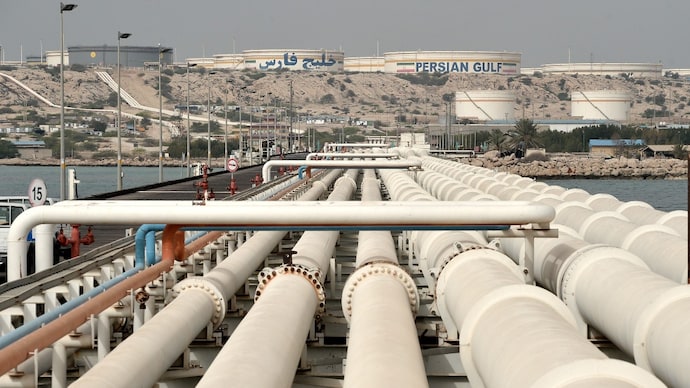
Trump wants to force Iran to shut down its oil production in Kharg Island

The US's Operation Epic Fury seems to have turned to 'Economic Fury'. While Donald Trump's decision to extend the Iran ceasefire was viewed as a step back from escalation, a hushed post by the US Treasury Secretary minutes later clearly outlined the real reason behind the move. By continuing the naval blockade of Iranian ports, Trump wants to force Iran to shut down its oil production in Kharg Island, directly hitting its main revenue stream. For Iran, the damage can be permanent.
The move suggests a shift in Trump's playbook on how the US is trying to pressure Iran and not just another TACO (Trump Always Chickens Out) moment. The Trump team is well aware that a month of bombing and threats has failed to deter Iran. This is why Trump, despite extending the ceasefire after vehemently asserting that "lots of bombs will start going off", has not lifted the blockade.
Iran had specifically sought the lifting of the blockade before any fresh round of talks in Pakistan, which is trying to mediate the war.
The US very well knows there are fissures within the current Iranian leadership. Trump also admitted it for the first time on Tuesday that the Iranian regime was "seriously fractured". Pulling the strings is shadowy Revolutionary Guard commander Ahmad Vahidi. Thus, for the US, the only way to cripple the regime is by permanently weakening Iran's capacity to produce oil - its economic lifeline.
WHY TRUMP EXTENDED IRAN CEASEFIRE
The strategy was effectively outlined by a largely unnoticed post by US Treasury Secretary Scott Bessent. The blockade in the Strait of Hormuz, through which 20% of the global oil passes, has restricted the movement of Iranian oil vessels entering or exiting its ports.
Now, if Iran is unable to export oil, its storage (oil wells) at Kharg Island - the country's main oil hub - is likely to fill within days. Once there is no place to store oil, Iran will be forced to shut production. It will be a direct hit on Iran's primary revenue source.
"In a matter of days, Kharg Island storage will be full, and the fragile Iranian oil wells will be shut in. Constraining Iran's maritime trade directly targets the regime's primary revenue lifelines," Bessent tweeted.
He further warned, "Any person or vessel facilitating these flows - through covert trade and finance - risks exposure to US sanctions." It's an all-out economic warfare now.
The US has already turned back 27 ships since the Hormuz blockade started a week ago. However, matters escalated when US Marines boarded and seized two Iranian-flagged cargo ships near the Gulf of Oman recently.
Analysts have forecast that Iran has limited storage capacity to absorb excess oil production. As per an April 13 estimate, Iran has about 50-55 million barrels of oil on land. Around 60% of onshore storage is already full. Iran has around 20 million barrels of spare capacity against a daily surplus of roughly 1.5 million barrels.
Thus, Iran is still producing more oil than it can sell. "Storage fills in approximately 13 days from April 13. It comes to around April 26," sanctions analyst Miad Maleki wrote in an article in The Iran International.
Thus, if storage tanks fill up, Iran will have little choice but to halt production. It risks long-term damage to Iran's ageing oil wells.
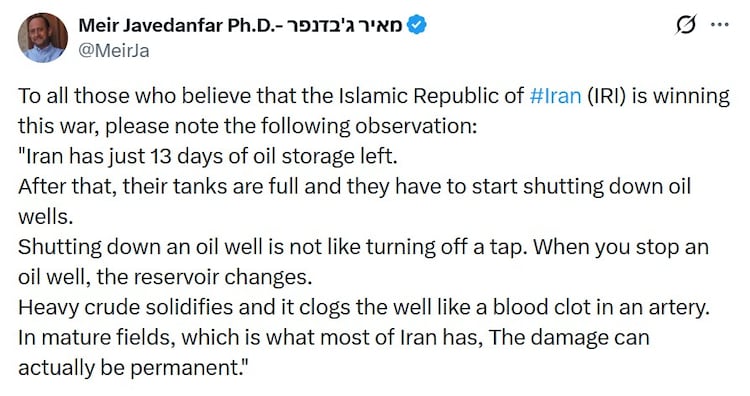
Now, shutting down oil wells is not like turning off a tap. Reservoir pressure drops, which may cause water to seep in. It can permanently damage the underlying rock structures. Moreover, heavy crude is thick and sticky. If it sits still, it will thicken, form solid deposits, and clog the system.
"When you stop an oil well, the reservoir changes. Heavy crude solidifies, and it clogs the well like a blood clot in an artery. In older fields, which is what most of Iran has, the damage can actually be permanent," Iranian political expert Meir Javedanfar tweeted.
MOVE TO CRIPPLE IRAN'S REVENUES
Once an oil well is shut, restarting production will be a herculean task that may take years. Moreover, the well may never produce the same amount of oil again.
According to geopolitical expert Shanaka Anslem Perera, Iran is likely to loose 3,00,000-5,00,000 barrels per day. This is around $9-15 billion (Rs 75,000 crore to Rs 1.25 lakh crore) per year in lost revenue.
For Iran, it's a stark reality - its economy remains heavily reliant on crude exports.
Over the years, amid US sanctions and even during the war, Iranian oil flowed through shadow fleet tankers. However, this allows limited exports. It does little to ease pressure on its storage facilities.
Thus, through such forced shutdown of oil fields, Trump is now aiming to cripple Iran and force its hand at accepting the US's terms of ceasefire. This is bound to cause more lasting damage than any military action.
In essence, the extension of the ceasefire while continuing the naval blockade now seems more like a tactical move. Factor this in before you put out that TACO (Trump always chickens out) meme.
- Ends