
US won't allow ships to enter or leave Hormuz: Trump after failed Iran talks
The US would begin clearing any mines in the Strait of Hormuz and would stop vessels suspected of paying what he described as "illegal tolls" to Iran. "No one who pays an illegal toll will have safe passage on the high seas," President Donald Trump said.
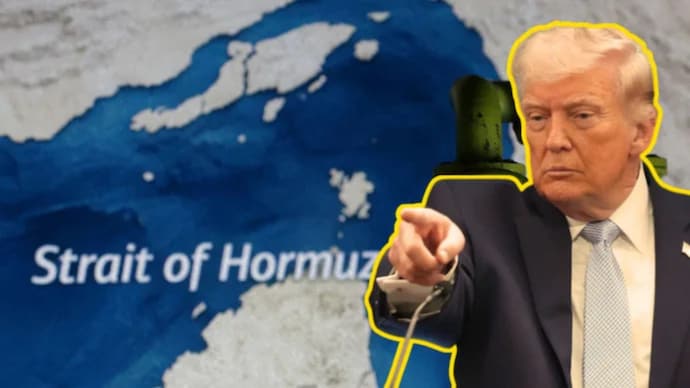
Donald Trump says US Navy will shortly begin blockading ships trying to enter or leave Hormuz. (Photo: AP)

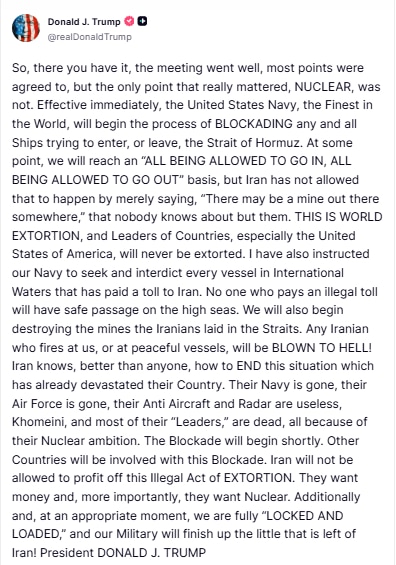
US President Donald Trump said Washington would shortly begin blockading ships attempting to enter or leave the Strait of Hormuz, marking a big escalation after US-Iran talks failed to produce an agreement.
"Effective immediately, the United States Navy will begin the process of BLOCKADING any and all Ships trying to enter, or leave, the Strait of Hormuz," he said. He also claimed that Iran had failed to honour assurances to keep the waterway open, alleging that threats of naval mines had already deterred shipping activity. "They say there may be a mine out there somewhere what ship owner would want to take the chance?" he said.
The Strait of Hormuz is not just another maritime route. It is one of the world’s most critical oil chokepoints, handling around a 20 per cent share of global energy flows.
TALKS FAIL ON NUCLEAR RED LINE
Trump said marathon talks with Iranian officials -- held in Islamabad, which stretched close to 20 hours -- resulted in agreement on several issues, but failed on the only point that mattered: Iran’s nuclear programme. He made it clear that everything else discussed at the table was secondary.
"The meeting went well, most points were agreed to, but the only point that really mattered, NUCLEAR, was not," Trump said, adding that Iran remained "unyielding" on its nuclear ambitions.
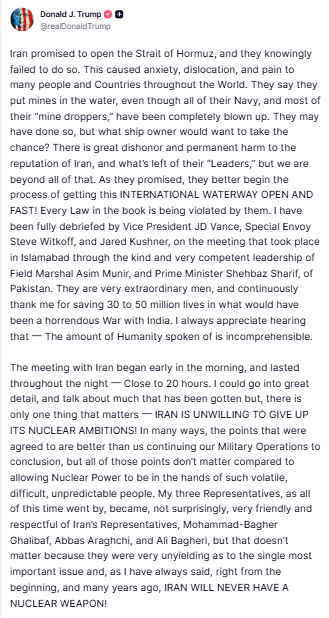
He reiterated his long-standing position, saying, "IRAN WILL NEVER HAVE A NUCLEAR WEAPON!", while indicating that continued diplomacy without movement on the issue would not be acceptable. The talks were facilitated by Pakistan, with Trump saying he had been briefed by Vice President JD Vance and special envoy Steve Witkoff, and Jared Kushner following the negotiations.
TRUMP PRAISES PAKISTAN’S ROLE IN TALKS
Trump said the talks were held under the "competent" leadership of Pakistan’s Field Marshal Asim Munir and Prime Minister Shehbaz Sharif. He described both leaders as "extraordinary men" and claimed they had repeatedly thanked him for preventing what he called a potential large-scale war with India.
US NAVY TO ENFORCE BLOCKADE IN HORMUZ
By signalling a blockade, Washington is effectively placing a chokehold on this artery. Trump framed the move as a response to Iranian "extortion", accusing Tehran of leveraging uncertainty over naval mines to control access to the waterway. "THIS IS WORLD EXTORTION," he said, adding that the United States would not allow Iran to profit from what he called an illegal act.
The proposed measures are not a mere show of force. Trump said US naval forces would actively interdict vessels suspected of paying tolls to Iran, warning that "no one who pays an illegal toll will have safe passage on the high seas."
The rhetoric accompanying the announcement leaves little room for ambiguity. Trump warned that any Iranian action against US forces or commercial vessels would be met with overwhelming retaliation. "Any Iranian who fires at us, or at peaceful vessels, will be BLOWN TO HELL!" he said.
Trump also claimed that Iran’s military capabilities had already been significantly degraded, asserting that its navy, air force and defence systems were effectively neutralised.
What makes this moment particularly dangerous is the scale of its potential fallout. The Strait of Hormuz is a lifeline for global oil supply. Any sustained disruption could send energy markets into turmoil, impacting economies far beyond the Middle East. Trump insisted that Iran "knows how to END this situation", placing the responsibility squarely on Tehran.
IRAN SAYS US FAILED TO BUILD TRUST
A 14-day ceasefire had been established earlier in the week to create space for negotiations, but the truce failed to translate into a breakthrough at the talks in Islamabad. Iran’s Parliamentary Speaker Mohammad Baqer Qalibaf, who led the delegation alongside Foreign Minister Abbas Araqchi, had said the talks faltered because US failed to build trust despite constructive proposals from Tehran.
"The US has understood Iran's logic and principles and it's time for them to decide whether they can earn our trust or not," Qalibaf said on X.
The meeting, held days after a ceasefire, marked the first direct engagement between the two sides in over a decade and the highest-level contact since the 1979 Islamic Revolution. US Vice President JD Vance, however, said Iran had chosen not to accept American conditions, including a commitment not to pursue nuclear weapons.
- Ends