
Any Iranian ship that comes close to US blockade will be eliminated: Trump
A fresh warning from Trump escalates tensions in the Strait of Hormuz, as a US naval blockade disrupts shipping, sends oil prices soaring, and raises fears of a supply shock not seen in decades.
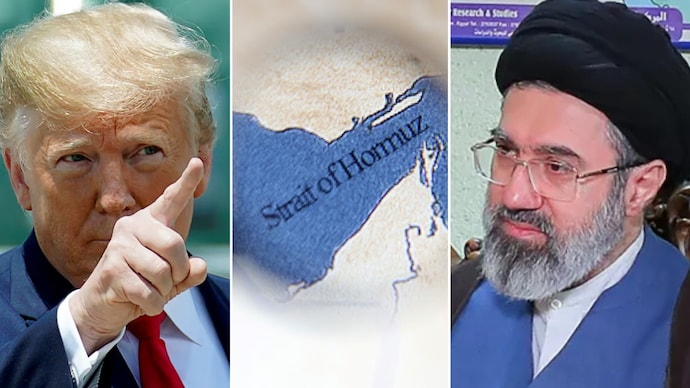
Trump warns Iran fast attack ships will be eliminated in Hormuz

UPDATED: Apr 13, 2026 20:26 IST
Edited By: Sonali Verma
A stark warning from Donald Trump has sharpened tensions in the Strait of Hormuz, with the US President threatening to “eliminate” Iranian vessels that approach an American naval blockade.
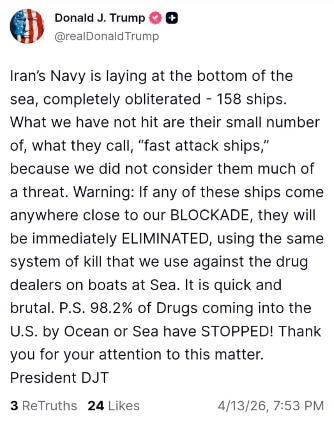
“Iran’s Navy is laying at the bottom of the sea, completely obliterated - 158 ships,” Trump said in a post on Truth Social.
“What we have not hit are their small number of ‘fast attack ships’ If any of these ships come anywhere close to our BLOCKADE, they will be immediately ELIMINATED It is quick and brutal,” he added.
The warning comes as the US Navy moves to block vessels entering or exiting the Strait of Hormuz, a corridor that carries a significant share of global oil trade.
Shipping through the strait has once again slowed to a near halt after briefly recovering during a two-week ceasefire. Before the conflict began on February 28, nearly 125 vessels passed through daily, a number now reduced to low single digits.
IRAN’S HIDDEN FLEET REMAINS A THREAT
Despite US claims of having destroyed much of Iran’s naval strength, a key component of its maritime power remains intact.
The Islamic Revolutionary Guard Corps operates a separate fleet of smaller, fast attack boats designed specifically for the confined waters of the Gulf and Hormuz.
Unlike larger naval ships, these vessels are built for speed, stealth and disruption, capable of launching missiles, laying mines and harassing commercial traffic.
At its narrowest, the strait is only about 20 miles wide, giving these boats a tactical advantage. Experts say they are harder to detect, often concealed in underground coastal facilities carved into rocky terrain.
“It will be a long time before the US can take all those out,” a maritime intelligence expert said.
This strategy dates back to April 1988, when the US destroyed much of Iran’s fleet in a single-day naval battle during the Tanker War, forcing Tehran to shift towards smaller, more elusive craft.
OIL PRICES SURGE AMID SUPPLY FEARS
The escalation has sent shockwaves through global energy markets.
Oil prices crossed the $100-per-barrel mark on Monday. Around 3 pm, Nymex crude was up eight per cent, while Brent crude rose seven per cent.
Analysts warn the blockade could squeeze supplies further, with Iran’s oil exports, estimated at nearly two million barrels per day, now under strain.
SUPPLY SHOCK ‘FAR LARGER’ THAN PAST CRISES
Experts say the current disruption could exceed previous oil shocks in scale.
A study by the Federal Reserve Bank of Dallas suggests earlier crises removed between four and six per cent of global supply. This time, the shortfall could approach 20 per cent.
That could push crude prices to $115 per barrel if disruptions persist, and up to $132 in a prolonged scenario, raising concerns over inflation and economic slowdown.
GLOBAL IMPACT DEEPENS
The conflict has already forced Gulf countries to cut oil production by around 10 million barrels per day.
Even with increased output from Russia and Kazakhstan, global supply is estimated to have dropped by eight million barrels per day in March.
Refining capacity has also taken a hit, with more than three million barrels per day shut due to attacks and export disruptions, according to the International Energy Agency.
A WIDENING FLASHPOINT
Trump’s warning and the continued presence of Iran’s fast attack fleet point to a volatile stand-off in one of the world’s most critical waterways.
With naval forces facing off and supply chains under strain, the Strait of Hormuz risks becoming a prolonged flashpoint with global consequences.
- Ends