My Diwalis with Vijay
A fan traces how Thalapathy Vijay's Diwali releases became a cherished personal ritual. His move into politics now turns that annual theatre celebration into a bittersweet memory.
I’ve always had a slightly different relationship with Diwali. I am South Indian, so the festival – while warm and festive – was never the centrepiece of the year in my house. There were no elaborate rituals, no grand celebrations that defined the day. Diwali existed, yes. But it didn’t define us. Cinema did. More specifically, a Thalapathy Vijay release on Diwali night. And I had my own little ritual.
I would quietly carry packets of murukku and ribbon pakoda into the theatre, almost like smuggling a piece of home with me, so the experience felt complete. The last shows, often late into the night, became my Diwali. While the world outside burst into colour, crackers lighting up the sky, sweets being exchanged, neighbourhoods buzzing with energy, my celebration was happening somewhere else. Inside a theatre. That was my Diwali. And at the centre of it all was Vijay. Not just as an actor. Not just as a star. But as a feeling.
Over time, I realised this wasn’t random. Vijay’s films had quietly become part of my festive memory. There was Thuppakki (Gun) 2012, which made Diwali feel sharp, fast, electric. Then Kaththi(Knife) 2014, where celebration came with a conscience, a voice that spoke for farmers, for people who didn’t always get heard. Mersal (Zapped) 2017 didn’t just entertain, it made you sit up, think, question. Sarkar (Government) 2018 went even further. It didn’t just stay on screen, it followed you out of the theatre. Your vote. Your voice. Your place in the system. And then came Bigil (Whistle) 2019. That Diwali felt different. For the first time, I wasn’t just watching Vijay as the hero who wins. I was watching someone who lifts others, who believes in others. There was a warmth to it. A quiet strength. And somehow, sitting there in that theatre, it felt personal.
Because Vijay had started feeling personal. The theatre experience only amplified it. Packed halls. Charged air. The kind of noise that isn’t noise – it’s emotion. I found myself in theatres in Delhi, far from the South, surrounded by people who felt the same way. Whistles, cheers, claps – every reaction louder than the last. It was surreal. To see an entire theatre erupt for Thalapathy Vijay in a city where Tamil isn’t even the dominant language, tells you something. This wasn’t just fandom. This was a connection. The moment he appeared on screen, the theatre transformed. And somewhere in all of that, I realised what Vijay had become for me. He wasn’t just part of Diwali. He was Diwali. Vijay’s films didn’t just give you moments – they gave you a sense of certainty. You knew what you were going to feel. You knew you would walk out charged, satisfied, complete.
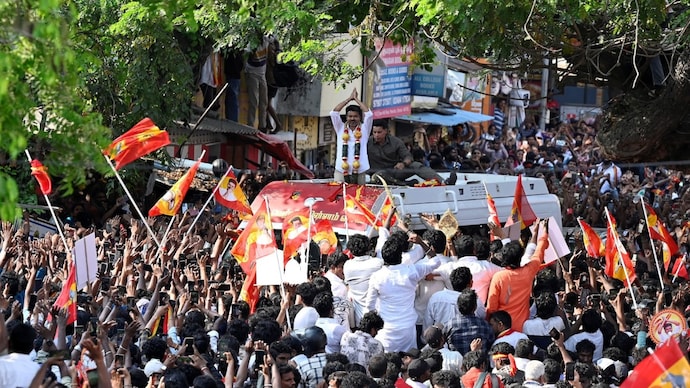
And maybe that’s where he separates himself from others who have tried to make the same leap recently. We’ve seen it before in Tamil Nadu. Rajinikanth never really started – hesitation turned into absence. Kamal Haasan did take the plunge, but the connection never fully translated into electoral success. He faced significant challenges in connecting with the masses in Tamil Nadu, with critics often citing his ideological approach as a major barrier. With Vijay, it feels different. Because this wasn’t built overnight. This was lived. Felt. Absorbed. Over years. Over films. Over moments that stayed. And now, as Thalapathy Vijay steps fully into politics, on a path that leads straight to the Chief Minister’s office, it feels like something is ending. Not abruptly. Not dramatically. But quietly.
Because I know there will come a Diwali where I walk into a theatre, and he won’t be there on-screen.
No entry shot.
No whistle moment.
No collective roar.
Just silence where there used to be celebration. And maybe that’s what hits the most. It’s not just about missing films. It’s about missing a feeling. So for fans like me, this victory is bittersweet. I’m happy. Proud, even, to see him grow into something bigger, to step into a role that carries real power and responsibility. But at the same time, there’s a question I didn’t think I would have to ask. What do I do on Fridays now? How do we fill that void? More importantly – who fills it? Because a part of it, my part of it, will always belong to a theatre, a screen, and a star who unknowingly became the centre of my Diwali. Not just as an actor. But as an emotion. That was my celebration. That was my Vijay vibe.
I’ve always had a slightly different relationship with Diwali. I am South Indian, so the festival – while warm and festive – was never the centrepiece of the year in my house. There were no elaborate rituals, no grand celebrations that defined the day. Diwali existed, yes. But it didn’t define us. Cinema did. More specifically, a Thalapathy Vijay release on Diwali night. And I had my own little ritual.
I would quietly carry packets of murukku and ribbon pakoda into the theatre, almost like smuggling a piece of home with me, so the experience felt complete. The last shows, often late into the night, became my Diwali. While the world outside burst into colour, crackers lighting up the sky, sweets being exchanged, neighbourhoods buzzing with energy, my celebration was happening somewhere else. Inside a theatre. That was my Diwali. And at the centre of it all was Vijay. Not just as an actor. Not just as a star. But as a feeling.
Over time, I realised this wasn’t random. Vijay’s films had quietly become part of my festive memory. There was Thuppakki (Gun) 2012, which made Diwali feel sharp, fast, electric. Then Kaththi(Knife) 2014, where celebration came with a conscience, a voice that spoke for farmers, for people who didn’t always get heard. Mersal (Zapped) 2017 didn’t just entertain, it made you sit up, think, question. Sarkar (Government) 2018 went even further. It didn’t just stay on screen, it followed you out of the theatre. Your vote. Your voice. Your place in the system. And then came Bigil (Whistle) 2019. That Diwali felt different. For the first time, I wasn’t just watching Vijay as the hero who wins. I was watching someone who lifts others, who believes in others. There was a warmth to it. A quiet strength. And somehow, sitting there in that theatre, it felt personal.
Because Vijay had started feeling personal. The theatre experience only amplified it. Packed halls. Charged air. The kind of noise that isn’t noise – it’s emotion. I found myself in theatres in Delhi, far from the South, surrounded by people who felt the same way. Whistles, cheers, claps – every reaction louder than the last. It was surreal. To see an entire theatre erupt for Thalapathy Vijay in a city where Tamil isn’t even the dominant language, tells you something. This wasn’t just fandom. This was a connection. The moment he appeared on screen, the theatre transformed. And somewhere in all of that, I realised what Vijay had become for me. He wasn’t just part of Diwali. He was Diwali. Vijay’s films didn’t just give you moments – they gave you a sense of certainty. You knew what you were going to feel. You knew you would walk out charged, satisfied, complete.
And maybe that’s where he separates himself from others who have tried to make the same leap recently. We’ve seen it before in Tamil Nadu. Rajinikanth never really started – hesitation turned into absence. Kamal Haasan did take the plunge, but the connection never fully translated into electoral success. He faced significant challenges in connecting with the masses in Tamil Nadu, with critics often citing his ideological approach as a major barrier. With Vijay, it feels different. Because this wasn’t built overnight. This was lived. Felt. Absorbed. Over years. Over films. Over moments that stayed. And now, as Thalapathy Vijay steps fully into politics, on a path that leads straight to the Chief Minister’s office, it feels like something is ending. Not abruptly. Not dramatically. But quietly.
Because I know there will come a Diwali where I walk into a theatre, and he won’t be there on-screen.
No entry shot.
No whistle moment.
No collective roar.
Just silence where there used to be celebration. And maybe that’s what hits the most. It’s not just about missing films. It’s about missing a feeling. So for fans like me, this victory is bittersweet. I’m happy. Proud, even, to see him grow into something bigger, to step into a role that carries real power and responsibility. But at the same time, there’s a question I didn’t think I would have to ask. What do I do on Fridays now? How do we fill that void? More importantly – who fills it? Because a part of it, my part of it, will always belong to a theatre, a screen, and a star who unknowingly became the centre of my Diwali. Not just as an actor. But as an emotion. That was my celebration. That was my Vijay vibe.

