Career FOMO: Gen Z's new anxiety of watching others' careers, doubting their own
In a digital-first world where careers are constantly on display, Gen Z is navigating a new kind of pressure: Career FOMO. As achievements become content and success becomes visible, the line between inspiration and anxiety continues to blur, reshaping how young professionals perceive growth, ambition and self-worth.
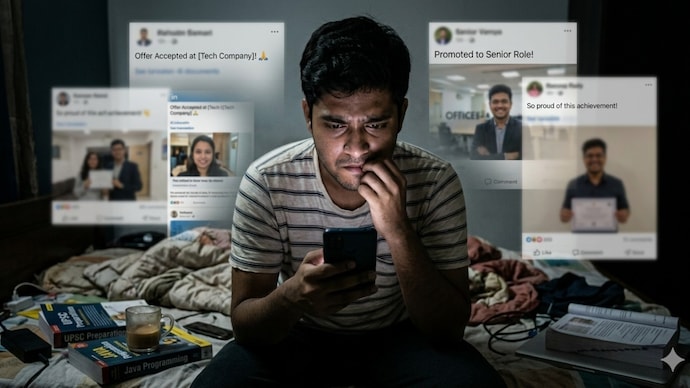
Social media, once a space to showcase holidays, fitness transformations and relationship milestones, has steadily expanded into the professional realm. Today, timelines are filled with job announcements, certifications, project recognitions and career milestones, turning work life into a public display.
What was once a curated window into one’s ‘perfect’ personal life has now evolved into a stage for professional achievements.
For Gen Z, this shift has introduced a new form of anxiety: Career FOMO, or the fear of falling behind in one’s professional journey. Unlike traditional career pressures, this anxiety is amplified by constant digital exposure, where success is not only achieved but also continuously broadcast.
Career FOMO can be understood as the psychological response to repeatedly witnessing peers’ achievements online, leading to comparison, self-doubt and urgency to 'keep up'. It often manifests in impulsive decisions such as job-hopping, overworking, or constantly upskilling without direction. At its core lies a persistent fear: “Am I doing enough?”
RESEARCH SAYS IT ALL
Research increasingly supports this phenomenon. A study titled 'Managing Gen Z Anxiety and Digital Perfectionism on LinkedIn' highlights how platform design itself contributes to stress.
Drawing on Self-Determination Theory and Social Comparison Theory, the research shows how visible metrics, including likes, endorsements and profile views, create a culture of constant evaluation. Users begin to curate not just their profiles, but their identities, engaging in performative professionalism.
This pressure to present an ‘ideal’ career trajectory often leads to impostor syndrome, low self-esteem and even disengagement from professional platforms altogether.
The study suggests that without intervention, such digital perfectionism can impact both career confidence and long-term workforce readiness.
Similarly, another study, 'A Study on How Social Media FOMO Impacts the Gen Z Audience', finds that constant exposure to others’ achievements fuels compulsive checking, trend-following and heightened comparison.
For a generation deeply embedded in digital ecosystems, FOMO becomes more than a fleeting feeling; it shapes behaviour, decision-making and emotional well-being. The research links it to lower life satisfaction, increased anxiety and a continuous need to stay connected.
'AM I LAGGING BEHIND?': VOICE OF GEN Z
For many young professionals, career FOMO is not just a concept but a lived experience.
“Yes, I feel Career FOMO a lot of times,” says Nishita Sinha, 24, a teacher. “One of my closest friends recently opened her own offline academy. I have always wanted to do the same, but I am still working in someone else’s academy. Seeing her success makes me question where I am missing out,” she adds.
Her experience reflects a common trigger: watching someone close achieve what you aspire to.
Others describe it as a quieter, more internal struggle. “Seeing other people’s achievements gives me a feeling that I am missing out on something major,” says Somya Singh, 23, a journalist. “It’s not jealousy, but a sense of failure,” she adds.
For Kirti Gupta, 21, the impact has gone a step further. “I stopped opening LinkedIn altogether. Even though I have a job, seeing others constantly achieving makes me feel like I am doing nothing. You end up comparing yourself even when you are trying your best," she says.
Yet, not everyone experiences Career FOMO negatively.
Kritika Thakur, 22, a journalist, sees it differently. “When I see people doing well, it motivates me. Everyone has their own strengths. Instead of feeling bad, I try to bring that energy into my own life," she says.
Her perspective highlights an important nuance: Career FOMO is not universal in its impact. For some, it becomes pressure; for others, it becomes inspiration.
This divide reveals that Career FOMO operates on a spectrum. On one end, it drives anxiety, comparison and burnout. On the other, it can act as a motivator, pushing individuals to grow and explore opportunities.
The difference often lies in how individuals interpret what they see online. While some internalise others’ success as a benchmark, others view it as a possibility.
However, the risk lies in mistaking curated success for complete reality. Social media rarely show uncertainty, failure or the time it takes to reach milestones. What appears as rapid success is often the result of years of unseen effort.
IS CAREER FOMO REAL?
Offering a different perspective, career counsellor Bhawana Bhardwaj believes the phenomenon is often misunderstood. Speaking to India Today, she argues that what is labelled Career FOMO may, in many cases, reflect a shift in how Gen Z approaches career decisions.
“It cannot simply be called Career FOMO. Gen Z today is more aware and tends to make informed decisions. What they need is a more comprehensive and guided approach, which is where mentorship and structured support become important,” she says.
However, she acknowledges that the pace at which young professionals expect growth has changed. “This generation wants everything on a fast track. Quick results, quick success,” she adds, pointing to how evolving educational models, including integrated programmes introduced by universities, are attempting to address this need for direction and clarity.
Emphasising solutions rather than labels, Bhardwaj suggests that the key to managing such anxieties lies in consistency and self-development. “Keeping yourself in a continuous learning process and maintaining a steady pace can help reduce or even eliminate this sense of pressure,” she explains.
She further highlights the importance of humility and long-term focus in career building. “One should not be limited by ego but instead focus on gaining expertise in their chosen field. Even if the process does not always seem exciting, learning remains essential for growth,” Bhardwaj adds.
Another career counsellor, Preetha Ajit, says that one does not need to be visibly perfect. One should learn to accept that no one is perfect. She talks about how every individual has a different wavelength and capacity when it comes to their career.
“No one is cookie-cut to be in a perfect shape and size,” she told India Today.
She discusses factors like socio-economic background and emotional intelligence, which vary from one person to another in shaping one’s career.
“Resilience needs to be practised,” she adds.
Career FOMO reflects a broader cultural shift in how success is perceived, pursued and displayed in a hyper-connected world. While social media can amplify pressure and fuel comparison, it can also serve as a source of motivation when approached with perspective and self-awareness.
The challenge for Gen Z lies in balancing ambition with patience, recognising that career growth is rarely linear and that behind every visible milestone lies unseen effort, struggle and time.
Developing resilience, seeking guidance and maintaining a focus on personal growth may be key to navigating this evolving professional landscape without losing sight of individual well-being.
Social media, once a space to showcase holidays, fitness transformations and relationship milestones, has steadily expanded into the professional realm. Today, timelines are filled with job announcements, certifications, project recognitions and career milestones, turning work life into a public display.
What was once a curated window into one’s ‘perfect’ personal life has now evolved into a stage for professional achievements.
For Gen Z, this shift has introduced a new form of anxiety: Career FOMO, or the fear of falling behind in one’s professional journey. Unlike traditional career pressures, this anxiety is amplified by constant digital exposure, where success is not only achieved but also continuously broadcast.
Career FOMO can be understood as the psychological response to repeatedly witnessing peers’ achievements online, leading to comparison, self-doubt and urgency to 'keep up'. It often manifests in impulsive decisions such as job-hopping, overworking, or constantly upskilling without direction. At its core lies a persistent fear: “Am I doing enough?”
RESEARCH SAYS IT ALL
Research increasingly supports this phenomenon. A study titled 'Managing Gen Z Anxiety and Digital Perfectionism on LinkedIn' highlights how platform design itself contributes to stress.
Drawing on Self-Determination Theory and Social Comparison Theory, the research shows how visible metrics, including likes, endorsements and profile views, create a culture of constant evaluation. Users begin to curate not just their profiles, but their identities, engaging in performative professionalism.
This pressure to present an ‘ideal’ career trajectory often leads to impostor syndrome, low self-esteem and even disengagement from professional platforms altogether.
The study suggests that without intervention, such digital perfectionism can impact both career confidence and long-term workforce readiness.
Similarly, another study, 'A Study on How Social Media FOMO Impacts the Gen Z Audience', finds that constant exposure to others’ achievements fuels compulsive checking, trend-following and heightened comparison.
For a generation deeply embedded in digital ecosystems, FOMO becomes more than a fleeting feeling; it shapes behaviour, decision-making and emotional well-being. The research links it to lower life satisfaction, increased anxiety and a continuous need to stay connected.
'AM I LAGGING BEHIND?': VOICE OF GEN Z
For many young professionals, career FOMO is not just a concept but a lived experience.
“Yes, I feel Career FOMO a lot of times,” says Nishita Sinha, 24, a teacher. “One of my closest friends recently opened her own offline academy. I have always wanted to do the same, but I am still working in someone else’s academy. Seeing her success makes me question where I am missing out,” she adds.
Her experience reflects a common trigger: watching someone close achieve what you aspire to.
Others describe it as a quieter, more internal struggle. “Seeing other people’s achievements gives me a feeling that I am missing out on something major,” says Somya Singh, 23, a journalist. “It’s not jealousy, but a sense of failure,” she adds.
For Kirti Gupta, 21, the impact has gone a step further. “I stopped opening LinkedIn altogether. Even though I have a job, seeing others constantly achieving makes me feel like I am doing nothing. You end up comparing yourself even when you are trying your best," she says.
Yet, not everyone experiences Career FOMO negatively.
Kritika Thakur, 22, a journalist, sees it differently. “When I see people doing well, it motivates me. Everyone has their own strengths. Instead of feeling bad, I try to bring that energy into my own life," she says.
Her perspective highlights an important nuance: Career FOMO is not universal in its impact. For some, it becomes pressure; for others, it becomes inspiration.
This divide reveals that Career FOMO operates on a spectrum. On one end, it drives anxiety, comparison and burnout. On the other, it can act as a motivator, pushing individuals to grow and explore opportunities.
The difference often lies in how individuals interpret what they see online. While some internalise others’ success as a benchmark, others view it as a possibility.
However, the risk lies in mistaking curated success for complete reality. Social media rarely show uncertainty, failure or the time it takes to reach milestones. What appears as rapid success is often the result of years of unseen effort.
IS CAREER FOMO REAL?
Offering a different perspective, career counsellor Bhawana Bhardwaj believes the phenomenon is often misunderstood. Speaking to India Today, she argues that what is labelled Career FOMO may, in many cases, reflect a shift in how Gen Z approaches career decisions.
“It cannot simply be called Career FOMO. Gen Z today is more aware and tends to make informed decisions. What they need is a more comprehensive and guided approach, which is where mentorship and structured support become important,” she says.
However, she acknowledges that the pace at which young professionals expect growth has changed. “This generation wants everything on a fast track. Quick results, quick success,” she adds, pointing to how evolving educational models, including integrated programmes introduced by universities, are attempting to address this need for direction and clarity.
Emphasising solutions rather than labels, Bhardwaj suggests that the key to managing such anxieties lies in consistency and self-development. “Keeping yourself in a continuous learning process and maintaining a steady pace can help reduce or even eliminate this sense of pressure,” she explains.
She further highlights the importance of humility and long-term focus in career building. “One should not be limited by ego but instead focus on gaining expertise in their chosen field. Even if the process does not always seem exciting, learning remains essential for growth,” Bhardwaj adds.
Another career counsellor, Preetha Ajit, says that one does not need to be visibly perfect. One should learn to accept that no one is perfect. She talks about how every individual has a different wavelength and capacity when it comes to their career.
“No one is cookie-cut to be in a perfect shape and size,” she told India Today.
She discusses factors like socio-economic background and emotional intelligence, which vary from one person to another in shaping one’s career.
“Resilience needs to be practised,” she adds.
Career FOMO reflects a broader cultural shift in how success is perceived, pursued and displayed in a hyper-connected world. While social media can amplify pressure and fuel comparison, it can also serve as a source of motivation when approached with perspective and self-awareness.
The challenge for Gen Z lies in balancing ambition with patience, recognising that career growth is rarely linear and that behind every visible milestone lies unseen effort, struggle and time.
Developing resilience, seeking guidance and maintaining a focus on personal growth may be key to navigating this evolving professional landscape without losing sight of individual well-being.

