Four places to start anew | Travel destinations
Where travel is heading this year
The New Year calls for a different kind of travel, one that offers genuine recalibration. The four destinations below highlight reasons to travel now: a return to nature, cities that are evolving in real time, a preference for lower-impact journeys, and a renewed desire for places that reset perspective rather than merely stimulate the senses.
The New Year calls for a different kind of travel, one that offers genuine recalibration. The four destinations below highlight reasons to travel now: a return to nature, cities that are evolving in real time, a preference for lower-impact journeys, and a renewed desire for places that reset perspective rather than merely stimulate the senses.
SOSSUSVLEI, NAMIBIA
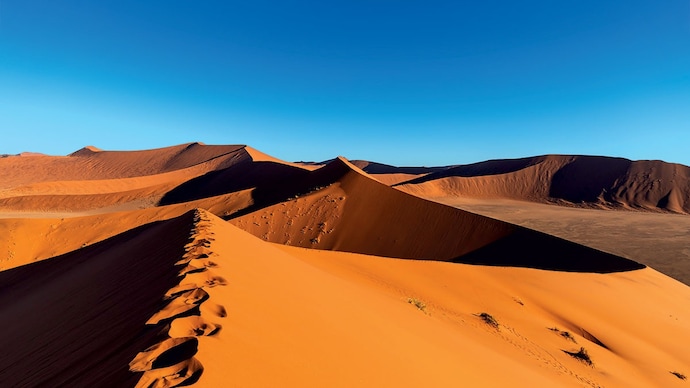
If you ever need a reminder of how vast the world is and how small your problems are, you will find it in Namib-Naukluft National Park, in the heart of the Namib Desert. Within this protected landscape, and within the Namib Sand Sea, a UNESCO-listed ocean of massive, shifting dunes, lies Sossusvlei, a surreal place framed by some of the oldest and tallest dunes on Earth. Its sands, born of ancient erosion, began their journey millions of years ago and were carried here by wind and time.
The desert is most striking at the edges of the day, when sunrise and sunset sharpen the orange slopes, and shadows fall like ink across the sand. Climbing the dunes is the most direct way to understand the scale of the place. I begin with Dune 45, one of the most accessible. Each step through the loose sand demands effort, but the sensation of being surrounded by waves of orange makes the climb feel exhilarating. The ascent takes about forty-five minutes. The run back down takes five and feels like flying.
For a deeper sense of the desert’s silence, there is Big Daddy, one of the tallest dunes in the area and the classic vantage point over Deadvlei. From its summit, views of the pan spread out below, a white clay floor scattered with camel thorn trees that died centuries ago. In a landscape too dry even for decay, these trees remain standing, darkened and preserved by the sun. The blackened trunks against the blazing dunes serve as a reminder that the real architects here are time and wind.
BRISBANE, AUSTRALIA
With the 2032 Olympics approaching, Brisbane is undergoing a visible transformation. It is most evident along the river, where former industrial edges have softened into spaces for walking and relaxing, especially at Howard Smith Wharves and along the still-developing sections of Queen’s Wharf and South Bank.
This is also where the city’s food culture comes into focus, relaxed and confident, built around ingredients like barramundi, Moreton Bay bugs, finger lime, and lemon myrtle, and influenced by Indigenous, Asian, and Pacific traditions. The city’s cultural pull centres on QAGOMA, the Queensland Art Gallery and Gallery of Modern Art, now among the region’s most significant institutions. Its flagship Asia Pacific Triennial attracts artists and ideas from across Asia and the Pacific, transforming Brisbane into a true crossroads of contemporary art.
But the change is most noticeable on foot. In Fish Lane, once a service alley and now a seam between South Bank and West End, murals turn walls into landmarks, and a narrow strip of small restaurants and wine bars keeps the street lively late into the night. Then, quite swiftly, the city thins into landscape. In the Scenic Rim, an hour south of Brisbane, days revolve around volcanic soil, small producers, and a thoughtful food culture. It is this easy transition between city and country, along with a strong appetite for change, that gives Brisbane its very current appeal.
THE WADDEN SEA, GERMANY
The Wadden Sea, a UNESCO World Heritage Site and the largest unbroken system of intertidal sand and mudflats worldwide, is one of Europe’s most quietly instructive landscapes. It is a place defined by impermanence. Here, the land appears and disappears twice daily.
We base ourselves in Sankt Peter-Ording, a renowned German North Sea resort town celebrated for its salt air, stilted houses, and dune landscapes on the edge of this vast tidal world. With a guide, we walk out onto the seabed across mudflats that only appear for a few hours before the water returns, quietly erasing all traces of us. The horizon is expansive, but we are taught to look for the smallest signs. The guide refers to them as the Small Five (a popular ecotourism term for small mudflat creatures): lugworms, tiny crabs, snails, mussels, and shrimp. Once you learn to read the surface, their signs are everywhere: coils of sand, tiny holes, faint lines, the slightest disturbance where something breathes just beneath your feet. We stop, kneel, and dig. A lugworm emerges. A crab vanishes. Nothing announces itself. This apparent emptiness is, in fact, one of the world’s great nurseries of life and an essential stopover for millions of migratory birds.
The wind in the North Sea here is so unrelenting that it has even given rise to a sport: land sailing, where people harness the wind with wheeled sails to glide across the hard, sandy beach. When storms roll in, people shelter in wicker beach chairs to watch the sky and sea perform. What stays with you isn’t the spectacle but the rhythm: water ebbing and flowing, and tiny lives at work beneath the sand.
LODZ, POLAND
Lodz, a UNESCO City of Film, lies slightly off the usual European routes, which is precisely what gives it its charm. Its main thoroughfare is Piotrkowska Street, one of the longest commercial streets in Europe. Nineteenth-century facades, murals in all their permutations, and a Walk of Fame honouring Polish celebrities make strolling through the city a way of reading its story. Along the street and in nearby squares, you encounter public tributes to beloved local icons, from the cartoon bear Mis Uszatek to sculptural tributes celebrating the city’s musical talents, such as the pianist Arthur Rubinstein.
Lodz has always been at the heart of creative production, first of textiles and later of images. It is the home of the renowned Lodz Film School, which has nurtured directors such as Andrzej Wajda and Roman Polanski. The city was vividly depicted in Wajda’s film The Promised Land, a defining portrait of its industrial age. The old factories have not vanished but have been reinhabited. The vast Poznanski complex now thrives as Manufaktura, a cultural and urban quarter of museums, cinemas, galleries, restaurants, and public squares. The industrialists’ houses, including the Herbst and Poznanski palaces, preserve the social architecture of that earlier world.
Even the underworld has its place on Lodz cultural map. Sections of historical sewer infrastructure, now open to visitors, evoke the city’s atmospheric past. Above ground, visual culture circulates freely. Visit the Comics and Interactive Narration Centre. Here comics, animation, games, and graphic storytelling are treated as serious narrative arts, part of a lineage that runs from folklore to contemporary fantasy. In a Europe increasingly curated into predictable experiences, odz still feels like a place you have to meet on its own terms and that, in 2026, may be its most marvellous quality.

