European Space Agency builds video game on a hunt for the hidden ninth planet
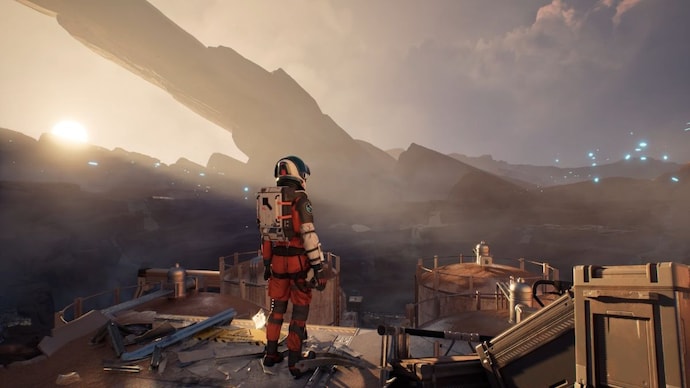
Esa has partnered with French studio DON'T NOD Entertainment on Aphelion, a science-fiction video game grounded in real space science. Players explore a fictional ninth planet, Persephone, as fictional Esa astronauts on the Hope-01 mission.
What if you could suit up as a real European Space Agency (Esa) astronaut and land on a planet no human has ever seen?
That is exactly the premise of Aphelion, a new science-fiction video game developed by French studio DON’T NOD Entertainment in close partnership with the Esa.
And it is far more scientifically rigorous than you might expect from a video game.
Released on April 28, 2026 and available on PC, PlayStation 5 and Xbox Series X/S, Aphelion drops players into the boots of two fictional Esa astronauts, Ariane Montclair and Thomas Cross, on a mission called Hope-01.
Their destination: Persephone, a fictional ninth planet sitting at the outer edge of our Solar System, billions of kilometres from the Sun.
WHAT MAKES APHELION DIFFERENT FROM OTHER SPACE GAMES?
This is not your typical shoot-and-explore space adventure. Real Esa scientists, engineers and astronauts were directly involved in building the game’s world.
Everything from measurement units and physics to scientific instruments, vocabulary and even sound design was reviewed and shaped by real space professionals.
In space, for instance, there is no air to carry sound waves, so what you hear in a vacuum sounds very different from what you hear on Earth. Details like these were carefully woven into the game.
It marks the first time a science-fiction video game has placed an Esa mission, with real astronaut conditions, at the centre of its story.
IS THE HOPE-01 MISSION ACTUALLY REAL?
Not exactly, but Esa has given it a real presence. A dedicated mission page for Hope-01 exists on the ESA website, and a specially designed mission patch was created for the occasion, both hallmarks of actual Esa missions.
The line between fiction and reality is deliberately blurred, and that is the point.
WHY DID ESA GET INVOLVED IN A VIDEO GAME?
Space agencies spend decades trying to make science feel accessible. A video game reaches people who might never pick up a science journal.
Anne-Sophie Bradelle, Head of Esa’s Communication Department, noted that the project supports Esa’s recruitment push, with over 400 positions planned for 2026.
DON'T NOD CEO Oskar Guilbert put it plainly: video games can push the boundaries of fiction to reflect our reality.
Aphelion is proof that science and storytelling, when done right, can make even the cold vacuum of space feel wonderfully alive.
What if you could suit up as a real European Space Agency (Esa) astronaut and land on a planet no human has ever seen?
That is exactly the premise of Aphelion, a new science-fiction video game developed by French studio DON’T NOD Entertainment in close partnership with the Esa.
And it is far more scientifically rigorous than you might expect from a video game.
Released on April 28, 2026 and available on PC, PlayStation 5 and Xbox Series X/S, Aphelion drops players into the boots of two fictional Esa astronauts, Ariane Montclair and Thomas Cross, on a mission called Hope-01.
Their destination: Persephone, a fictional ninth planet sitting at the outer edge of our Solar System, billions of kilometres from the Sun.
WHAT MAKES APHELION DIFFERENT FROM OTHER SPACE GAMES?
This is not your typical shoot-and-explore space adventure. Real Esa scientists, engineers and astronauts were directly involved in building the game’s world.
Everything from measurement units and physics to scientific instruments, vocabulary and even sound design was reviewed and shaped by real space professionals.
In space, for instance, there is no air to carry sound waves, so what you hear in a vacuum sounds very different from what you hear on Earth. Details like these were carefully woven into the game.
It marks the first time a science-fiction video game has placed an Esa mission, with real astronaut conditions, at the centre of its story.
IS THE HOPE-01 MISSION ACTUALLY REAL?
Not exactly, but Esa has given it a real presence. A dedicated mission page for Hope-01 exists on the ESA website, and a specially designed mission patch was created for the occasion, both hallmarks of actual Esa missions.
The line between fiction and reality is deliberately blurred, and that is the point.
WHY DID ESA GET INVOLVED IN A VIDEO GAME?
Space agencies spend decades trying to make science feel accessible. A video game reaches people who might never pick up a science journal.
Anne-Sophie Bradelle, Head of Esa’s Communication Department, noted that the project supports Esa’s recruitment push, with over 400 positions planned for 2026.
DON'T NOD CEO Oskar Guilbert put it plainly: video games can push the boundaries of fiction to reflect our reality.
Aphelion is proof that science and storytelling, when done right, can make even the cold vacuum of space feel wonderfully alive.

