Artemis-II astronauts are officially on their way to the Moon, confirms Nasa
Nasa Administrator Jared Isaacman has confirmed that the Artemis-II crew is officially on a lunar trajectory. The Orion spacecraft completed its critical engine burn on April 3, 2026, leaving Earth orbit.
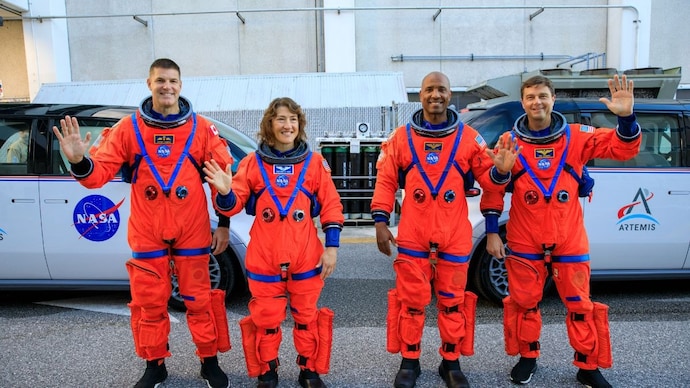
The astronauts of the historic Artemis-II mission are officially on their way toward the Moon.
This milestone was confirmed today, April 3, 2026, after the crew successfully completed a high-stakes engine firing that broke them free from Earth orbit.
Nasa Administrator Jared Isaacman, who was recently confirmed to lead the agency and reset the lunar roadmap, noted that the spacecraft is performing with precision as it begins the first human voyage to the Moon in over 50 years.
The manoeuvre, which scientists call a translunar injection, is a powerful milestone.
By firing the main engine for five minutes and 49 seconds, the Orion capsule accelerated to a staggering 36,000 kilometres per hour.
This speed is necessary to reach escape velocity, the point where a spacecraft travels fast enough to break free from the constant pull of Earth’s gravity and transition onto a direct path to our celestial neighbour.
IS ARTEMIS-II GOING TO THE MOON NOW?
Until this morning, the crew was looping around Earth in a high elliptical orbit, a long, oval-shaped path.
This allowed the four astronauts to test the spacecraft systems while still relatively close to home.
Nasa confirmed that the engine performance during the burn was spot on.
Commander Reid Wiseman and his team have now officially left Earth orbit, a feat last achieved by the Apollo 17 crew in 1972.
They are now in cislunar space, the silent void between Earth and the Moon.
HOW DID THE ARTEMIS-II SPACECRAFT LEAVE EARTH?
The burn used the main engine on the European Service Module. This module is the powerhouse of the spacecraft, providing electricity, water, and air.
By firing the engine at exactly the right second, the crew moved from being Earth-bound to Moon-bound.
Everything on board is functioning 100 per cent as expected, providing confidence to the teams at Mission Control in Houston as the astronauts begin their four-day coast toward the lunar far side.
WHO ARE THE ASTRONAUTS ON THE ARTEMIS-II MISSION?
The crew consists of four pioneers: Commander Reid Wiseman, Pilot Victor Glover, and Mission Specialists Christina Koch and Jeremy Hansen.
They have spent the last 48 hours testing the manual handling of the spacecraft and checking life support.
As they move further away, they will eventually become the most remote human beings in history, surpassing the distance record of 4,00,171 kilometres set by the Apollo 13 mission.
WHEN WILL THE ARTEMIS-II CREW REACH THE MOON?
The spacecraft is now on a direct trajectory across the void.
It is scheduled to reach the lunar environment on April 6, where it will swing around the far side of the Moon.
While they will not land this time, the mission is a vital dress rehearsal for future missions that aim to put boots back on the lunar south pole.
The astronauts of the historic Artemis-II mission are officially on their way toward the Moon.
This milestone was confirmed today, April 3, 2026, after the crew successfully completed a high-stakes engine firing that broke them free from Earth orbit.
Nasa Administrator Jared Isaacman, who was recently confirmed to lead the agency and reset the lunar roadmap, noted that the spacecraft is performing with precision as it begins the first human voyage to the Moon in over 50 years.
The manoeuvre, which scientists call a translunar injection, is a powerful milestone.
By firing the main engine for five minutes and 49 seconds, the Orion capsule accelerated to a staggering 36,000 kilometres per hour.
This speed is necessary to reach escape velocity, the point where a spacecraft travels fast enough to break free from the constant pull of Earth’s gravity and transition onto a direct path to our celestial neighbour.
IS ARTEMIS-II GOING TO THE MOON NOW?
Until this morning, the crew was looping around Earth in a high elliptical orbit, a long, oval-shaped path.
This allowed the four astronauts to test the spacecraft systems while still relatively close to home.
Nasa confirmed that the engine performance during the burn was spot on.
Commander Reid Wiseman and his team have now officially left Earth orbit, a feat last achieved by the Apollo 17 crew in 1972.
They are now in cislunar space, the silent void between Earth and the Moon.
HOW DID THE ARTEMIS-II SPACECRAFT LEAVE EARTH?
The burn used the main engine on the European Service Module. This module is the powerhouse of the spacecraft, providing electricity, water, and air.
By firing the engine at exactly the right second, the crew moved from being Earth-bound to Moon-bound.
Everything on board is functioning 100 per cent as expected, providing confidence to the teams at Mission Control in Houston as the astronauts begin their four-day coast toward the lunar far side.
WHO ARE THE ASTRONAUTS ON THE ARTEMIS-II MISSION?
The crew consists of four pioneers: Commander Reid Wiseman, Pilot Victor Glover, and Mission Specialists Christina Koch and Jeremy Hansen.
They have spent the last 48 hours testing the manual handling of the spacecraft and checking life support.
As they move further away, they will eventually become the most remote human beings in history, surpassing the distance record of 4,00,171 kilometres set by the Apollo 13 mission.
WHEN WILL THE ARTEMIS-II CREW REACH THE MOON?
The spacecraft is now on a direct trajectory across the void.
It is scheduled to reach the lunar environment on April 6, where it will swing around the far side of the Moon.
While they will not land this time, the mission is a vital dress rehearsal for future missions that aim to put boots back on the lunar south pole.

