
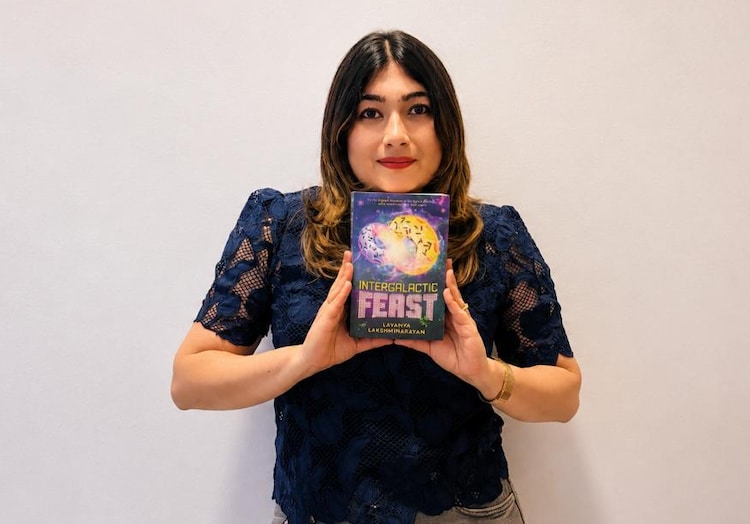
This Indian sci-fi turns food into power, memory and intergalactic identity
An Indian sci-fi series is turning food into a language of power, identity, and belonging across galaxies. In this immersive conversation, Lavanya Lakshminarayan reveals how Intergalactic Feast expands her bold universe, where memory, migration, and taste collide in ways readers may have never experienced before.
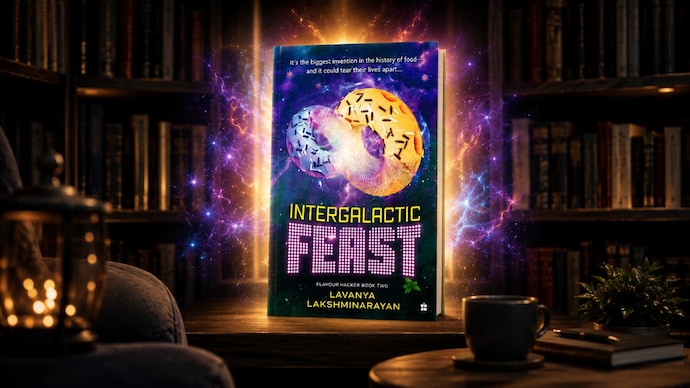
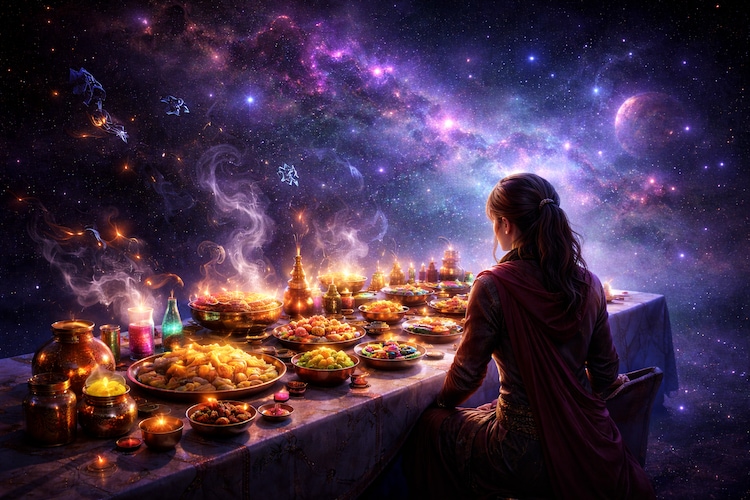
An Indian sci-fi series is turning food into a language of power, identity, and belonging across galaxies. (AI-generated image)

New Delhi,UPDATED: May 16, 2026 13:17 IST
In most science fiction, the future looks metallic. It’s usually all about cold corridors, humming machines, power measured in weapons and speed.
But Intergalactic Feast gives us something very different. Here, the future smells like spices hitting hot oil. It carries the warmth of rice and rasam. It remembers where you came from even when you are light years away.
This is not the kind of sci-fi Indian readers grew up with. It does not borrow its imagination from the West and repaint it. It builds its own universe from scratch, one that feels both distant and strangely familiar.
And surprisingly, at the centre of it is food – it is not mere decoration or comfort. It is power, and it is part of the central narrative.
And that is where Intergalactic Feast, the second book in the Interstellar MegaChef series by Lavanya Lakshminarayan, becomes something far bigger than a story about cooking in space.
WHERE IT ALL BEGAN: A BOWL OF RASAM
The origin of this vast, interstellar world is unexpectedly intimate.
“The idea for Interstellar MegaChef began in a very personal place. I was recovering from a serious illness, and during that time, I lost my appetite for almost everything with one exception. My grandmother’s rasam and rice,” says Lakshminarayan.
That one detail opens the door to everything that follows.
“It made me think about how deeply food is tied to memory, identity, and comfort, but also how unevenly different cuisines are valued in the world. Rasam, for instance, is something that hasn’t caught on in the global popular imagination like many other Indian dishes have,” she says.
From there, the questions only grew sharper.
“Who decides which food is ‘worthy?’ What cuisines get dismissed, and why? And how much of that is tied to power, history, and cultural dominance?”
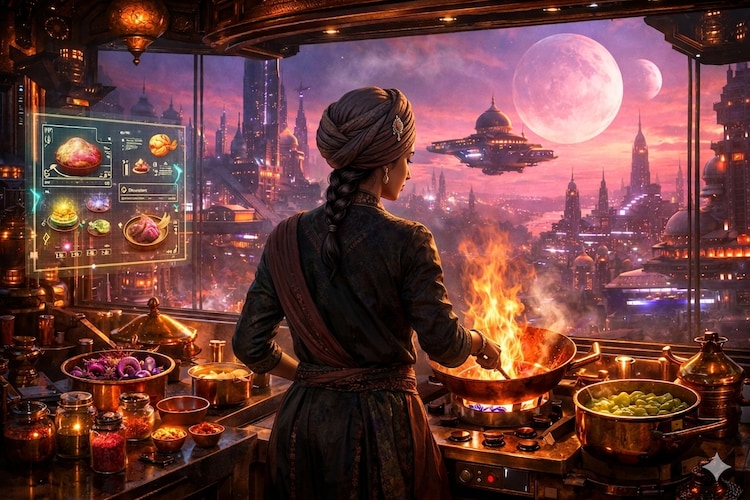
You can almost see the shift happening. A personal memory expands into a political lens. A kitchen becomes a galaxy.
“I went down the rabbit hole into the realms of food history, and examined how food has always been an expression of conflict, aspiration, self-expression, and resistance,” Lakshminarayan explains.
“Science fiction felt like the perfect playground to examine humanity’s relationship with food, so I projected my questions into the future, on a galactic scale.”
A FUTURE THAT SOUNDS AND FEELS LIKE US
One of the most striking things about this series is how it refuses to flatten culture into something generic.
The universe is vast, but it is not empty of identity.
“I wanted the universe to feel vast, but never unmoored from what makes us human. Even in a far-future, interstellar setting, what travels with us isn’t just technology. It’s memory, language, food, and all our quiet rituals of everyday life,” says Lakshminarayan.
That idea shapes everything. The language carries echoes of Indian rhythms. The food is layered with regional memory. Even the social systems feel like extensions of things we already recognise.
“I built the world from those intimate details outward. Culture, to me, isn’t static; it’s something that shifts, adapts, and accumulates as people move through space and time,” she says.
There is a quiet thrill in seeing Indian textures not as background, but as the foundation of a futuristic world. It feels less like representation and more like ownership.
“The future, however distant, is still made out of who we are now.”

FOOD AS POWER, LANGUAGE AND CONFLICT
In this universe, food is never just food.
“Food is a language. We just don’t always recognise it as one," says Lakshminarayan.
That sentence alone reframes how you read every scene.
“Food is deeply political. It encodes identity, history, class, caste, history and power, often in ways we don’t consciously acknowledge.”
And when those dynamics are stretched across planets, they do not disappear. They intensify.
“When you bring together cultures across planets, food becomes a site of negotiation -- of who gets to belong, whose traditions are validated, and whose are erased or appropriated,” the author explains about the pulse of Intergalactic Feast.
This is where the series becomes subtly radical. It does not lecture. It lets you experience these tensions through taste, through competition, through the choices characters make.
“The same dish can be an offering of love in one context, and a marker of ‘otherness’ in another,” says Lakshminarayan.
WHAT HAPPENS AFTER SUCCESS?
If the first book Interstellar Megachef was about entering this world and challenging it, Intergalactic Feast asks a harder question.
What happens after you win?
“With Intergalactic Feast, I wanted to move from examining acts of resistance to the consequences of those acts. The first book is about challenging a dominant system; the second asks what happens after you succeed, when that disruption is absorbed, scaled, and commodified,” explains Lavanya Lakshminarayan.
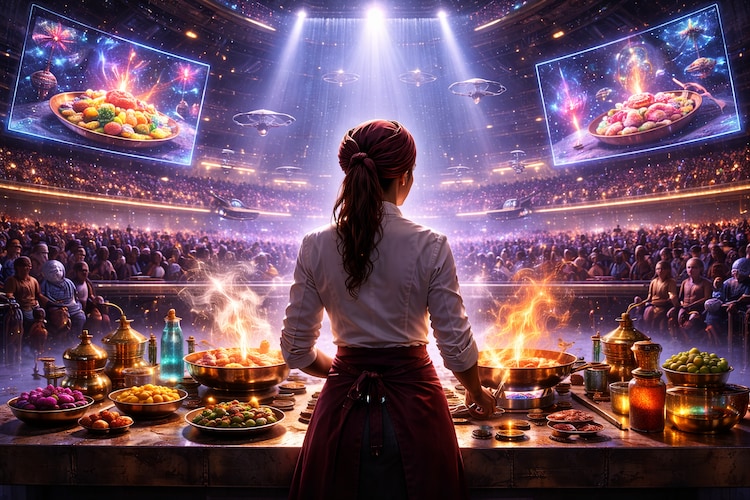
The scale expands. So does the pressure.
“What happens when you build food tech that’s so powerful that humanity might not be ready for it yet? Who claims ownership of it? And where do you, the creator, locate yourself within larger corporate and political structures that seek to use it towards their own purposes?”
There is something deeply current about these questions. You can feel echoes of today’s tech debates, but filtered through something far more sensory and human.
“I was drawn to the idea that success itself can be destabilising. Fame and visibility come at a terrible cost -- everything the characters in this novel thought they wanted, now unravelling,” she says.
THE QUIET WEIGHT OF BELONGING
At its heart, this science fiction series is about people trying to find where they fit in an intergalactic empire where humans reside in a number of planets apart from Earth.
It’s about humans trying to find themselves not just in obvious ways, but in the subtle, everyday negotiations that define identity.
“One of the themes that became much more important to me while writing Intergalactic Feast was responsibility, particularly around technology,” says Lakshminarayan.
But alongside that runs another thread.
“At a more personal level, I kept returning to the idea of othering, not just in its overt forms, but in quieter, more insidious ones. Micro-aggressions, stereotyping, the subtle ways people are reduced to something legible or convenient.”
That tension runs through characters like Saraswati, who carries the weight of being an outsider in a system that claims to be inclusive.
“Because that’s how power can operate. It doesn’t always need spectacle. Often, accumulation and complicity through everyday acts slowly reshape what is considered normal,” explains the author.
WHY THIS WORLD STAYS WITH YOU
There is a moment when you realise this is not just a clever concept.
It is a world that mirrors our own, but with enough distance to make you see things clearly.
Lakshminarayan herself puts it simply when asked what readers can expect.
“I often describe the series as MasterChef meets Star Trek, infused with a strong undercurrent of Indian flavour.”
But that only scratches the surface.
“There’s a lot to enjoy on the surface -- vivid food, high-stakes competition, political tension, and a central queer romance -- but underneath that, it’s asking deeper questions about who gets to define taste, whose stories are valued, and what happens when something deeply personal becomes part of a much larger system,” she says.
That is what lingers. Long after the last page.
“If you enjoy speculative fiction that’s immersive but still rooted in human experience, with a mix of heart, tension, and a bit of bite, this is a universe that will hopefully stay with you long after you’ve left it.”
And it does.
Because once you enter a future that tastes like home, it becomes very hard to forget.
- Ends