
CBSE Class 12 re-test? Why it's the nuclear option nobody wants
If answer sheets are mismatched, how can CBSE guarantee the integrity of the results? We ask experts whether the board should consider a mass recheck, a return to manual verification, or even a wider retest to restore trust in the system?
CBSE Class 12 re-test? Why it’s the nuclear option nobody wants

New Delhi,UPDATED: May 26, 2026 09:04 IST
Update: As CBSE admits that Physics and Chemistry answer sheets were mixed up amid portal crashes and re-evaluation chaos, the controversy has opened a Pandora’s box. How can the board ensure that all 17 lakh Class 12 students actually received correct answer scripts? If one student could end up with someone else’s copies, could others have too, and is a larger review, or even a retest, now entering the conversation?
For millions of CBSE Class 12 students, the board examination season did not end with the declaration of results on May 13. In many ways, that was only the beginning of another draining battle. Several students were already caught in the turmoil surrounding the NEET paper leak controversy that erupted just days later.
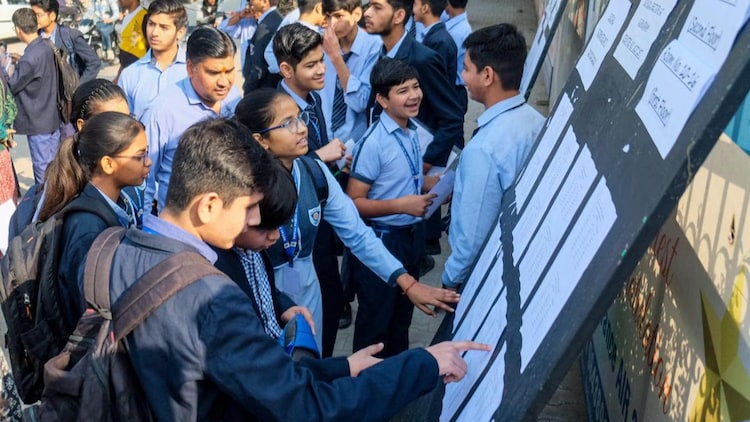
Over the past week, what should have been a routine post-result process has spiralled into one of the biggest credibility crises the Central Board of Secondary Education (CBSE) has faced in recent years. Students trying to access scanned answer sheets or apply for verification and re-evaluation found themselves trapped in a maze of crashing portals, failed payments, inaccessible links and delayed uploads.
Social media platforms filled with screenshots of error messages and frantic pleas from students and parents struggling to complete applications before deadlines.
The controversy became serious enough for Union Education Minister Dharmendra Pradhan to step in personally and call experts from Indian Institute of Technology Madras and IIT Kanpur to help stabilise the system. Four public sector banks were also brought in after complaints emerged about payment failures and excess deductions during the re-evaluation process.
That intervention alone says something important, because when IITs are being summoned to rescue a board exam portal, the issue is no longer merely technical, it becomes institutional.
And that raises an uncomfortable question few in the education ecosystem want to publicly entertain. What happens if trust in the process collapses completely?
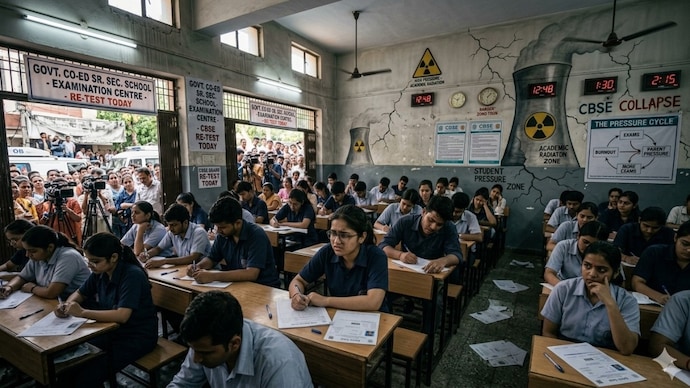
Could CBSE ever be pushed toward the unthinkable, a Class 12 re-test?
RESULT SEASON ALREADY UNDER PRESSURE
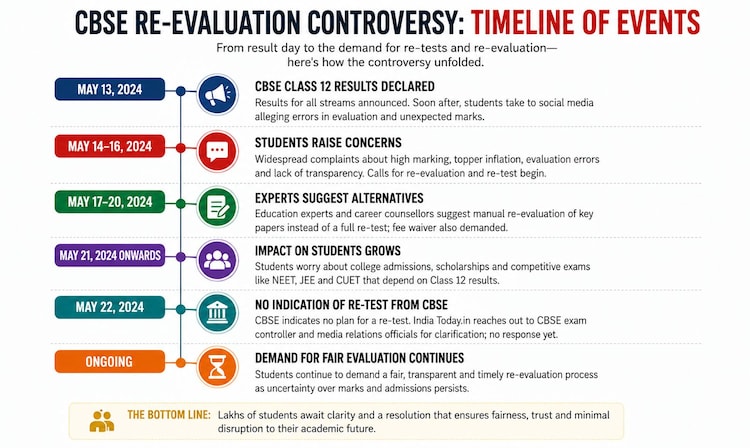
This year’s CBSE Class 12 results were already under scrutiny even before the re-evaluation mess exploded online. The overall pass percentage dropped to 85.20 percent, down sharply from 88.39 percent last year, a fall of 3.19 percentage points and the lowest performance in seven years.
Over 17.68 lakh students appeared for the examination, while nearly 1.63 lakh students were placed in the compartment category.
The lower scores triggered immediate debate among parents, teachers and coaching institutes over whether the new On-Screen Marking (OSM) system, tougher papers or changes in evaluation standards had affected student performance. That anxiety only deepened once students began applying for scanned answer sheets.
HOW THE CBSE RE-EVALUATION MESS UNFOLDED
CBSE announced results on May 13 and opened the application process for scanned answer sheets on May 19 under its revised post-result framework. The new process allowed students to first obtain scanned copies before applying for verification or re-evaluation.
But almost immediately, the portal began collapsing under pressure.
Students across the country reported repeated login failures, “service unavailable” messages, captcha errors and frozen pages. Some said payments were deducted multiple times without confirmation. Others claimed the portal became unresponsive during the final stage of submission.
Several students also complained that the uploaded answer sheets were blurry or incomplete, making it difficult to properly verify the evaluation.
By May 20, the outrage had become so widespread that CBSE was forced to extend deadlines for obtaining scanned answer books. Yet even after the extension, complaints continued pouring in for days. The scale of demand itself was enormous.
CBSE later said it had received 1.27 lakh applications covering nearly 3.87 lakh answer sheets within just three hours after the portal resumed functioning on May 20 evening.
That number alone explains why the system buckled.
'WE SPENT MORE TIME REFRESHING THE WEBSITE'
For students and parents, the frustration quickly turned personal. A Class 12 student described trying repeatedly through the night to complete the process after being redirected to a new portal. “On May 20, after being redirected to a new portal, I again faced maintenance downtime and heavy traffic. I finally managed to apply at 6 am on May 21, but even then faced payment glitches,” Debasmita Halder, a student of DPS Mathura Road, said.
Another parent wrote online that despite paying twice for answer sheets, access was still unavailable. “The portal continues to throw errors, fail to load, or become unresponsive,” the parent wrote, adding that transaction screenshots had been preserved.
Vir Dubey, a student of Shri Ram School in Delhi, told India Today.in that after waiting hours for access, the uploaded answer sheet was “so blurred that it was impossible to properly verify marking.”
Another student posted online that the payment had been deducted successfully, but the portal continued showing “payment unsuccessful” even after several hours.
Others complained that fee amounts kept changing unexpectedly. In one widely shared case, a student claimed the portal showed a fee of nearly Rs 3 lakh for four answer sheets. Another screenshot showed a demand of Rs 69,000 for photocopies.
For many families, the experience stopped feeling like a grievance redressal mechanism and started feeling like another exam altogether.
Ritu and Rishabh Sahni from Noida summed up the mood bluntly for us. “We spent more time refreshing the website than actually checking the answer sheet,” the parents of the student said.
TEACHERS SAY THE ROLLOUT MAY HAVE BEEN RUSHED
The controversy has also revived scrutiny over CBSE’s On-Screen Marking system. CBSE had officially expanded large-scale implementation of OSM for Class 12 evaluation this year, with nearly 77,000 teachers participating in digital evaluation. But several educators now believe the transition happened too quickly.
Several teachers had limited prior exposure to the system before implementation
A DAV school teacher told us that they had not been adequately trained before the rollout. “They have not trained teachers properly for the new system and applied it in a hurry. Now we are witnessing chaos unleashed by the OSM system,” she said.
A CBSE teacher from Lucknow described the evaluation process as “deeply disorganised”. “The answer-checking process for Class 12 this year was chaotic. Teachers received answer sheets in multiple sets,” the teacher said, adding that server issues and delayed loading affected evaluation schedules.
Rohit Mishra, an examiner from Saharanpur, said some teachers struggled with prolonged screen usage and unfamiliarity with the system. “Several teachers had limited prior exposure to the system before implementation,” the examiner said.
A school coordinator from Chandigarh said parents had been calling schools “almost hourly” because students remained unsure whether their applications had even gone through successfully.
“The biggest problem is uncertainty. Nobody knows whether the payment has gone through, whether the answer-sheet request exists, or whether deadlines will shift again,” the coordinator said.
COULD THIS EVER LEAD TO A RE-TEST?
At present, there is no indication that CBSE is considering a re-test for Class 12 students. India Today.in reached out to CBSE Examination Controller Sanyam Bhardwaj as well as the Board’s media and public relations officials seeking clarification on the matter. However, no response had been received from either at the time of publication.
The current crisis is about post-result services, not about a paper leak or compromised examination itself. That distinction matters.
A re-test is the absolute last resort. Once you even discuss it seriously, you are effectively admitting a systemic collapse of trust
But education experts say prolonged failure in re-evaluation systems can eventually become a fairness issue.
“If students are denied equal access to rechecking mechanisms, then the issue shifts from technology to procedural justice,” said Deepak Mishra, an education policy researcher based in Bengaluru.
Another academician and former CBSE advisor, Meenal Singh, said the board’s immediate focus appears to be “damage containment”. “A re-test is the absolute last resort. Once you even discuss it seriously, you are effectively admitting a systemic collapse of trust,” the academician said.
And the numbers explain why.
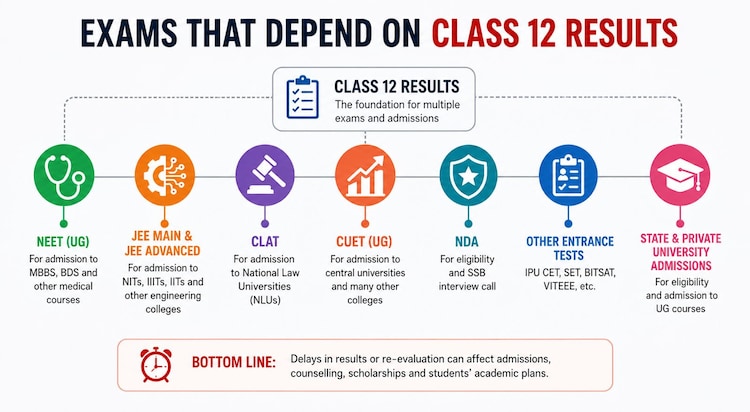
More than 17.6 lakh students appeared for the Class 12 examination this year. Conducting a fresh exam at that scale would amount to a national logistical operation. It would mean printing and transporting new papers, securing centres across India and abroad, redeploying invigilators and somehow fitting the entire exercise into a calendar already packed with CUET, JEE, NEET and university admissions.
The emotional cost could be even worse.
According to career counsellor Jayprakash Gandhi, a complete re-test is simply not feasible. “It would be a logistical nightmare,” he told India Today.in. “Instead, the focus should shift to manual reevaluation. Even if it is not possible for every subject, manual rechecking can certainly be considered for key papers such as Mathematics, Physics, Biology, Economics, and a few others. That would help ensure a process that is both fast and fair.”
But would such an exercise not take an enormous amount of time? Gandhi disagrees. “We are actually in a slightly better position because NEET has already been delayed, which means the academic calendar has shifted anyway. The entire CBSE rechecking process could be completed within a month,” he said.
Even if it is not possible for every subject, manual rechecking can certainly be considered for key papers such as Mathematics, Physics, Biology, Economics, and a few others
Gandhi also believes the Rs 100 rechecking fee should be waived if the Board wants to maintain the trust and confidence of students.
India has seen this nightmare before. In 2018, after the Class 12 Economics paper leak, CBSE ordered a re-examination amid national outrage and legal pressure. The fallout triggered protests, panic and months of uncertainty for students already preparing for competitive examinations.
That memory still haunts the system.
THE BIGGER DANGER FOR CBSE
The real threat is not merely a crashing portal, it is the gradual erosion of trust.
Board examinations in India are not ordinary academic exercises. They influence university admissions, scholarships, overseas applications and career trajectories. Once students begin feeling that access to post-result remedies depends on whether a website loads correctly, the institution itself comes under scrutiny.
That is precisely why the government moved quickly to bring in IIT experts before the outrage spiralled further. Because in India’s examination system, a re-test is the nuclear option: technically possible, politically explosive and emotionally devastating.
And nobody, not CBSE, not the government, not parents, wants nearly 18 lakh students dragged back into examination halls again.
- Ends