
Ground Zero Murshidabad: Did ballots silence bullets this time?
The attack on Humayun Kabir was a stark reminder of Murshidabad's bloody legacy, though the scale of violence felt contained compared to past polls. What happened in Nowda seemed like an aberration on an otherwise heavily guarded day.
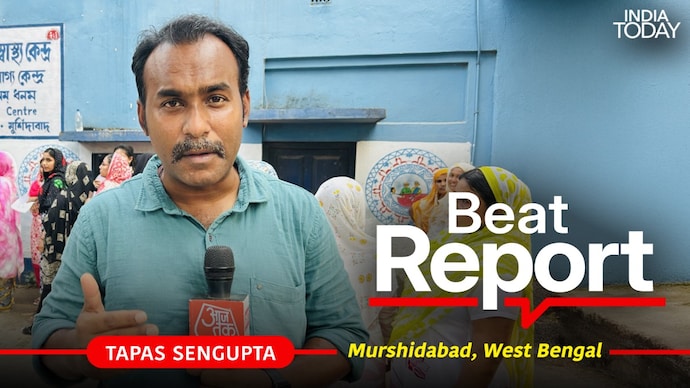

As I hit the road from Kolkata toward the heart of Bengal’s minority-dominated belt, the ghosts of 2021 loomed large. I still remember the terrifying whistles of crude bombs in Domkal and scrambling desperately for cover in Raninagar. This year, however, the Election Commission’s “zero-tolerance” stance and the heavy footprint of Central Armed Police Forces (CAPF) offered a sliver of hope that the ballot might finally silence the bullet.
My day began at 5:30 am in Berhampore. By the time I reached a local school-turned-polling station at 6:00 am, I was stunned. Even with an hour to go before the official start, lines of voters stretched beyond the gates -- a silent, determined testament to the region’s democratic spirit.
THE SHADOW OF HUMAYUN KABIR
By 8 am, after wrapping up my first few "lives", the focus shifted toward Rejinagar. The man of the hour was undoubtedly Humayun Kabir, the veteran firebrand now leading his own Aam Janata Unnayan Party (AJUP). Having fielded himself from his bastions of Nowda and Rejinagar, Kabir remains the gravitational centre of Murshidabad’s political friction. Aware of the volatile history of these pockets, I called Kabir to track his movement.
"Follow me from Rejinagar; I’m heading to Nowda," he told me. But by the time I reached the spot, his convoy had already left. In the sprawling, dusty expanse of Nowda, finding a single candidate is like chasing a ghost. I relied on a journalist friend’s WhatsApp live location, trailing the convoy through Beldanga.
90 MINUTES OF TENSION AT NOWDA
As I reached Amtala, my phone buzzed. It was the same colleague, his voice strained as he said, “Kahan ho aap? Jaldi aayiye! (Where are you? Hurry up!) Humayun has been gheraoed!”
I reached the spot within ten minutes to find a sea of people. I pushed through the first layer of agitated locals, only to hit a wall of khaki and camouflage—a joint cordon of Bengal Police, the RAF, and CAPF, led by Additional SP Majid Khan, IPS. Beyond the line, I saw Kabir sitting defiantly on a plastic chair in the middle of the road, surrounded by his supporters.
The air was thick with humidity and hostility. Protesters from both sides were locked in a high-decibel sloganeering match. When I asked Kabir why he was staging a sit-in, his response was curt: “I will not move until the police act against those who misbehaved with me.”
For 90 minutes, we stood in the blistering heat. Water was nowhere to be found, and the political temperature seemed to rise with every degree on the thermometer.
ATTACK IN THE NARROW LANES
When Kabir finally decided to move, the situation turned from tense to dangerous. My car was pinned behind a group of TMC protesters, making it impossible to follow the convoy. I had to abandon my vehicle and find a spot in the car of my colleagues, Anirban and Sabyasachi. Along with my video journalist, Tapas Bairy, we tailed the convoy closely.
We hadn’t gone 100 metres before the ambush began. Alleged TMC supporters, armed with bamboo sticks, emerged from the sidelines. A hail of stones struck the convoy. The sound of shattering glass echoed through the street; the front windshield of one of Kabir’s lead cars was smashed to pieces.
I jumped out of the car, my heart racing. In Murshidabad, stone-pelting is often a precursor to the sound of muri-moshla (crude bombs). I looked for cover, fearing escalation, but the central forces acted with clinical precision. They charged the crowd, dispersing the agitators and carving a path for the vehicles to escape.
A DIFFERENT KIND OF ELECTION?
The rest of the day saw Kabir visiting other parts of Rejinagar, but the heavy security presence kept a lid on further outbursts.
While the Nowda clash was a stark reminder of the district’s bloody legacy, the scale of violence felt contained compared to previous years. It appeared to be an aberration on an otherwise heavily guarded day, similar to reports from Asansol, where BJP candidate Agnimitra Paul’s car was also targeted by stone-pelters, resulting in a shattered rear window.
As the sun set over the Bhagirathi River, Murshidabad breathed a sigh of relief. The “massive measures” may not have stopped the friction, but today, they likely prevented funerals.