

Paschim Bangal ka garv; Gyanesh Kumar hails over 92% turnout in Bengal
West Bengal witnessed a total turnout of 92.47 per cent (combining both phases), its highest since independence. The numbers surpassed the 84.75% turnout in the 2011 assembly elections, in which the Mamata Banerjee-led Trinamool Congress ousted the 35-year-long Left rule in Bengal.

Gyanesh Kumar welcomes record voter turnout in West Bengal

Chief Election Commissioner, Gyanesh Kumar, on Wednesday hailed the highest-ever voter turnout in West Bengal since independence. The state went to the polls on April 23 and 27, respectively, and in both phases, people voted massively.
Talking about the enthusiastic participation of the electorate, Kumar said, "Highest ever percentage of polling in West Bengal in both Phase I & II since Independence." Adding further, he said, "Chunav ka Parv, Paschim Bengal ka Garv (The festival of democracy was the pride of West Bengal).
In the first phase, where 152 seats went to the polls across the northern and southwestern parts of Bengal, the voter turnout stood at 93.19%. In the second phase, polling happened across 142 seats in southern Bengal, and the turnout touched a record 92.47%. Combining two phases, Bengal witnessed a 92.83% turnout, its highest since independence.
The numbers surpassed the 84.75% turnout in the 2011 assembly elections, in which the Mamata Banerjee-led Trinamool Congress ousted the 35-year-long Left rule in Bengal.
FEMALE VOTERS SURPASS MALE VOTERS
In the 2026 assembly election, women voted in larger numbers than men.
As per the data shared by the Election Commission of India, 93.24% of female voters cast their votes, outplaying 91.74% of male voters in the combined two phases. In the first phase, 94.10% of women voters practised their democratic rights compared to 92.34% of men voters.
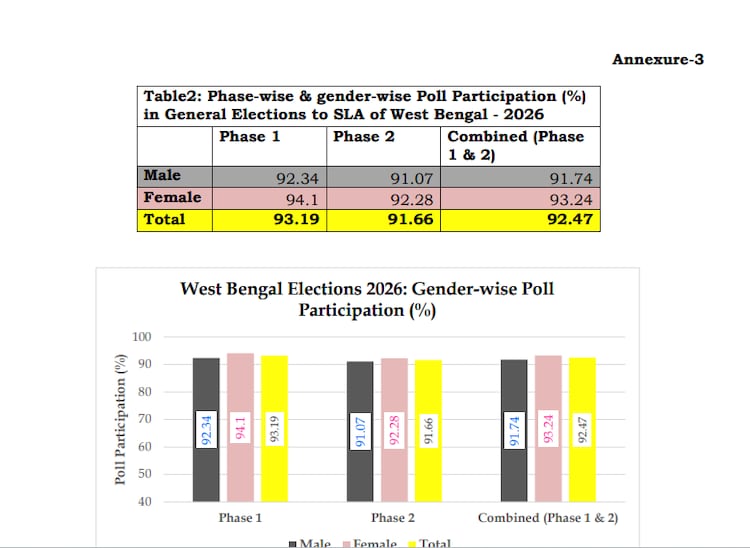
The percentage slightly changed in the second phase, where 91.07% of the male electorate voted in comparison with 92.28% of their female counterparts.
Participation among third-gender voters reached 91.28% in the second phase.
HIGHEST POLLING IN PURBA BARDHAMAN, LOWEST IN KOLKATA SOUTH
Purba Bardhaman reported the highest turnout of voters at 93.60%, followed by South 24 Parganas at 92.18%. The lowest turnout was reported in Kolkata South with 87.59%.
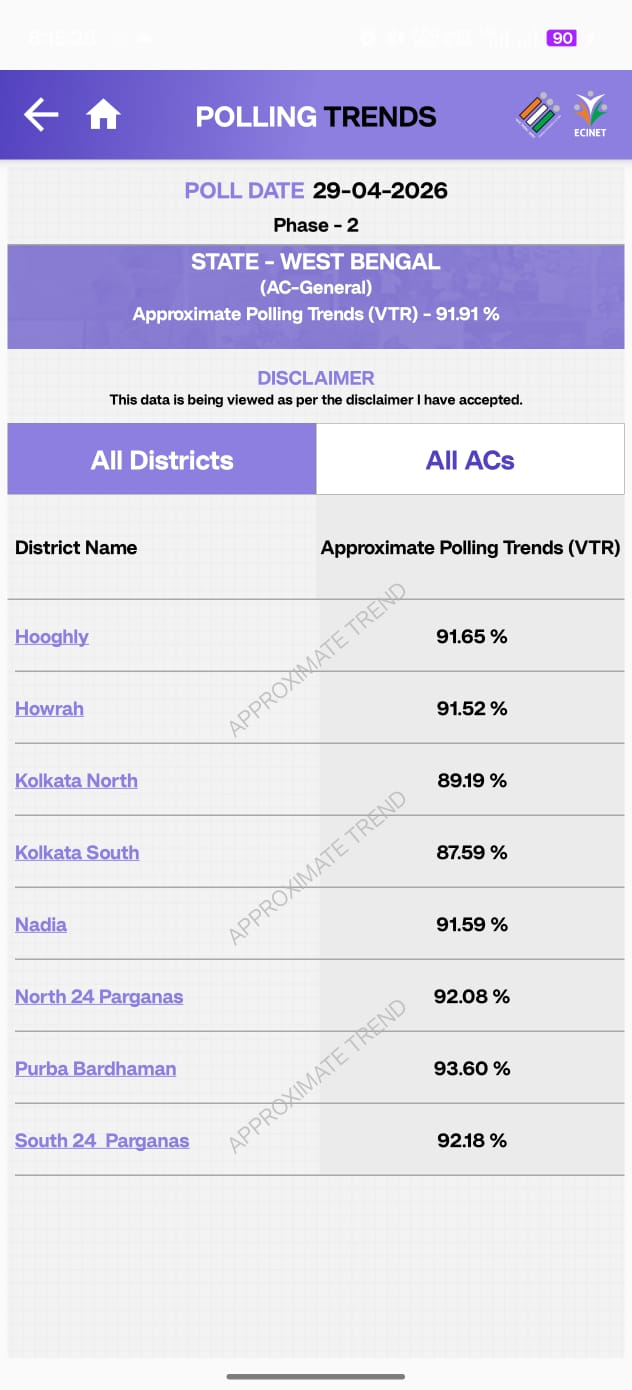
Among the seats, Haroa from the North 24 Pargana district registered the highest turnout at 97.14%, and Rajarhat Gopalpur from the same district registered the lowest at 85.10%.
Chief Minister Mamata Banerjee's Bhabanipur constituency in Kolkata recorded 85.51 per cent polling till 5 pm.
From Bhabanipur in Kolkata to Basanti in South 24 Parganas, and from Chapra in Nadia to Bally in Howrah, polling day followed Bengal's well-worn pattern -- snaking queues outside booths, sporadic skirmishes on the ground, and sharp exchanges between rival camps.
Against this backdrop, the key question is whether anti-incumbency and revisions in electoral rolls will be enough to shift the balance of power at Nabanna, the state secretariat, which is currently ruled by the Trinamool Congress (TMC).
Of the 142 constituencies that went to the polls in this phase, the ruling party had secured a dominant 123 seats in 2021, while the BJP managed 18 and the Indian Secular Front (ISF) just one.
Tension briefly escalated in the Bhabanipur Assembly segment earlier in the day as Mamata Banerjee and BJP's Suvendu Adhikari, both contesting the high-profile seat, traded barbs in the same polling area.
TMC, BJP CLAIM VICTORY
The TMC framed the high turnout as an endorsement of its welfare plank and Mamata Banerjee's continued grip over South Bengal. The party has also accused the BJP of trying to 'rig' the election by using central forces, election observers and officials.
"The BJP wants to rig this election. Polls in Bengal are usually peaceful. Is there a goonda raj here?" Mamata Banerjee said, alleging that Central Reserve Police Force (CRPF) personnel visited the homes of TMC leaders late on Tuesday night, triggering fear among party workers.
The BJP, on the other hand, read it as evidence of simmering anger over alleged corruption, recruitment scams, law-and-order issues and anti-incumbency, translating into a quiet but decisive pushback against the Mamata Banerjee government, which is eying its fourth stint in the state.
- Ends