
Still Alive works for Samay Raina, but Apoorva Mukhija makes it matter
Samay Raina's Still Alive may be his comeback story, but its most revealing moment lies in his retelling of the Apoorva Mukhija episode, where a viral clash exposes the gendered cost of speaking back.
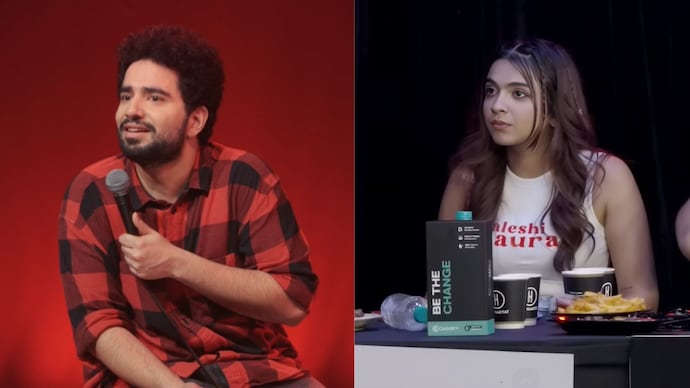

Samay Raina’s Still Alive is messy, raw and often overwhelming, a 90-minute unravelling disguised as stand-up where mental health, backlash and a self-styled “villain era” become one. It is compelling, yes, but also expected. What truly lands is a moment in the act when he talks about content creator Apoorva Mukhija, also known as The Rebel Kid. It was a moment his carefully curated “bro-comedy” universe collided with something far less controllable.
For those who came in late, the moment, in a previous episode of Samay Raina's show India’s Got Latent, was not just another viral clip. It was a rupture in the grammar of Indian bro-comedy. When a rapper took a derogatory shot at Apoorva, she did not deflect or defer. She hit back, instantly and decisively, with an equally abrasive punch. At that moment, she stopped being a panellist on a comedy show and became a mirror to the industry’s casual misogyny.
Watch the video here:
Usually, when a comedian is “cancelled”, the special that follows becomes a defensive exercise. A narrative is constructed to reclaim victimhood and reframe outrage. Samay begins there with his new video, Still Alive, but then shifts. Instead of holding the spotlight on himself, he turns it outward to illuminate Apoorva’s experience at one point.
The background of what had happened, first: On Still Alive, Samay narrated a green room backstory from the previous show. He recalled how, during a break from the fateful episode that also featured Apoorva, he discovered she had panicked and was in tears in the green room. She had self-doubt, he said, about her ability to live up to the show's nature of no-holds-barred humour.
Then the cameras rolled again, and the rapper on the show tossed a crude joke at Apoorva. That was when Samay steeled up to defend her – except she didn't need his defending. She gave it back to the rapper in his own tone. It had been the comeback punchline of the show, Samay recalled on Still Alive.
What was the rapper's insult, and what was Apoorva's comeback? If you abhor all that is vulgar, we suggest you stop here.
The rapper insulted Apoorva by asking, “V****a mein sensation khatam ho gayi hai kya?” (Has the sensation in the v****a ended?). Before Samay, as show host, could reply on Apoorva's behalf, she fired back, “Kabhi v****a dekhi hai maa se nikalne ke baad (Have you ever seen a v****a right after birth?).
The recent Still Alive special saw Samay humanising a woman the internet had flattened into a caricature for being “loud” and “rude” after that exchange. He does not merely assert that she was right. He demonstrates that her response was not a performance for attention, but a moment of exhaustion breaking through.
Rewriting the punchline
There is a quiet irony in how Samay chose to “man up”. In digital spaces, that phrase often implies doubling down or pushing further into provocation. Here, it translated into accountability and a form of allyship. By giving space to her story within his own in his new special, Samay signalled that while his experience matters, hers exposed something deeper about the ecosystem they both inhabited.
The contrast is difficult to ignore. A man survives controversy with professional consequences and the possibility of reinvention. A woman, for asserting herself, faces a far more hostile and personal backlash. The disparity is not incidental. It is structural.
Samay also reframes his audience’s gaze. By admitting he was “jealous” of her comeback punchline, he positions her as a peer rather than a prop, stripping away the lens that often reduces women in comedy to supporting roles or symbolic inclusion. It is a subtle but significant shift.
From a narrative standpoint, the backstory becomes essential. Without it, Apoorva’s comeback remains a viral moment. With it, the moment acquires weight and context. The audience is made to sit with her reality rather than scroll past it. The memory of that episode is no longer just about a sharp retort, but about the conditions that made it inevitable.
Moral of the story
Samay’s arc in Still Alive is about recalibration. Apoorva’s, however, is about resistance. While he navigated FIRs and professional setbacks, she faced a far more volatile digital environment, one that carried threats and sustained hostility. The cost of her wit was not limited to outrage. It was deeply personal.
This is what makes her role in his narrative more significant than his redemption. Samay may have built the stage, but Apoorva gave it its spine. Her refusal to remain silent after an insult, as Samay recalled it on his special, forced both the audience and the performer to confront the price of a woman asserting herself in a space designed for male comfort.
In the end, Samay’s story is about survival and return. Apoorva’s story is about cultural resistance. In a landscape driven by virality and provocation, the bravest act is not telling the most shocking joke, but refusing to become one. As Samay rebuilds, it is worth remembering who held the line when it mattered. Apoorva Mukhija did not simply endure the moment. She defined it.