
Why Gujaratis worship this Yemeni island
Ancient Indian mariners worshipped a Yemeni island and brought it back home as a deity. The island of Socotra, near East Africa, is believed to have manifested as Sikotar Mata, a sea goddess worshipped in Gujarat even today. Socotra was a vital refuge in the Arabian Sea for maritime traders, over 2,000 km from home.

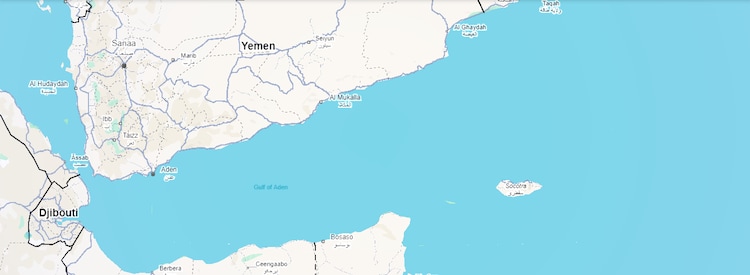
The island of Socotra is between the Gulf of Aden and the Horn of Africa in in the Arabian Sea. Sikotar Mata is also known as Dariya Ki Devi (Goddess of the Sea). (Images: Flipkart/ Unsplash)

New Delhi,UPDATED: May 1, 2026 18:00 IST
Humans have always worshipped the things that terrify them, and those that protect them. For ancient Indian seafarers, one such God was an island itself. An island, that is today governed by Yemen. For seafarers from India sailing across the Arabian Sea, it was the first sight of land after over 2,000 kilometres of sailing. It was their first refuge, a vital halt before reaching the shores of the Middle East, or venturing deeper into Africa. That island was Socotra.
The coasts of Oman, Yemen, and the Horn of Africa lie just 350 to 550 km from Socotra. But to sail those distances thousands of years ago was no small feat. Any refuge along the way was an immense relief. Socotra provided that haven. Over centuries, the spirit of this island travelled back with the sailors and took root in India as Sikotar Mata or Sakotar Ma, the sea goddess and kuldevi of Gujarat's seafaring communities.
Literature suggests that when storms raged on the open sea and death was close, seafarers remembered Sikotar Mata, also known as Dariya Ki Devi (Goddess of the Sea), and prayed for protection and safe passage.
Today, the waters around Socotra are vulnerable. The island is very close to the Bab el-Mandeb Strait, the narrow chokepoint at the southern entrance of the Red Sea. Houthi attacks on commercial shipping since late 2023 have repeatedly disrupted one of the world's busiest maritime routes, and the US and Israel's war on Iran has forced vessels to reroute around Africa, and has significantly driven up global shipping costs.
In a way, it echoes the ancient times, when every stop carried risks.
But the island whose manifestation became the deity was no ordinary island itself. Socotra, which lies about 340 km southeast of Yemen, and east of the Horn of Africa, is a crescent-shaped island and has a landscape straight out of a Gulliver's Travels. It has often been referred to as the most alien-looking place on Earth.
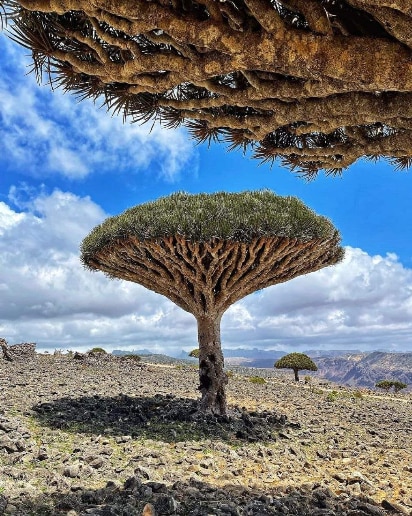
Imagine Dragon Blood trees with bright red sap oozing out of them, their umbrella-like canopies perched atop thick trunks like flying saucers balanced on elephant legs, the bizarre baobab trees, and a windswept terrain. The island also has limestone caves filled with hanging rock formations from the ceiling, creating eerie interiors. It was here that ancient mariners, including those from India, left their marks.

For seafaring communities of India's western coast, Socotra was the first reliable landfall after crossing the open sea. Fresh water was its greatest offering, which was essential for replenishing supplies before entering taxed and competitive ports further west.
Historian, archaeologist, and anthropologist, Kurush Dalal, in a conversation with India Today Digital, explained, "Once you crossed over from India, this is where you made landfall first. Fresh water was the most important thing that Socotra gave you. Also, every stop meant paying taxes, tithes. So, one wanted as fewer stops as possible."
In the age of dhows and stitched ships, this was a formidable voyage which depended almost entirely on the seasonal monsoon winds.
Let's see how these ancient mariners carried the island back home with them, not as stone or soil, but as Sikotar Mata, who, till today, is worshipped as the sea goddess of Gujarat.
COMMUNITIES OF THE WESTERN COAST WHO MASTERED THE ARABIAN SEA, INHABITED ON SOCOTRA ISLAND
Indian seafarers who reached Socotra, the Middle East, and East Africa hailed primarily from India's western coast.
Gujarati traders and sailors from Kutch and regions like Ghogha dominated later medieval and early modern trade, keeping routes to the Red Sea and Persian Gulf alive long after Indian communities scaled back their trade in the region.
They traded everything, from textiles and spices to onions — a major Indian export to ports in Persia (Iran), Mesopotamia (Iraq), Majan (Oman), and beyond.
The communities also included the Kolis, who are fishermen and seafarers native to both Gujarat and Maharashtra. Other seafaring communities from along the Konkan coast included Kharvas, Vaghers, Mangelas, Gabits, Bhandaris, and many more.
These groups supplied crews for voyages and naval fleets.
"There is a misconception that it was only the Gujaratis who were seafarers. It was just one community. There were a large number of seafarers. From the Pakistan coast down to Maharashtra, and maybe even further down. The Kolis and the Machis of Gujarat and Maharashtra were accomplished seamen, and they were definitely part of the trade. But there were many others," Dalal explained.
Today, evidence of their presence on Socotra spans centuries.
A 1st-century CE Greek sailor's handbook on Indian Ocean navigation — the Periplus of the Erythraean Sea — notes that Indians were already living on Socotra. The most spectacular proof comes from Hoq Cave, where over 200 inscriptions in Brahmi script — the ancestor of most modern Indian scripts, with roots possibly influenced by Semitic writing systems — appear alongside boat drawings and ritual marks.
Later Gujarati inscriptions, including 17th–18th century gravestones and references to the island as "Sri Sikotara", confirm continued visits by Gujarati mariners.
These facts were archived by Kurush Dalal in an article on Live History India (LHI), a digital platform on history and culture.
Dalal, in his article on LHI, wrote that some Indians lived on Socotra temporarily, and others visited it enroute to East Africa or Yemen, to pay obeisance to cave shrines.
HOW YEMEN'S SOCOTRA ISLAND BECAME A GODDESS
Speaking to India Today Digital, Dalal said, "Socotra Island itself is the deity. A manifestation of the island is what is Sikotar Mata."
Sailors experienced Socotra as both a fearful, isolated place and a lifesaving refuge. They propitiated its spirit with toy ships offered into the waters, seeking safe passage.
Back home, this spirit took form as Sikotar Mata, or Sikotari Mata. She is the protector of ships, sailors, and voyages, and is often depicted with boat motifs and worshipped as a form of Shakti.
Temples to her thrive in Gujarat today, especially in Kutch and coastal areas like Ralej near Khambhat, where a tall copper lamp is kept as a symbol that once guided lost ships safely to shore. "The cult remains strongest there, kept alive by Gujarati traders," said Dalal.
Also revered as Vahanvati Mata, she is depicted seated on a goat placed inside a ship or with one foot resting on a vessel. Devotees traditionally offer miniature toy boats, coconuts, and flowers to her before setting sail.
Notably, Sikotar Mata's worship involved rituals before the journey began, with families, particularly wives of seafarers, praying for safe returns. Dalal emphasised, "Their wives would worship the deity so that the husbands would have a safe journey. The worship was to give the seamen a sea passage."
In 2022, during the review of the National Maritime Heritage Complex at Lothal, Gujarat, Prime Minister Narendra Modi also highlighted this heritage. "A temple of Sikotar Mata was unearthed during excavations near Vadnagar," Modi said, refering to the town he was born and raised in.
FAITH IN SIKOTAR MATA SURVIVED PORTUGUESE HURDLES
People's connection to Sikotar Mata has endured for centuries despite challenges.
When the Portuguese arrived in the Konkan and Goa from the early 16th century, maritime trade routes were reshaped through customs duties, naval controls, and the Cartaz pass system, under which vessels were required to purchase passes, use approved routes, and risk interception if they sailed outside Portuguese authority.
This increased costs, reduced flexibility, and disrupted older patterns of direct movement across the Arabian Sea. These measures affected established sailing networks, but did not erase goddess worship tied to the sea.
"Devotion to Sikotar Mata survived, remaining the strongest in Gujarat and Kutch, where maritime communities continued to invoke her protection," Kurush Dalal said.
Nau Devi, a shrine tradition in Goa associated with a ship goddess, reflects a similar coastal belief in maritime guardianship, but is a distinct local tradition from Sikotar Mata.
Sikotar Mata represents the grit and prime of ancient Indian mariners — their courage in crossing vast seas, their ingenuity in trade, and their ability to bring home the sacred from distant shores. The deity is a direct link between India's western shores and Yemen's very mystical island.
- Ends