
Did a tigress kill villager in MP's Shivpuri? Rare man-animal conflict in area explained
Forest officials await forensics confirmation even as the tigress, following protests, has been put in an enclosure in the adjacent Madhav National Park
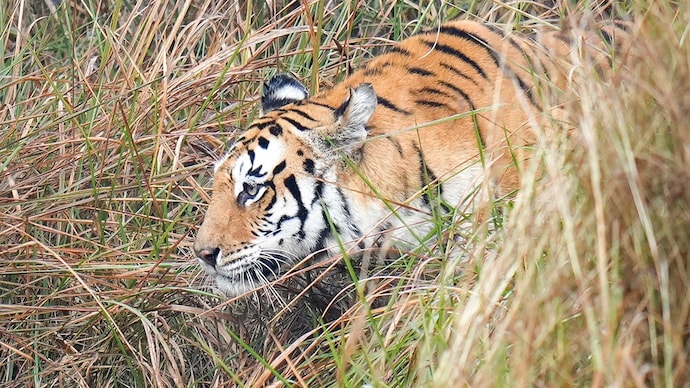

 Madhya Pradesh has reported the death of a man in a suspected encounter with a tiger, but in a geography not known so far to have human-animal conflicts. The 50-year-old was killed in the attack on April 24 near Narwar in Shivpuri district. The area is in the vicinity of the Madhav National Park, recently accorded tiger reserve status.
Sarwan, a tribal from Airawan village, was bathing on the banks of a water body when he was reportedly dragged away by the wild cat. Villagers found his partly-eaten body. They said a tigress, coined the name ‘MT 6’ by the Madhav National Park management, had been seen some 200 metres from the spot where the body lay. The animal had been reported in the area for some weeks.
On April 25, protesting villagers erected a blockade on the Shivpuri-Narwar road, demanding that the tigress be captured. Two days on, the forest department tranquilised the animal and put her in a fenced enclosure at the national park.
The forest department is yet to confirm if this was a tiger kill. “We are awaiting the forensics report to ascertain if the villager was killed by a tiger; and if so, by which one specifically,” said L. Krishnamurthy, additional principal chief conservator of forests, Madhya Pradesh.
The forests around Shivpuri were a popular animal hunting ground during the Gwalior State days. Some of the biggest tigers hunted in India came from these forests. However, unlike other areas of the country, such as the Terai, Bastar and Sundarbans, man-eating tigers were not reported in the forests of Shivpuri.
“There are written records of wildlife from the Gwalior State days, but there is no major mention of human-animal conflict except probably one account of a British officer arriving to hunt a tiger that had killed a man,” says Neelesh Karkare, a Gwalior-based history researcher. Similar views are held by Lieutenant General Dushyant Chauhan (retired), who spent his childhood years in Shivpuri as his father was posted there as a police officer.
What then could have changed now? The Madhav National Park had lost all its tigers, but recently got tiger reserve status. The Dehradun-based Wildlife Institute of India studied the habitat and determined a carrying capacity of five tigers in the park. Three tigers were brought to the reserve first, followed by two more, including tigress MT 6, from the Bandhavgarh National Park. Two cubs have been born to these relocated tigers.
The Madhav National Park is spread over 350 sq km, with many villages located around it. “Although the core area doesn’t have villages, some 50-60 villages lie close to the park’s boundary,” said Shubhranjan Sen, principal chief conservator of forests, Madhya Pradesh.
Two highways pass through the reserve. Shivpuri town, with a population of around 300,000, is barely 6 km from the national park. With such a big human settlement in the periphery, conflict with animals is not something easy to manage, say experts. They add that the forests are historically tiger-bearing habitats and closer monitoring is essential to ensure tigers and humans do not cross paths very often.
Subscribe to India Today Magazine