
How fashion entrepreneur Manish Tripathi inspired India Post's Axiom Mission stamp
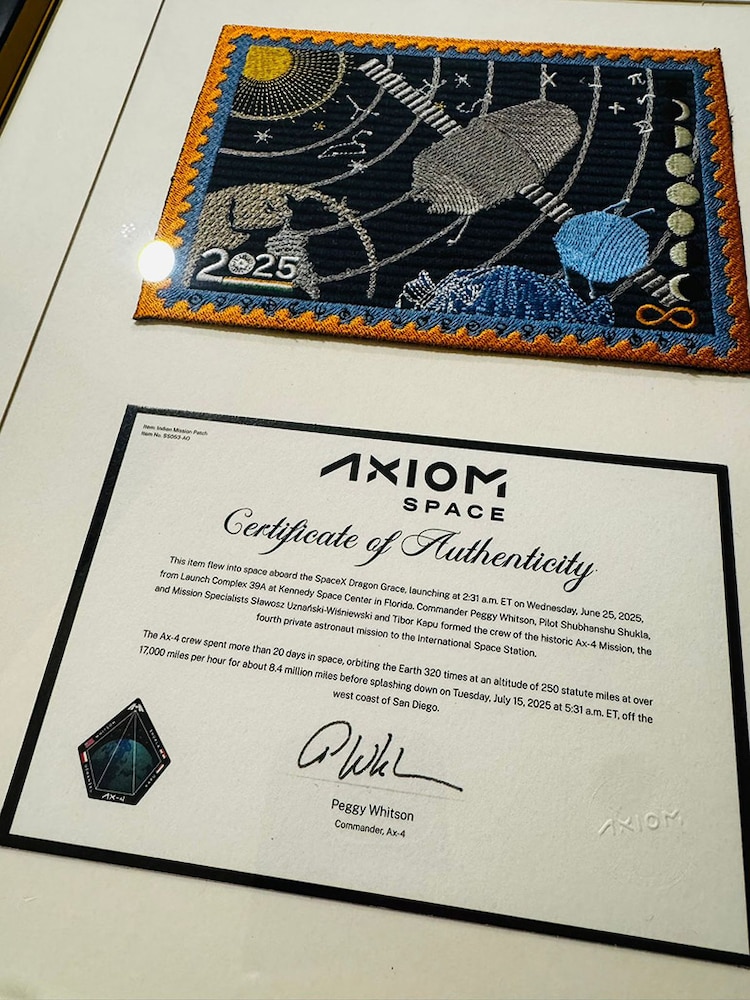
The patch was originally developed in consultation with astronaut Shubhanshu Shukla for India's participation in Axiom Mission 4

UPDATED: Apr 27, 2026 18:52 IST
Edited By: Ashish Mukherjee
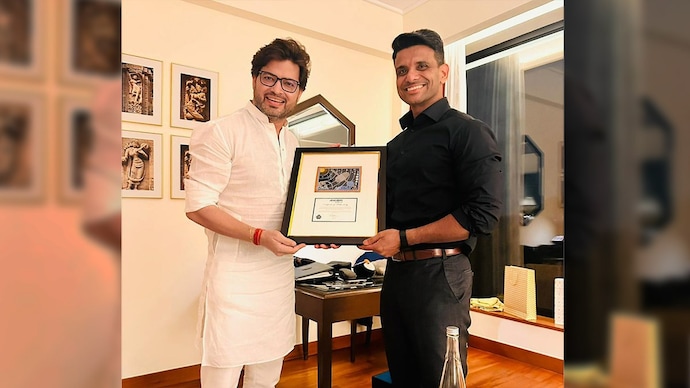
 India Post, the country’s postal department, has issued a commemorative stamp inspired by India’s Axiom Mission 4 patch, translating a piece of space insignia into a lasting public artefact. The stamp, now in circulation, draws directly from a patch designed by fashion entrepreneur Manish Tripathi, founder of menswear label aantarDESI.
The release places a small-format visual—typically worn on a space suit—within the country’s formal archival medium. Postal authorities have described the stamp as a record of India’s growing footprint in human spaceflight while also marking an intersection of design, science and state storytelling.
The patch was originally developed in consultation with astronaut Shubhanshu Shukla for India’s participation in the 2025 Axiom Mission. While mission patches are standard in international space programmes, their translation into official stamps is less common.
In this case, the original design has largely been retained. That continuity, Tripathi says, preserves intent. “A stamp is not just communication; it’s a record,” he noted in an interaction with INDIA TODAY, adding that the design was meant to endure beyond the Axiom Mission’s immediate timeline.
The patch compresses multiple layers of symbolism into a compact frame. Tripathi had designed the patch in a stamp-like silhouette. A fingerprint motif signals a unique national imprint. The composition subtly forms an astronaut’s visor, with Earth visible within it.
Astronomical references draw from India’s historical knowledge systems, particularly the Pi, attributed to Indian scientist Aryabhata 170 years ago, which is the basis of much that we understand about the universe. “The patch has culture, story, spirituality. It is the pride of India,” says Tripathi.
The design process itself was notably low-tech. The patch was sketched by hand over 35 days, using basic stationery, before being digitised for execution. “I wanted the thinking to remain human,” he says.
Tripathi, a graduate of the National Institute of Fashion Technology (NIFT), has worked across bespoke fashion, institutional commissions and cultural projects. He claims his work is purpose-led rather than portfolio-driven.
Raised in a village in Uttar Pradesh’s Ambedkar Nagar district, he describes his early years as distant from formal design exposure. Participation in school cultural activities, he says, shaped his instinct for visual organisation long before he understood it as a discipline.
Tripathi’s entry into design education required persuading his family, particularly his father, that it could be a viable career. He went on to rank among the top candidates nationally at NIFT and began working independently. During the COVID pandemic, his practice shifted towards livelihood generation. Working with local administrations, Tripathi and his team trained rural women, many of them returning migrants, to produce cloth masks.
The initiative, according to him, engaged around 7,000 women and combined production with distribution models that encouraged both purchase and donation. It culminated in a large-scale public installation in Uttar Pradesh in 2021.
While limited in scale, the project reflected a broader repositioning of design as an economic tool. Tripathi was also involved in designing the attire for the deity at the Ram Temple in Ayodhya. The project extended beyond costume design into textile integration of Indian handicrafts.
He proposed sourcing fabrics from different regions of India and incorporating them into daily temple attire, effectively turning ritual practice into a rotating showcase of handloom traditions. Variations of this approach, he says, are now being adopted across multiple temples, bringing handcrafted textiles into regular use.
The underlying objective remains linking cultural visibility with artisan livelihoods. “If design doesn’t reach people, it remains incomplete,” says Tripathi.
For now, the stamp circulates as both functional currency and symbolic document. It carries, in miniature, a layered account of India’s scientific ambitions, its cultural narratives and a designer’s attempt to bridge the two without reducing either to ornament.
Subscribe to India Today Magazine
- Ends