
How Great Nicobar is emerging as India's strategic answer to China's maritime reach
The Great Nicobar Island's location gives India unique advantage in monitoring maritime activity as China steadily expands footprint in the Indian Ocean
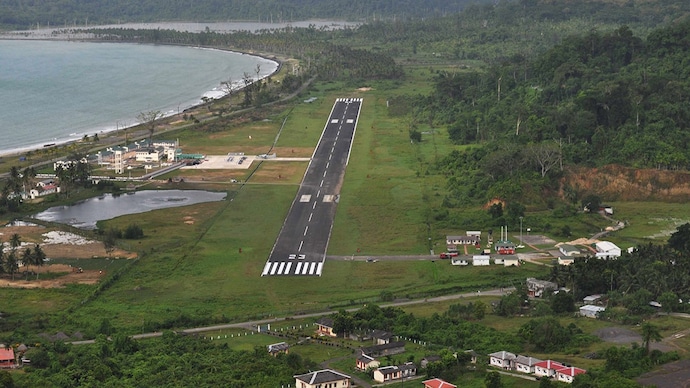

 The strategic and ecological future of the Great Nicobar Island has once again entered the national spotlight after Congress leader Rahul Gandhi flagged concerns over the scale and nature of the Rs 81,000 crore infrastructure development underway there, prompting the Union government to strongly defend the project as vital for India’s long-term maritime and national security.
At the heart of the debate lies the ambitious Great Nicobar project— envisioned as a transhipment port, airport, tourism hub and strategic logistics centre—which the government argues is essential for strengthening India’s footprint in the Indo-Pacific amidst growing Chinese activity in the Indian Ocean Region (IOR).
Government officials and strategic experts maintain that the Andaman and Nicobar archipelago, stretching nearly 800 km across the Bay of Bengal, occupies one of the world’s most consequential maritime geographies. Located close to key global shipping arteries, the island chain overlooks crucial sea lines of communication linking the Indian Ocean with the Pacific through the Strait of Malacca.
The southernmost point of the archipelago, Great Nicobar, sits near the strategically important Six Degree Channel, through which a significant portion of global trade and energy shipments pass annually. Nearly 70,000 of the 120,000 ships transiting the Indian Ocean move through the Malacca Strait and adjacent channels near the Andaman and Nicobar Islands.
Security analysts argue that this location gives India a unique strategic advantage in monitoring maritime activity, especially as China steadily expands its naval footprint across the IOR through investments, dual-use ports and military partnerships with regional states.
India’s only integrated tri-service theatre command—the Andaman and Nicobar Command—was established in 2001 precisely to leverage this strategic geography. Military infrastructure in the islands has since seen gradual but significant upgrades.
A central pillar of India’s presence in Great Nicobar is INS Baaz, the country’s southernmost military air station located at Campbell Bay. Operating under the Andaman and Nicobar Command, INS Baaz serves as a forward surveillance and reconnaissance hub for monitoring the eastern Indian Ocean and approaches to the Malacca Strait. The Indian Navy has plans to expand its existing airfield INS Baaz and create a naval jetty on the Great Nicobar Island, but the proposal is yet to be approved by authorities.
Although not a major warship base, INS Baaz enables the navy to operate Dornier maritime surveillance aircraft and helicopters for reconnaissance, logistics and maritime patrol missions. Officials say the ongoing runway extension project is intended to eventually support larger and longer-range aircraft, such as the P-8I maritime patrol aircraft, significantly enhancing India’s maritime domain awareness.
While Great Nicobar itself does not permanently host major frontline warships, it forms a critical component of the broader Andaman and Nicobar Command operational grid. Naval vessels assigned under this command routinely operate in the waters around the island group. These include missile corvettes such as the Kora-class, offshore patrol vessels (OPVs), fast attack craft (FACs), amphibious warfare ships, landing craft units (LCUs), and patrol craft of classes such as Bangaram, Car Nicobar and Trinkat. These assets undertake maritime patrol, sea control, surveillance, area denial and surface warfare missions across the eastern Indian Ocean, often operating in coordination with air assets from INS Baaz.
Over the past few years, India has accelerated military infrastructure expansion across the islands. Naval air stations at Shibpur and Campbell Bay are undergoing runway extensions while surveillance systems, jetties, logistics facilities and troop accommodations are being upgraded. Precision approach radar systems and integrated underwater harbour defence systems have also been commissioned to improve operational readiness.
Military sources indicate that the Andaman and Nicobar Command currently operates more than 30 naval vessels, including offshore patrol vessels, missile corvettes, amphibious ships, fast attack craft and landing craft units. Air assets include helicopters, Dornier surveillance aircraft and fighter aircraft detachments, with plans for expanded deployment of special forces and maritime strike capabilities.
Strategic experts believe these deployments are directly linked to concerns over increasing Chinese naval movements in the Indian Ocean and Beijing’s growing strategic partnerships around India’s maritime periphery.
Former Indian Navy chief Admiral Arun Prakash (retd), who earlier became the first commander-in-chief of the Andaman and Nicobar Command, said that when India constituted this command in the post-Kargil war spurt of security reforms, it was perceived by China as a step towards establishing military or naval dominance in the Bay of Bengal and approaches to the Malacca Strait.
“This led Chinese president Hu Jintao to declare his apprehensions over China’s ‘Malacca dilemma’ and call for mitigating strategies to protect its seaborne trade. While the Andaman and Nicobar Command has stagnated, Hu Jintao’s forebodings not only led to China acquiring ‘bases or places’ in the Indian Ocean but to the spectacular growth of the PLA Navy,” Admiral Prakash told INDIA TODAY.
Admiral Prakash believes the archipelago’s “blue economy” has tremendous potential. Its exclusive economic zone (EEZ) adds 660,000 sq km (about 30 per cent) to India’s total EEZ. Waters of the Andaman Sea abound in marine life and comprise a rich “protein repository” of edible fish. Possibly, a cornucopia of hydrocarbons, polymetallic nodules and rare-earth elements awaits discovery and exploitation on the seabed. All this potential needs to be safeguarded.
“The crux of Andaman and Nicobar’s strategic importance lies in the ability of island-based forces to monitor and, if required, interdict trade and energy shipping lanes traversing the Bay of Bengal. Herein lies China’s vulnerability: the sea lanes connecting Shanghai, for example, with both the Red Sea and the Persian Gulf are over 11,000 km long, and a full one-fifth or 2000 km crosses waters of the Bay of Bengal,” said Admiral Prakash.
He added that the Andaman and Nicobar Islands offer opportunities as well as challenges. They can be a springboard for India to project power, exert influence or strike bonds of friendship in its eastern neighbourhood. And yet, they could also be lucrative objects of desire for any country wishing to dominate the Bay of Bengal.
Meanwhile, security officials remain wary of developments on Myanmar’s Great Coco Island, where satellite imagery has revealed expanded military infrastructure near facilities long suspected of hosting Chinese surveillance activity.
At the same time, the Indian government insists that the Great Nicobar project is not solely military in character. Officials describe it as a strategic national initiative integrating economic growth, logistics, tourism and security objectives.
A key Indian Coast Guard official maintained that India does not have control and privileges over the Andaman and Nicobar waters similar to one enjoyed by an archipelagic state as defined in the UN Convention on the Law of the Sea (UNCLOS). India did make a bid to secure such status during the preparatory discussions at the third Law of the Sea conference, but didn’t succeed. Nevertheless, ships passing through the EEZ in the Andaman Sea can be subjected to environmental protection laws.
The official thinks India hasn’t sufficiently leveraged the strategic location of these islands as there have been divergent perspectives concerning protecting security interests on the one hand and the untapped potential for tourism and trade on the other. In the 1980s and 1990s, the biggest challenge was poaching by big foreign fishing trawlers, which has been eliminated by the strong Coast Guard presence. India’s immediate strategic interests are concerned with the over 90,000 ships transiting every year south of the Andaman and Nicobar waters.
At the same time, the official pointed out that the Kra Canal project, through Thailand as an alternative to the Malacca Strait, would significantly change these dynamics as it would have huge implications for maritime safety and security in the Andaman Sea. Over 200 ships pass through the Malacca Strait every day. If the Kra channel becomes a reality, a huge amount of shipping traffic would pass through the waters of the Andaman and Nicobar Islands. There would be opportunities to exercise better control over critical maritime trade and also a manifold increase in maritime safety challenges and even greater threat to the marine environment.
Naval expert Rear Admiral Sudarshan Shrikhande (retd), former head of the Naval Intelligence and Foreign Cooperation wing in the ministry of defence, felt India often underestimates the strategic significance of the Andaman and Nicobar and Lakshadweep Island chains, despite their advantages being comparable to the island chains China relies upon in the Indo-Pacific. Unlike Beijing’s contested maritime claims, he noted, India’s island territories are sovereign and internationally recognised, giving New Delhi a legitimate strategic foothold across critical sea lanes.
Rear Admiral Shrikhande argued that these islands should be viewed as integral to India’s broader maritime deterrence framework, where integrated tri-service military capabilities—supported by strong mainland logistics and infrastructure—can significantly enhance India’s ability to project power, secure sea lanes and respond rapidly to regional threats.
However, environmental concerns remain intense. Critics, including Rahul Gandhi, have questioned the ecological impact of large-scale construction in one of India’s most fragile island ecosystems, warning about deforestation, habitat disruption and threats to indigenous communities and biodiversity.
Strategic analysts acknowledge those concerns but argue that environmental safeguards and strategic imperatives must proceed simultaneously. Captain Sarabjeet S. Parmar, a retired Indian Navy officer and distinguished fellow at the Council for Strategic and Defence Research and the Australia India Institute, said the Andaman and Nicobar Islands have deep-sea waters, which allow bigger ships to berth, and can easily be used to house warships as well.
“The Andaman and Nicobar archipelago is no longer a peripheral outpost—it is a strategic fulcrum in India’s Indo-Pacific calculus. The calibrated basing of additional naval assets and the commissioning of forward air facilities at Diglipur in the north and Campbell Bay in the south significantly enhance maritime domain awareness, operational reach and response capability. These installations, operating in concert with the naval air station at Port Blair and the air force base at Car Nicobar, create a layered surveillance and deterrence grid astride critical sea lanes,” he said.
Government officials maintain that every major infrastructure decision in the islands is being calibrated against ecological considerations while keeping national security requirements at the forefront. For India, the stakes are increasingly geopolitical. As strategic competition intensifies across the Indo-Pacific, Great Nicobar is rapidly emerging as one of India’s most consequential maritime frontiers.
Subscribe to India Today Magazine