
How Tamil Nadu's record 85% voter turnout masks a measured reality
Here's the reason analysts caution against reading the turnout as a sudden spike in voter participation or strong anti-incumbency
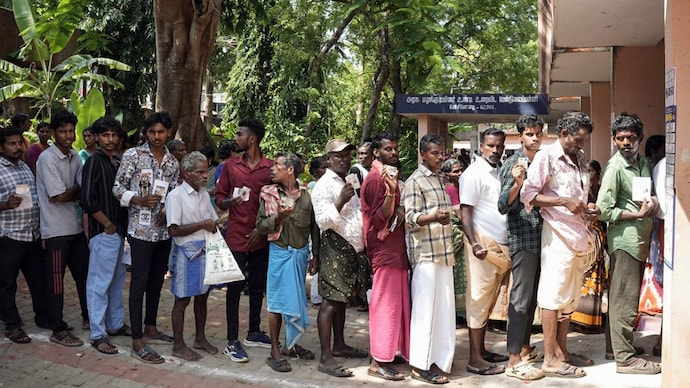

 Voting for the Tamil Nadu assembly election last week produced a striking headline: around 85 per cent turnout, the highest in the state’s electoral history. A statistic like this would suggest a dramatic expansion in democratic participation, a surge of voters responding to a high-stakes contest.
Actor-politician Vijay, whose Tamizhaga Vetri Kazhagam (TVK) debuted in this election, described the turnout as “unprecedented”, stating that women and youth who had earlier stayed away from politics were now engaging with it.
But a closer reading of the data tells a more measured story. A comparison with recent elections shows that while the turnout has reached a record high, the increase in votes polled is the lowest in the past 15 years. That contrast sits at the heart of this election’s analytical puzzle.
The key lies in the denominator. Ahead of elections, the Election Commission carried out a Special Intensive Revision (SIR) of voter rolls, resulting in a significant contraction of the electorate. The total electorate fell from roughly 62.9 million in 2021 to about 57.3 million in 2026, down by around 5.6 million names. Some estimates placed the net deletions after accounting for addition of new voters at 6 to 6.7 million.
The polling turnout rose sharply against this reduced base. However, the numerator, that is the number of people who voted, tells a different story. In 2021, about 46.3 million voters cast their ballots. In 2026, that number rose to approximately 48.5 million. This is a genuine increase, but it is modest relative to the size of the electorate and broadly consistent with what one would expect from natural population growth over five years.
The interaction between these two movements explains the headline. A relatively small increase in actual voters combined with a large reduction in the electorate produces a disproportionately high turnout percentage.
A comparison with previous elections reinforces this reading. The rate of increase in votes polled has steadily declined over recent cycles, falling from double-digit growth to around 5.5 per cent in 2026, the lowest in over a decade. This suggests that participation is slowing in relative terms even as turnout percentages rise.
Placed in a historical context, the jump becomes even more striking. Tamil Nadu’s turnout has typically ranged between 60 per cent and 75 per cent, with assembly elections occasionally pushing into the high-70s. There has been a gradual upward drift over time, but nothing that anticipates a leap into the mid-80s in a single cycle. So, the 2026 spike aligns more with the contraction of the electorate than with any comparable surge in voter mobilisation.
None of this is to suggest this election lacked intensity. On the ground, Tamil Nadu’s characteristic style of electioneering was fully visible. Party machineries operated with precision: booth committees tracking voters, local organisers ensuring turnout street by street, and campaigns blending welfare messaging with targeted outreach. From dense urban neighbourhoods to rural clusters, mobilisation networks were active.
But observers caution against reading the turnout as evidence of a sudden expansion in voter participation. “Vijay is both wrong in claiming the voter turnout as unprecedented and the political engagement of women and youth as something new in Tamil Nadu politics,” said an analyst. “Tamil Nadu has a long history of political engagement across women and youth, especially in anti Hindi agitations.”
The aggregate data offers a more restrained picture. The increase in actual voters remains limited and the growth in votes polled is the lowest in recent election cycles. The gap between perception and numbers suggests that what appears as a surge may, in significant part, be the result of a more efficient mobilisation within a smaller electorate, rather than a dramatic expansion of the voting base.
The gender data further supports continuity. Women recorded a slightly higher turnout than men—around 85 per cent compared to 83 per cent—but this pattern has been visible in recent elections as well. Tamil Nadu’s welfare-driven politics has long engaged with women as a central constituency, and their participation has remained consistently high.
Similarly, while there are indications of improved participation in urban areas, the aggregate numbers do not point to a large influx of previously disengaged voters. In some constituencies, the number of votes polled has remained broadly stable even as turnout percentages have surged.
For political interpretation, this matters because a high turnout is typically read as a sign of anti-incumbency. But when the electorate itself has changed significantly, that signal becomes less reliable.
For political parties, the implications are subtle. Mobilisation in Tamil Nadu has been about expanding the pool of voters while ensuring that core supporters turn out. In a context where the pool itself has contracted, the emphasis shifts towards maximising turnout within a smaller base. The difference is not immediately visible in percentages, but it changes how electoral strength is built and measured.
For analysts, the lesson is clearer. Comparisons with previous elections must now account for both absolute votes and electorate size. The 2021 and 2026 elections are not directly comparable in percentage terms without adjusting for the change in the denominator. A rise from the low-70s to the mid-80s suggests a dramatic shift only if the underlying electorate remains constant. In this case, it did not.
None of this diminishes the significance of the election itself. Tamil Nadu continues to exhibit high levels of participation among registered voters, and its electoral processes remain deeply embedded in political culture. Yet the 2026 turnout is best understood as the result of a reduced electorate, modest growth in actual voters and the slowest expansion in votes polled in over a decade. The figure is historic. The shift beneath it is more measured.
Subscribe to India Today Magazine