
Samrat Choudhary vs Tejashwi: How Bihar battlelines are getting personal
The acrimonious trust vote debate in the legislative assembly was as much a contest for ownership of Nitish Kumar's political legacy
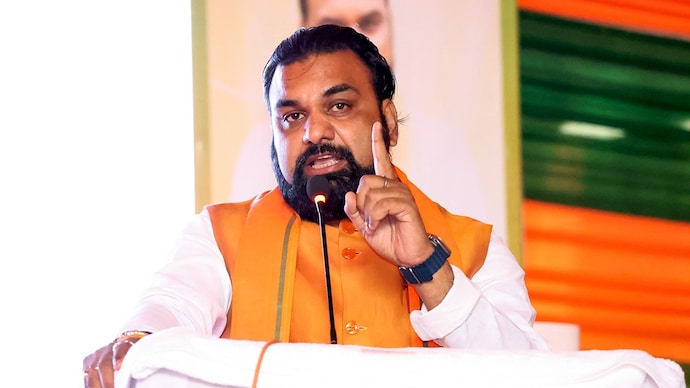

 Bihar chief minister Samrat Choudhary securing the vote of confidence in the legislative assembly on April 24 was a preordained outcome. With the National Democratic Alliance (NDA) commanding an unassailable 201 MLAs in the 243-member House, the vote was merely the formal ratification of a transition already engineered within the ruling coalition.
Yet, if the arithmetic was predictable, the politics around it was anything but that. The debate preceding the confidence motion offered a glimpse of what is likely to become Bihar’s central political theme: a pitched battle between Choudhary and Rashtriya Janata Dal (RJD) leader Tejashwi Yadav for ownership of Nitish Kumar’s legacy.
Opening the Opposition’s attack, Tejashwi questioned both the necessity and the legitimacy of the special session of the assembly. His argument: had the BJP declared earlier that it would install its own chief minister, the current situation might have been avoided. Invoking the Janata Dal (United)’s 2025 poll campaign slogan—‘2025 to 30, phir se Nitish’—he framed the leadership change as a betrayal of electoral messaging, remarking that the BJP had effectively “finished Nitish ji within that period”.
Tejashwi’s sharper framing lay in his “selected versus elected” distinction. By portraying Choudhary as a product of the NDA’s internal manoeuvring, he attempted to cast a shadow over the transition’s democratic legitimacy. The line sought to not merely criticise the BJP but position Tejashwi as the custodian of electoral morality in contrast to what he implied as backroom politics.
Tejashwi, who is leader of the Opposition in the assembly, extended this critique into governance, highlighting what he described as chronic instability—“the fifth government in five years”—and questioning whether such churn had any parallel elsewhere in the country. But his most-pointed intervention came when he looped in the BJP’s own ranks. By naming senior leaders such as Prem Kumar, Nand Kishore Yadav, Giriraj Singh and Ashwini Choubey, he suggested that the party’s “original” leadership had been marginalised—an attempt to provoke disquiet in the ruling benches.
The debate went beyond institutional critique. It quickly acquired a personal edge, signalling the tenor of the rivalry ahead. Tejashwi invoked Choudhary’s familial and political background—at one point referencing his father—to question both lineage and legitimacy. The insinuation: Choudhary’s rise to chief ministership was orchestrated, not organic.
Choudhary’s response was equally sharp, and at times more cutting. He underlined that no one had “removed” Nitish, and that the transition was a voluntary handover—a veteran chief minister passing the baton to the next generation. In doing so, Choudhary sought to anchor himself firmly within Nitish’s political continuum.
He countered the “selected versus elected” charge with a broader conception of the election mandate, arguing that the legitimacy of the chief minister’s office ultimately flows from the people of Bihar. It was a rhetorical pivot—from procedural legitimacy to popular sovereignty.
But it was in the personal exchanges that the debate revealed its deeper fault lines. Choudhary alluded—without naming anyone—to allegations about disrespect within Tejashwi’s own family, remarking that some individuals are “known to disrespect their own sisters”. The comment marked a significant escalation, transforming what began as political critique into a deeply personal confrontation.
This sharpness signals the contours of a rivalry that is likely to define Bihar’s politics in the near term. Both leaders are, in different ways, attempting to inherit Nitish’s political space. Tejashwi, as the principal Opposition face, is positioning himself as the natural successor to Bihar’s social justice narrative. Choudhary, meanwhile, is attempting to fuse that legacy with the BJP’s organisational and ideological framework, presenting himself as both inheritor and moderniser.
Beyond the rhetoric, Choudhary used his reply to outline a governance agenda that he said would carry forward Nitish’s developmental focus. He spoke about generating 10 million jobs, boosting private investment and strengthening infrastructure in health and education. He also announced tighter administrative oversight, with the chief minister’s office set to directly monitor functioning at the block, circle and police station levels.
On social representation, the chief minister pushed back against the Opposition’s demand for an OBC sub-quota within women’s reservation by citing existing representation data. On law and order, particularly women’s safety, he adopted a hard line, warning that offenders would be pursued relentlessly.
Supporting the narrative, deputy chief minister Vijay Kumar Chaudhary of the JD(U) described the transition as emblematic of a “second generation” of NDA leadership in Bihar—a rare instance, he argued, of power being relinquished smoothly rather than contested bitterly.
In strictly legislative terms, the outcome was never in doubt. The NDA’s overwhelming majority ensured that the confidence motion passed without the need for a formal division. However, the debate made clear that the real contest lies ahead. And it won’t be about numbers but rather about narrative, legitimacy and legacy. In that unfolding contest, Choudhary and Tejashwi have already drawn their sharp and personal lines.
Subscribe to India Today Magazine