
West Bengal voted big, but which way will the mandate tilt?
Multiple exit polls, high voter turnout and a fiery BJP campaign suggest a regime change. But don't forget Mamata's enduring appeal and 'identity' narrative
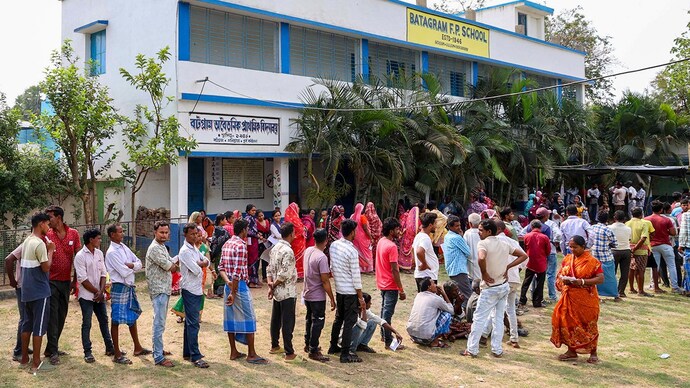

 West Bengal has, in the words of the Election Commission (EC) and poll pundits, witnessed unprecedented voter participation in this assembly election. With 91.66 per cent voting in phase 2 on April 29 and 93.19 per cent in phase 1 on April 23, the total turnout stands at 92.47 per cent—the highest in the state’s history.
Considering the previous high of 84.72 per cent in 2011, when power transferred after 34 years of Left Front rule to Mamata Banerjee’s Trinamool Congress (TMC), the sharp spike in turnout in 2026 fundamentally alters how this mandate must be read. At the same time, the high turnout has not helped exit pollsters clarify the outcome. If anything, it has only deepened the uncertainty till May 4, counting day.
Exit polls beaming on TV news since the evening of April 29 are sharply divided. Peoples Pulse, one of them, projects a sweeping victory for the TMC with 177-187 seats in the 294-member legislative assembly whereas agencies such as Matrize, JVC, P-Marq and Poll Diary place the BJP ahead—their estimates ranging from 138 seats to 175 seats for the party.
The wide range of seat tallies predicted reflects not just a statistical variation but some deeper political ambiguity. On the ground, the contest was far more competitive than what forecasts of a straightforward BJP surge suggest. There was undoubtedly visible dissatisfaction with TMC’s governance both at the state and local levels, besides allegations of corruption. These concerns gave the BJP a clear narrative, its campaign consistently framing this election as a referendum on what it termed as Mamata’s misgovernance and the TMC’s entrenched patronage networks.
The BJP’s organisational groundwork was methodical. Since the reverses suffered in the 2024 Lok Sabha elections, it invested heavily in booth-level mobilisation, cadre expansion and micro-targeting. The messaging sharpened further after the Bihar election victory for the BJP-led National Democratic Alliance (NDA) in late 2025, as Prime Minister Narendra Modi invoked the symbolism of the Ganga flowing from Bihar to Bengal.
Within BJP circles in Bengal, this was a signal that the state was the party’s central political objective in 2026. In fact, in one of his last election rallies in Bengal, Modi said he would return to participate in the swearing-in ceremony of a new government.
Senior BJP leaders projected the same confidence throughout the campaign. Union home minister Amit Shah claimed after the first phase of polling, covering 152 seats, that the BJP could win over 110 seats and go on to form the next government.
BJP heavyweight Suvendu Adhikari, who was pitched against Mamata from the Bhabanipur seat, went further, asserting that his party would cross 180 seats. “Exit polls are alright, but I am giving you an exit poll from the ground. The BJP is winning 180-plus seats and will comfortably form the government,” the outgoing Leader of the Opposition said on April 29.
And yet, the electoral mood hasn’t been unidirectional. Despite anti-incumbency, Mamata went into this election with a distinct advantage of perception. For a significant section of voters, she remains the strongest Bengali voice in national politics. That identity factor is not symbolic; it has consistently beefed up her political endurance.
The TMC’s internal assessment also reflects this confidence. Party leaders argue that the BJP’s aggressive pitch around “infiltrators” and the 6.6 million voter deletions under Special Intensive Revision (SIR) of the electoral rolls have backfired. According to them, wide sections of voters, particularly the minorities, migrants and poorer Bengali-speaking communities, interpreted the SIR deletions as targeted disenfranchisement.
The numbers involved are indeed substantial. Over 1.26 million names were deleted in North 24 Parganas, 1.09 million in South 24 Parganas and nearly 697,000 in Kolkata. In at least 25 constituencies, the deletions exceeded previous victory margins of the winning candidates.
The BJP defended SIR as necessary to remove bogus voters. And this very narrative difference is thought to have influenced voter psychology. In minority-dominated areas, there were clear indications of consolidation behind the TMC. In Hindu-majority belts, the BJP appeared to have made gains. This election, therefore, has seemed a polarised, segmented contest.
What complicates matters is the nature of voter behaviour. Unlike 2011, when anger against the Left Front translated into a wave in favour of Mamata, this election was marked by restraint. Many voters have been cautious about expressing political preferences openly. Conversations across constituencies suggest a mix of fatigue and apprehension. Some voters explicitly indicated concerns about political repercussions in everyday life.
This subdued expression makes traditional indicators less reliable—and probably exit polls too? The nature of polling day itself adds another layer to the analysis. For the first time in recent memory, Bengal witnessed an election largely free of major violence. There were no reports of deaths or large-scale clashes. Political analysts described it as unprecedented in the contemporary context. However, the absence of violence has not automatically settled questions about fairness of the election process itself.
The TMC alleged central forces intimidated voters and effectively took control of polling booths. Mamata said she had “never seen this type of democracy”, claiming that the state police were sidelined. The BJP counter-argued that the deployment of 2,321 companies of central forces ensured free and fair voting. Adhikari alleged attempts at bogus voting in Bhabanipur. These competing claims underline a familiar Bengal pattern—peaceful polling does not necessarily mean uncontested legitimacy.
At the same time, the scale of participation itself is politically significant. EC data shows that women voters (93.24 per cent) outpaced men (91.74 per cent). For long, women have been a crucial support base for the TMC, particularly through its welfare schemes. If this turnout reflects consolidation among women, it could tilt outcomes in the closely fought constituencies.
The BJP’s counter lies in consolidation along identity lines and its ability to convert dissatisfaction into votes. Its narrative of ‘fear versus freedom’ has been consistent, and its cadre strength was stronger than in previous elections. But whether that translates into a decisive sweep remains uncertain.
The shadow of the 2021 polls looms large over all projections. Exit polls then had predicted a tight race, most giving the TMC around 156 seats and the BJP over 120. The actual result was a landslide for Mamata, with 215 seats. The BJP finished with 77 seats. That gap between projection and reality has made both voters and political actors sceptical of the exit poll forecasts this time.
This scepticism is also visible in the responses of both camps. The BJP continues to project confidence about crossing the majority mark comfortably. The TMC dismisses exit polls entirely, arguing that ground mobilisation, particularly among women and marginal voters, will produce a decisive mandate.
There is also a deeper political layer at play. This election has increasingly been framed as a contest between competing identities. The BJP’s campaign emphasised on nationalism, citizenship and infiltration. The TMC countered with a Bengali identity narrative, portraying the BJP as an outsider force attempting to dominate the state. Remarks by the BJP’s central observers and the use of Hindi in confrontational political messaging were amplified by the TMC to reinforce this outsider-versus-insider narrative.
All of this could well have shaped voter alignment in subtle ways, especially in urban and semi-urban constituencies. Key seats such as Bhabanipur, Nandigram, Kolkata Port, Barrackpore, Bhatpara, Jagatdal, Bangaon, Dum Dum, Sandeshkhali, Ranaghat and Jadavpur are likely to determine the final balance. These are not just electoral battlegrounds but indicators of larger trends: urban versus rural, identity versus governance, welfare versus polarisation.
As counting day approaches, two parallel realities coexist. One is statistical. Multiple exit polls, a high turnout and an aggressive BJP campaign suggest the possibility of a breakthrough.
The other is political. Mamata’s enduring appeal, the consolidation of key voter blocs and the complex nature of Bengal’s electoral behaviour suggest that an outcome favouring the BJP is far from certain.
This doesn’t look like an election defined by a wave, rather one by layers of competing sentiments, many of them moving in opposite directions. If the BJP wins, it would mark a historic shift in Bengal’s political trajectory. But if the TMC holds onto power, especially against the backdrop of such intense mobilisation and narrative pressure, it would reaffirm Mamata’s ability to defy electoral arithmetic. Either way, expect no verdict as simple as the exit polls suggest.
Subscribe to India Today Magazine