

Kerala's Munambam row flares up after Waqf portal entry, CM blames previous govt
The Munambam land dispute sharpened after the Kerala State Waqf Board listed the contested land on the Umeed portal, triggering a fresh political row.
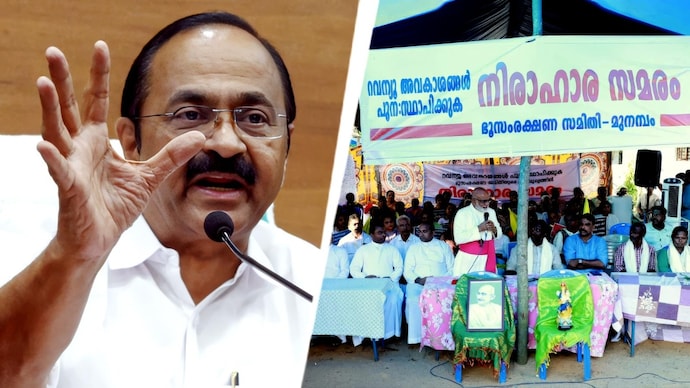


A fresh political row has erupted in Kerala over the Munambam Waqf land dispute after the state Waqf Board registered the disputed land on the Union government's Umeed portal. The controversy deepened after Chief Minister VD Satheesan on Monday alleged that the move was carried out by the politically appointed Waqf Board of the previous government and accused the Left Front of advancing the Sangh Parivar's agenda.
Around 600 families in Munambam, a coastal region near Kochi, have been fighting for revenue rights over land claimed by the Waqf Board, with the matter still pending before the courts.
Adding to the controversy, Deepika daily, the mouthpiece of the Syro-Malabar Catholic Church, criticised the registration of the land on the central Waqf portal and sought the immediate intervention of the new Congress-led UDF government. The newspaper recalled Satheesan’s earlier claim that the Munambam issue could be resolved within “10 minutes” if the UDF came to power.
Responding to questions over the promise, Satheesan said the registration of the land on the Umeed portal had complicated the matter and pushed it beyond the scope of a quick settlement. He, however, vowed to continue the legal battle and assured that none of the affected families would be evicted.
“All the ministers in the previous government went to Munambam and assured the agitators that they would not be evicted. Unfortunately, the Sangh Parivar has been trying to create divisions between two communities. The government also acted in a manner that directly advanced the Sangh Parivar agenda,” he said.
The chief minister added that the government would pursue all legal remedies to protect the residents and alleged that the decision to register the disputed land on the portal was politically motivated and aimed at preventing a swift resolution.
A day earlier, Kerala State Waqf Board chairman KS Hamza reiterated that there was no dispute over the Munambam land being Waqf property and said the registration on the Umeed portal was intended to safeguard such assets. Hamza said that even disputed properties considered by the Board as Waqf assets had been registered on the portal.
In an editorial published on Monday, Deepika said the Waqf Board’s move had challenged not just 610 affected families or the Christian community, but “secular Kerala” itself. The newspaper demanded withdrawal of the notification and immediate intervention by the state government. It questioned why the notification could not be revoked as easily as land acquisition notices and drew comparisons with the recent denotification of land linked to the K-Rail project.
The editorial also called for the removal of Waqf markers installed in Munambam, saying they should be thrown into the Arabian Sea.
The BJP, which has been backing the protesting residents, also called on Satheesan to keep his promise, and claimed that the amended Waqf Act would help address their concerns.
In a Facebook post, BJP leader K Surendran said reports of the Waqf Board notifying the Munambam land as Waqf property had caused anxiety among residents. He recalled Satheesan’s assurance to protesters and Church leaders that the issue would be resolved within “10 minutes” if the UDF came to power and said the chief minister should now honour that commitment. “Only if Satheesan fails to keep his word should there be further discussion,” Surendran said.
WHAT IS THE MUNAMBAM LAND DISPUTE?
The Munambam Waqf land dispute centres on a 404-acre coastal stretch in Kerala’s Ernakulam district, affecting nearly 600 families, mostly from Latin Catholic Christian and Hindu fishing communities. Residents claim they have lived on the land for generations, paid taxes and possess valid title deeds. The conflict escalated after the Kerala State Waqf Board asserted ownership over the property, declaring it Waqf land and effectively freezing land transactions, raising fears of eviction among residents.
The roots of the dispute date back to 1950, when landowner Mohammed Siddique Sait transferred the property to the management committee of Farook College in Kozhikode. Although the deed described the transfer as a Waqf endowment for educational purposes, it also permitted the college to manage, sell and alienate portions of the property. Over the years, Farook College sold plots to the current residents.
In 2019, the Waqf Board registered the entire area as a Waqf asset under Islamic law, contending that once land is dedicated as Waqf property, it permanently belongs to God and cannot be legally sold or transferred. The Board argued that this rendered the residents’ title deeds invalid. The issue soon triggered widespread protests and evolved into a major political and communal flashpoint in Kerala.
A significant legal development came when the Kerala High Court ruled that the Waqf Board’s unilateral 2019 declaration was “bad in law”, in an interim relief. The High Court observed that the original 1950 deed allowed the college to sell the land and therefore lacked the permanent and inalienable dedication required for a valid Waqf. The matter is currently pending before the Supreme Court.
With the Waqf Board standing firm on its claim, the state government promising legal intervention and protection against eviction, Deepika demanding withdrawal of the notification, and the BJP pressing Satheesan to fulfil his earlier assurance, the Munambam land row has entered a fresh and politically charged phase while the ownership dispute remains unresolved.