
AI damaging Indian college students, they can't think anymore: CEO Vivek Wadhwa after job interviews
AI tools are increasingly becoming central to how students write and apply for jobs, but concerns are growing that they may be weakening basic thinking skills. Vivek Wadhwa's recent hiring experience with Indian graduates has added fresh weight to this debate on over-reliance on AI.
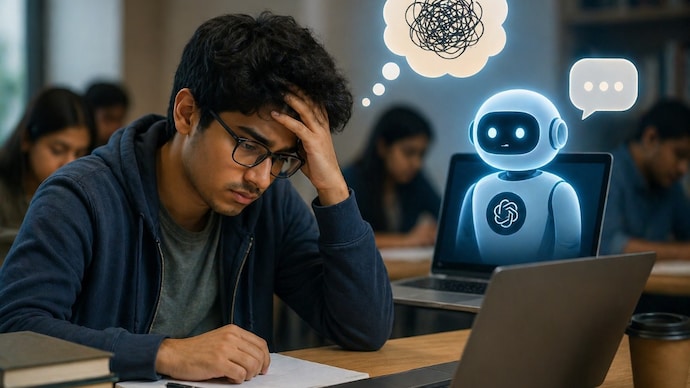
AI damaging Indian college students, they can’t think anymore: CEO Vivek Wadhwa after job interviews. (Image generated using AI)

New Delhi,UPDATED: Apr 30, 2026 20:02 IST
AI tools are becoming deeply embedded in student workflows, from writing emails to preparing job applications and even solving academic assignments. While these tools are widely seen as productivity boosters, a growing concern among researchers and industry leaders is that they may be quietly weakening the ability of students to think independently. This concern has now been highlighted again by entrepreneur and CEO Vivek Wadhwa, who says his recent hiring experiences with Indian graduates have raised serious questions about their real understanding behind polished AI-assisted outputs.
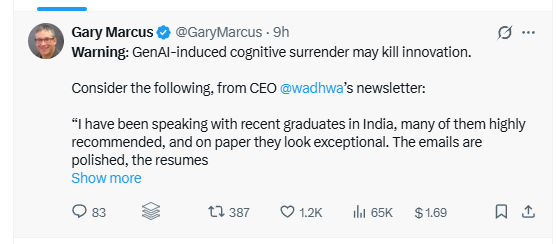
The discussion gained attention after American psychologist and cognitive scientist Gary Marcus shared Wadhwa’s comments on X, warning about what he described as "GenAI-induced cognitive surrender," a situation where users gradually stop thinking critically and start relying heavily on AI-generated answers.
“They cannot explain what they wrote”: Wadhwa’s hiring experience
In the newsletter quoted by Marcus, Wadhwa described his interactions with recent Indian graduates during recruitment. He said many candidates looked extremely strong on paper. Their emails were well-written, resumes were structured, and proposals appeared highly polished. However, the gap between presentation and understanding became clear during conversations.
To test genuine thinking ability, Wadhwa said he created a job process where candidates had to answer structured questions before getting an interview, with clear instructions not to use AI tools. Despite this, he claimed most responses appeared to be AI-generated.
According to him, the problem became obvious when he started questioning candidates about their answers. Many were unable to explain their reasoning or walk through how they arrived at their responses. Instead, they relied on vague general statements when pushed further.
Wadhwa said this pattern made him conclude that AI tools are already causing visible damage. He believes students, especially those from weaker education systems, are using AI not just as a support tool but as a replacement for thinking itself. He also noted that this issue is not limited to India, saying similar behaviour is visible among graduates in the US as well.
Growing research concern over "cognitive offloading"
Wadhwa's comments align with a wider debate in academic circles about the cognitive impact of large language models like ChatGPT, Google Gemini and Claude. Researchers are increasingly concerned about what is being called “cognitive offloading”, where people change mental effort to AI tools instead of processing information themselves.
A recent BBC report revealed findings from MIT researcher Nataliya Kosmyna, who observed similar patterns while reviewing student behaviour. She found that AI-generated cover letters from internship applicants were often long, polished and structurally similar, but lacked originality and personal depth.
In controlled experiments conducted at MIT Media Lab, students were asked to write essays using different methods: one group used ChatGPT, another used search engines, and a third relied only on their own thinking. Brain activity scans showed stark differences.
Students writing without tools showed strong brain activity linked to creativity and reasoning. The search engine group also showed active engagement. However, the ChatGPT group showed significantly reduced brain activity, in some cases up to 55 per cent lower, especially in areas related to creativity and information processing.
Researchers also found that students using AI struggled to recall what they had written and often felt less ownership of their work. Some studies suggest this reliance may lead to what experts call “cognitive surrender”, where users accept AI outputs without questioning them deeply.
While these findings are still under peer review, researchers warn that long-term dependence on AI tools could affect memory, problem-solving ability, and originality. Wadhwa's experience adds a real-world hiring angle to this concern, suggesting a widening gap between polished AI-generated output and actual human understanding.
- Ends