
Baby cream as moisturiser, baby powder as dry shampoo? Adults, please stop!
Planning to reach for that tub of diaper rash cream as a moisturiser or baby powder as dry shampoo? Hold on, experts have something to tell you.
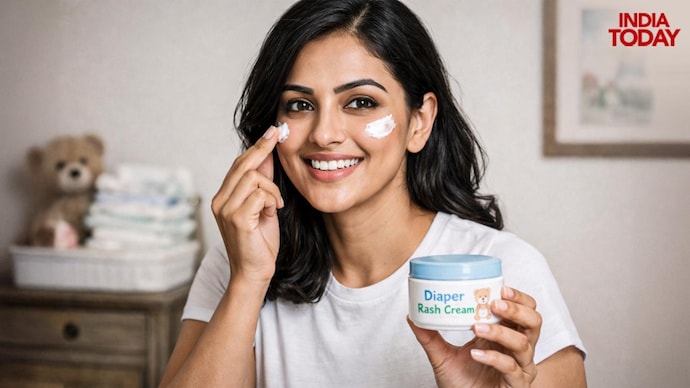
Baby products are designed for protection and comfort, not for addressing adult skin concerns | Photo: Generative AI

UPDATED: Apr 16, 2026 12:06 IST
Just admit it, you've done it. We have too. And anyone claiming they've never reached for baby cream hoping for that soft, baby-like skin is low-key lying.
It's not entirely our fault, though. Baby products are designed to be irresistible.
At first glance, baby skincare ticks all the right boxes. These formulas are made for delicate, developing skin, which automatically makes them seem gentler and safer than the often complex, ingredient-heavy world of adult skincare.
For anyone dealing with sensitivity, redness, or eczema-prone skin, baby products can feel like a comforting fallback because they are usually fragrance-free or only lightly scented, formulated to minimise irritation, and focused on hydration and strengthening the skin barrier.
And with many of us struggling with skincare routines that can spiral into 10-step rituals, baby products offer something refreshingly simple: cleanse, moisturise, done.
But here's the catch, adult skin isn't baby skin, and that's where things get a little (a lot) complicated.
"Baby skin is much thinner, softer, and more sensitive than adult skin, with a weaker protective barrier that loses moisture quickly and is more prone to irritation," says Dr Shireen Furtado, senior consultant, medical and cosmetic dermatology, Aster CMI Hospital, Bengaluru.
Further, the expert tells India Today that adult skin is thicker, stronger, and better at protecting itself, but may face issues like dryness, acne, pigmentation, and ageing due to environmental exposure and lifestyle factors.
Unlike baby skin, adult skin produces more oil and has fully developed pores, which means it needs targeted care products, whereas baby skin mainly needs gentle, mild, and protective products to maintain its natural softness and health.
Should you be reaching for that baby product?
According to Dr Furtado, adults can use some baby skincare products, especially if they have sensitive skin. However, they may not fully address adult skincare needs such as anti-ageing, acne control, or sun protection.
While products like mild cleansers, moisturisers, and baby oils can be safe and soothing, they should not completely replace skincare tailored for adult concerns. It is important to check ingredients and choose products based on your skin type, as relying only on baby products may not deliver the targeted benefits that adult skin often requires.
Further, Dr Saurabh Shah, senior clinical and cosmetic dermatologist and dermatosurgeon at Saifee Hospital, Mumbai, points out that messaging plays a big role here.
The language used around baby products often creates a strong perception of safety, purity, and gentleness, which can be especially appealing to adults with sensitive or reactive skin.
"However, these labels are often marketing-driven and not strictly regulated. 'Hypoallergenic,' for example, does not guarantee that a product will not cause irritation. The emotional association with babies, softness, innocence, and care, also plays a significant role in influencing buying decisions."
Now, some of the most common swaps people make include using diaper rash cream as a moisturiser, baby powder as dry shampoo, baby shampoo as a gentle face wash, kids' body SPF as face sunscreen, and baby oil as a body moisturiser.
Experts say that while these swaps can work in certain situations, they are not always ideal for regular use. Most baby products are designed to protect and soothe, not to meet the more specific needs of adult skin and hair.
For instance, diaper rash creams, often rich in zinc oxide, are great for calming irritated skin, but their thick texture can clog pores, especially on the face. Baby powder can absorb oil like a dry shampoo, but frequent use may lead to buildup or even irritate the scalp.
Similarly, baby shampoo is mild and non-stripping, but may not effectively remove makeup, sunscreen, or excess oil. Kids' body SPF can offer sun protection, but it may feel greasy or leave a white cast when used on the face. Baby oil, on the other hand, helps lock in moisture rather than hydrate the skin itself, and may not suit those with oily or acne-prone skin.
In short, while these products can double up in a pinch, they are not always the best long-term substitutes for products formulated specifically for adult concerns.
And, you can't ignore the side effects
Dr Furtado warns that swapping baby products for adult skincare can have side effects, especially when used regularly or on the wrong skin type. She explains that heavier formulations can clog pores and trigger breakouts, while baby powder may irritate the scalp and even pose a risk if inhaled.
She also points out that some baby products may not offer adequate cleansing or sun protection for adult skin, which can lead to damage over time. While most reactions tend to be mild, such as irritation or acne, they can become more serious if they aggravate existing skin conditions or delay proper treatment.
So, does this mean baby products have no place in an adult routine at all? Not really.
Dr Shah says they can be useful in certain situations. For instance, during phases of sensitive or irritated skin, minimal and gentle formulations can help soothe flare-ups. They may also be recommended after dermatological procedures, when the skin needs extra care and low-irritation products.
Simple, fragrance-free formulas can support barrier repair and aid healing, and in conditions like eczema, certain baby products formulated for sensitive skin may be suitable. The key, however, is to use them selectively rather than as a complete replacement for products designed to address adult skin concerns.
Takeaway
You must understand that baby products are intentionally basic. They are designed to protect and hydrate, not treat.
So yes, that baby lotion might leave your skin feeling soft, but it won't do much beyond that. It won't address issues like fine lines and wrinkles, hyperpigmentation, acne or clogged pores, and sun damage.
In simple terms, baby products help maintain your skin, but they do not actively work to improve it.
- Ends