
People are gaming Zomato and Swiggy with 'tiny orders'. We tried it ourselves
A new food-ordering method is becoming a hot topic online: place a tiny order on a delivery app (say, one roti), then ask the restaurant to combine it with a much larger offline order. The goal? To save money.
The internet is discussing a "loophole" in food delivery system. We tried it ourselves.

New Delhi,UPDATED: May 29, 2026 08:00 IST
To what extent would you go to save some money while ordering food online? You switch between Zomato and Swiggy to check where the same burger is cheaper. You apply three coupon codes before settling on one. You suddenly remember that one specific credit card gives 10% cashback on food delivery. Sometimes, you even call that one friend who owns the “right” card.
But the internet has now discovered one more way, which many people dramatically called a “terrifying loophole” in food delivery apps.
The idea is simple. Order one roti on Zomato or Swiggy for Rs 40. Then call the restaurant directly. Order paneer butter masala, dal makhani, butter naan, biryani, gulab jamun, basically an entire dinner for the family, and pay the restaurant separately through UPI. Then ask them to pack everything together with that one tiny Zomato order. The rider arrives, picks up the parcel, and delivers the entire feast. Meanwhile, Zomato only earns commission on that one Rs 40 roti.
Some people called it “unethical”, others called it “genius”. A few even declared that food delivery companies should be “losing sleep” over it. Naturally, we decided to try it ourselves.
So we started calling restaurants across Delhi-NCR...
...and almost immediately, we realised this was not some smooth operation.
Every attempt started awkwardly. “Hello bhaiya, ek request hai.” Then came the explaining. Then confusion. Then silence. Sometimes even suspicion. A few restaurants refused before we could even finish the sentence.
And here’s the important part that no one mentioned online: this trick does not work equally everywhere. In fact, at many restaurants, it barely makes sense. We realised that after speaking to several places.
For it to work, you first need to find a restaurant that:
- is not a cloud kitchen, because cloud kitchens rely heavily on delivery platforms and rarely offer lower direct prices.
- does not operate its own delivery fleet, because restaurants with in-house delivery would rather handle the entire order themselves instead of involving an aggregator.
- is not an establishment that strictly logs every bill and applies taxes uniformly, because such places are unlikely to indulge in this arrangement. Even if they do, you still end up paying GST on the offline order anyway. Premium restaurants are even less likely to cooperate because they usually operate with tighter SOPs, standardised billing systems, and higher order volumes.
- has cheaper offline prices than its online menu. That is where the actual savings come from for the customer. Remember, you are paying the platform fees and delivery charges regardless of whether the order is one roti or a full Rs 1,500 meal. The only meaningful savings come from avoiding inflated online menu prices.
And honestly, that is already a very long list of conditions.
How the restaurants reacted
No wonder many restaurants refused our request to combine a large offline order with a tiny online order.
One Korean restaurant we called immediately flagged the risk. “The delivery executive can complain about us,” they told us.
Several restaurants simply said, “Ma’am, app pe order kar dijiye normally.”
Fair enough.
A biryani joint in RK Puram told us they simply did not want the headache. “We already handle high-volume orders. Why create extra confusion? If something goes missing, then who handles it?” the owner said.
“At least through online platforms, everything is documented properly.”
But one restaurant, a Bihar-cuisine eatery, understood exactly what we meant almost instantly and was fully onboard with the idea.
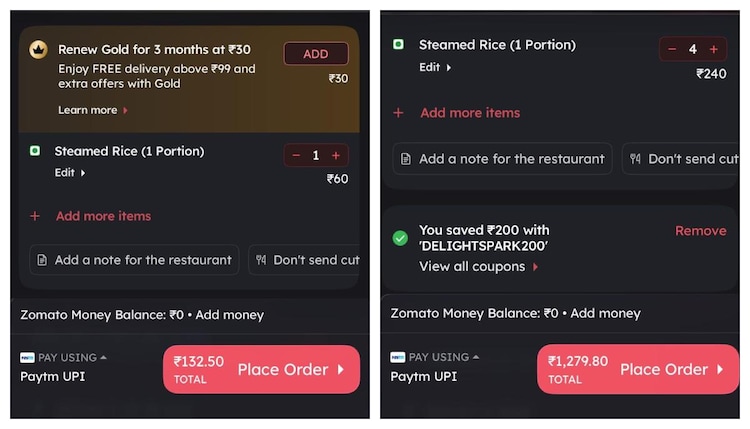
The order itself was simple: four portions of mutton curry priced at Rs 280, and four portions of rice priced at Rs 60 each.
Now here’s the funny part.
When I added just one portion of rice to the Zomato cart and ordered everything else directly through the restaurant, the total came to Rs 1,432. But when I added the entire order to the app normally, Zomato automatically applied a Rs 200 discount and brought the total down to Rs 1,279.
So by attempting the so-called viral "trick", I was actually losing Rs 153 instead of saving money.
Sure, the restaurant would have earned more by avoiding aggregator commissions, but as a customer, it made no sense.
A Noida restaurant, meanwhile, bluntly asked us to either place the whole order offline or online.
“The delivery guy would create an issue,” he said.
And that fear is real.
Can delivery executives create an issue?
One former Swiggy employee told us that delivery executives are technically supposed to check whether the items roughly match the order shown in the app. “If things don’t match, they’re supposed to flag it to the support team,” he said.
If platforms believe restaurants are repeatedly bypassing commissions while still using their logistics network, restaurants risk penalties or even delisting.
But riders we spoke to had a different perspective. “Everything is sealed,” one delivery executive said. “We can’t open packets and inspect them.”
Still, they admitted that sometimes the mismatch becomes visually obvious.
If the app shows a Rs 150 order and somebody hands over three giant bags of food, it is hard not to notice. At that point, the rider has two options: ignore it and move on, or report it.
Interestingly, riders themselves do not gain or lose much either way. Their earnings mostly depend on delivery distance, not the value of the food inside the packet.
So for many of them, it simply is not worth getting involved unless the mismatch is extremely blatant.
So, do you save money?
Okay, let’s assume you find a restaurant with lower offline prices and the food delivery app didn’t give you any discount either you might just end up saving some money. "Might" and "Some" are keywords here. As we found out ourselves.
We tried placing the famous “tiny order”. One roti. Price: Rs 40. Final checkout amount after fees? Rs 117. That is already nearly Rs 80 gone before the “hack” even begins.
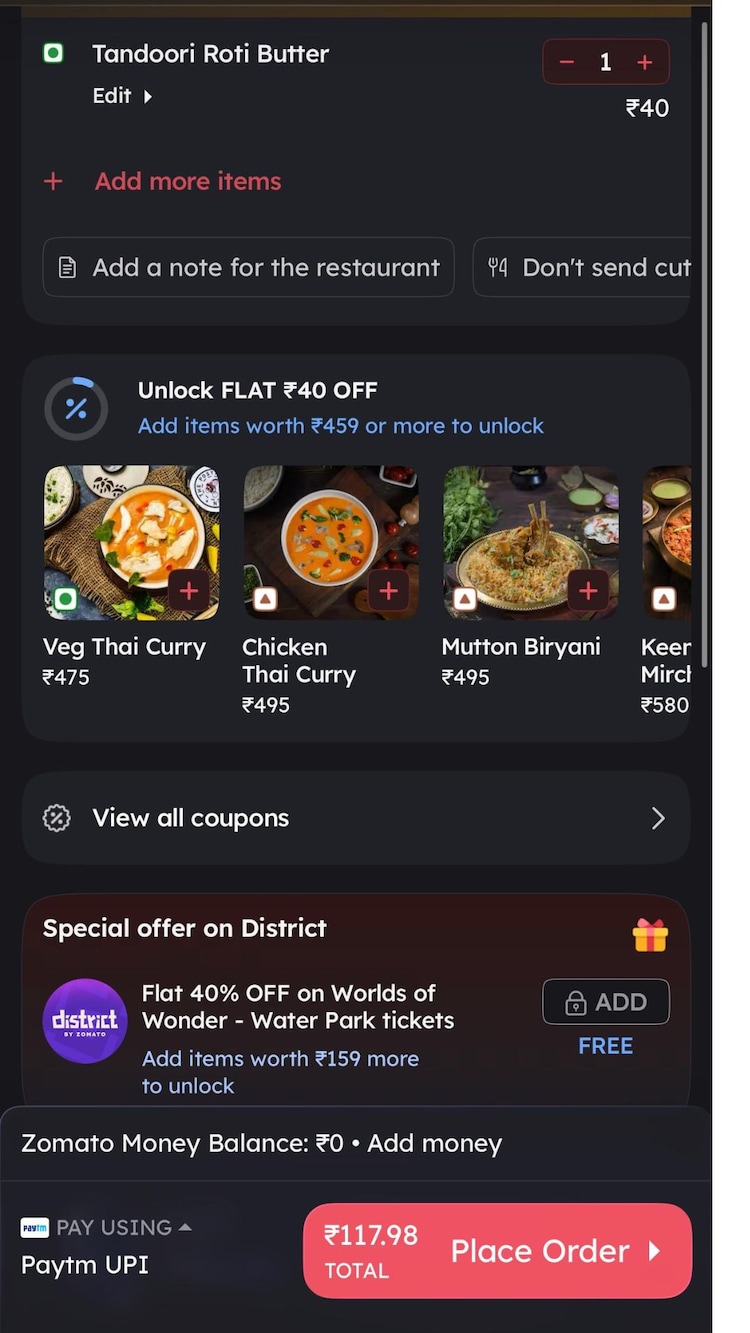
Then came the real order through the phone call: dal makhani, butter chicken, extra rotis. The actual savings were somewhere around Rs 80. That’s it. Did we place the order? No. It didn't feel worth it. I was compromising on the quality of food, I felt. The restaurant didn't even have a 3.5 star rating.
But the obvious question: is saving Rs 100 really worth turning dinner into a side quest?
Because this process is exhausting. First, you need the restaurant to agree. Then you explain the entire thing. Then you place the app order separately. Then coordinate the packaging. Then hope the rider does not question it. Then hope nothing goes wrong.
By the end of it, you feel like you’ve executed a financial crime for almost no reward.
Online, people have already started brainstorming how platforms could stop this. Some suggested that riders should verify invoices pasted outside packets. Others said restaurants could be forced to photograph parcels before dispatch.Some argued that unusually large package sizes linked to tiny-value orders could automatically get flagged.
We asked Zomato if they see it as a threat, they refused to respond to the query.
But after trying this ourselves, here’s the biggest takeaway: This is less of a revolutionary loophole and more of a mildly inconvenient jugaad. Yes, it works sometimes. Yes, some restaurants are willing. Yes, you might save a little money. But by the time you finish coordinating the whole operation, normal ordering suddenly starts feeling beautifully efficient again.
- Ends