
What CM Vijay's new cinema rule means after fan's death, early shows ban in state
Chief Minister Joseph Vijay has amended Tamil Nadu cinema rules to allow theatres five shows a day for the first week of new Tamil releases without separate approval. The move brings relief to producers and exhibitors, but the ban on early morning screenings remains unchanged.

CM Vijay permitted five shows for seven days for new releases. (Photo: PTI)

Chennai,UPDATED: May 27, 2026 14:27 IST
On May 25, 2026, newly-elected Tamil Nadu Chief Minister Joseph Vijay signed an order that the film industry had been waiting for. And Tamil Nadu producers, theatre owners and exhibitors breathed a sigh of relief. As per the new government order, all theatres in Tamil Nadu will now be permitted to screen five shows per day for the first seven days from the release date of newly released Tamil films — and also on weekends, public holidays and local festival days — without requiring separate government approval.
Under the old Rule 14-A of the Tamil Nadu Cinemas (Regulation) Rules, 1957, theatres across the state were permitted to screen only four shows per day — with a fifth show allowed exclusively on festival days or public holidays, requiring separate permission from the government. But Vijay's order changed that overnight.
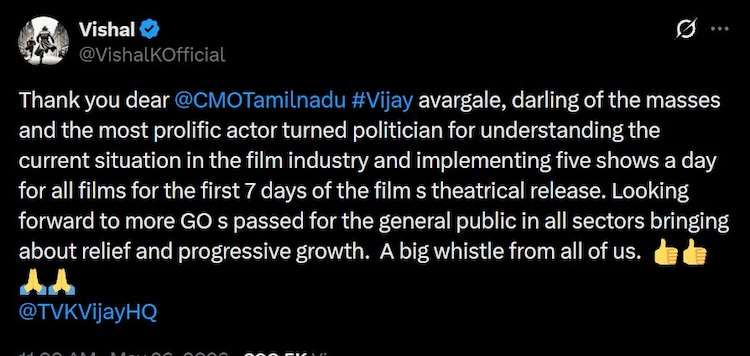
After this move, Vijay has been receiving congratulatory messages for understanding the plight of the concerned parties. Many actors, including Vishal, have expressed their happiness on social media for a move that they think will bolster the Tamil film industry.
For an industry that has spent years navigating a restrictive regulatory environment, to understand why it matters, you need to understand how Tamil Nadu got here in the first place.
When the fan frenzy became a problem
There was a time when theatres in Tamil Nadu would screen just four shows a day, usually beginning around 11:30 am or 12 noon. In the 60s and 70s, theatre screenings would begin after 3 pm and extend till 10 pm. Slowly that changed when the shows began at 1 pm instead of 3 pm. In the 90s, every film poster would list out the timings starting at 11 am, followed by 1 pm, 4 pm, 7 pm with the last show at 10 pm.
But with the advent of multiplexes, the system changed. Exhibitors began experimenting with 9 am and 10 am shows, and the strategy worked. For high-profile releases, cinemas even started organising shows as early as 5 am or 6 am. Eventually, the early morning shows became synonymous with the theatre-going culture in Tamil Nadu. Imagine getting to watch your favourite hero at 4 am or 5 am, much before a majority of the people could watch. That thrill and euphoria invited fans to attend these early-morning shows.
The craze was so great that in 2019, Ajith Kumar's Viswasam released at 1 am while Rajinikanth's Petta released at 4 am. I still remember driving to the theatre with my father at 12 am in Chennai and watching the film with hardcore Ajith fans. Sleep was never a concern for them. Crackers were burst, fans grooved to Ajith's hit songs, screamed and chanted his name throughout the screening and even broke into impromptu dances in front of the theatre screen — all to celebrate the star on the celluloid.
But, behind the screens were also incidents of fans stabbing each other and big hoardings collapsing on fans.
For Tamil Nadu, the early morning shows were never a run-of-the-mill screening. It was an event — a ritual tied to fan culture, star worship and a particular kind of collective celebration that few other film industries in the world could replicate. Fans would book tickets weeks in advance, pay thousands for one ticket in black, arrive in groups, burst crackers outside theatres and perform milk abhishekam on their hero's cutouts.
For the movies of Rajinikanth, Kamal Haasan, Vijay and Ajith Kumar, the first day first show was less about watching a film and more about being part of something larger. In most cases, one would not even be able to hear the dialogues amidst the screams and whistles.
Then came Pongal 2023 — and everything changed.
Thunivu, a fan's death and the crackdown
The Pongal box office clash between Ajith Kumar's Thunivu and Vijay's Varisu in 2023 was one of the most anticipated film events in recent Tamil cinema history. Thunivu had shows beginning as early as 1 am in Tamil Nadu, while Varisu was slotted for 4 am shows. The atmosphere outside theatres was charged — celebrations, crowds, noise and the particular frenzy that only a superstar release in Tamil Nadu can generate.
The celebrations, however, took a tragic turn when an Ajith fan died while celebrating the release of Thunivu. This episode further prompted the state government to clamp down on early morning shows. The incident was not isolated — there had been repeated instances of damage to public property, chaotic scenes outside theatres and fan groups clashing during high-profile releases. The government had seen enough.
Even before the release of Thunivu and Varisu, there was a government order in Tamil Nadu directing theatre owners to cancel early morning shows for these movies. The notification also said that permission should not be granted for performing milk abhishekam on cutouts of the stars. Similar rules were then enforced for the movies of other big stars across Tamil Nadu.
The crackdown reshaped the theatrical experience in the state fundamentally. Tamil Nadu, since 2023, has stood out as the only state where early morning shows are tightly regulated. The first regular show generally begins around 10:30 am or 11 am. For big-ticket releases, producers and distributors have to seek special permission from the state government, after which theatres are usually allowed to start shows from 9 am, with a complete ban on early morning shows.
This contrast with other states has become increasingly uncomfortable. In other states like Karnataka and even in centres like Mumbai, viewers are able to catch highly-awaited superstar-driven films at 6 am or even earlier — creating an awkward scenario where Rajinikanth, Vijay and Ajith fans in their own home state are among the last in the country to watch their heroes on screen. But the then DMK-led government stood firm in their decision.
Four shows, frustration and the industry's ask
With early morning shows effectively gone, Tamil Nadu settled into a four-show-per-day structure — a framework rooted in cinema regulations from 1957 that was never designed with modern multiplexes or franchise-driven opening weekends in mind.
The limitations were felt immediately by exhibitors, distributors and producers alike. A fifth show during the opening week, particularly for big releases, can meaningfully increase revenue — both for the film and for the theatres screening it. The inability to add that extra show without government approval, even during a film's most commercially critical window, was a persistent frustration.
For every film, producers, exhibitors and theatre owners would anxiously wait for the government order to permit a fifth show during the opening weekend. Usually, the orders came only a day before the actual release. The nervousness, paperwork and last-minute tensions made the hours leading up to every film release unnecessarily stressful.
Almost a week after Vijay became Chief Minister of Tamil Nadu on May 10, industry representatives met him on May 16, presenting various requests — chief among them the demand to permit all theatres across Tamil Nadu to screen five shows per day for all films. Vijay, who served the film industry for 33 years, responded quickly.
What the new order actually changes
The amendment to the Tamil Nadu Cinemas (Regulation) Rules is precise in its scope. All theatres in Tamil Nadu are now permitted to screen five shows per day for the first seven days from a Tamil film's release date — and this applies to weekends, public holidays and local festival days as well.

What makes this a huge relief to all parties concerned is simple: producers and exhibitors no longer need separate approval from the government or licencing authorities.
The practical impact is significant. An extra show per day across hundreds of screens over seven days adds up to a substantial increase in overall capacity — and therefore potential revenue — during the window that matters most commercially. For a film that opens strongly, it means more screens and more shows capitalising on that momentum. For exhibitors, it means less paperwork and no dependence on government approvals to run their theatres at full capacity during peak demand.
What the order does not change — at least not yet — is the question of early morning shows. The regulation addresses show count, not show timing. The 9 am slot for the first show remains in place. The industry had hoped the new government might restore the 4 am first-show culture that once defined Tamil cinema's biggest releases. That conversation, it appears, is still ongoing.
A government that understands the industry — and its limits
What makes CM Vijay's order interesting is its balance. It gives the industry a meaningful concession — the fifth show — without reopening the can of worms that early morning shows represent. The chaos, the fan violence and the public property damage that prompted the original crackdown have not been forgotten. The new order signals support for the industry's commercial interests while maintaining the guardrails that the previous government put in place for public safety reasons.
For Tamil cinema, which has spent the better part of three years operating under tighter restrictions than any other major film market in India, the five-show order is a step forward. Whether it is enough to meaningfully shift the box office arithmetic — or whether the industry will continue pushing for the full restoration of its early morning show culture — remains to be seen.
- Ends