
Congress comeback isn't Tamil Nadu's real story. Vijay's political messaging is
Vijay's cabinet expansion signals not just Congress's return to power after nearly six decades, but a sweeping political realignment in Tamil Nadu.
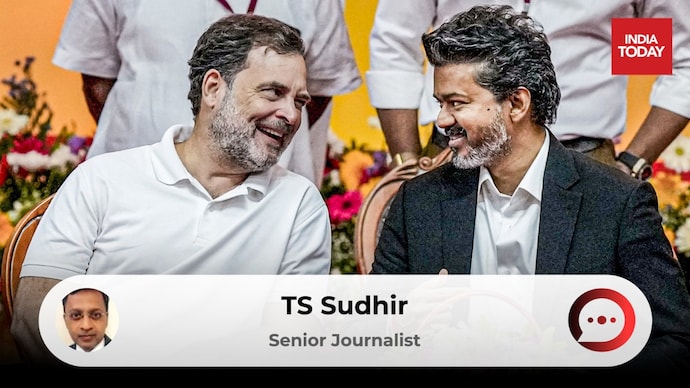

The plain vanilla headline on Thursday, when Chief Minister Joseph Vijay expanded his cabinet, is that the Congress made a return to office in Tamil Nadu after 59 years. It is not a tectonic shift simply because neither the Congress worked for it nor does the presence of its two ministers – S Rajesh Kumar and P Vishwanathan – immediately make the party a formidable political force on its own in the state.
The real headline number one is how the AIADMK has been sidelined, at least for now. 25 legislators of the AIADMK led by SP Velumani and CV Shanmugam, defied party general secretary Edappadi Palaniswami, to vote in favour of the Vijay government during the Trust vote. The Chief Minister also made it a point to visit Shanmugam's residence in Chennai to meet all the AIADMK rebels. The impression that gained ground was that the rebels did so in a quest for ministerial positions. Having been out of power since 2021, many of the former ministers wanted to reclaim power and influence by embracing Vijay.
They had the script ready for it as well. Their objection was to Palaniswami's willingness to shake hands with bete noire DMK, just to become CM. Choosing TVK over DMK was the perfect political fig leaf for the rebels and Vijay's visit gave hope that he would invite them to join his ministry.
But they had not factored in Vijay the politician. The TVK chief achieved two purposes by encouraging a difference of opinion in the AIADMK legislature party. He sent a message to the VCK, IUML, Left parties and the Congress that should the need arise, the TVK was not averse to doing business with a section of the AIADMK. Encouraging the divide also helped Vijay let the people of Tamil Nadu know that the AIADMK, which finished a poor third in the election, is not wedded to principles.
On Thursday, 23 ministers – 21 from TVK and 2 from Congress – were inducted. That leaves room only for two more ministers, one each from VCK and IUML, as the maximum cabinet strength can be 35. That effectively extinguishes any hopes the AIADMK rebels may have had.
But the decision not to induct the AIADMK legislators now was not without discussion in the TVK. In fact, a couple of senior TVK ministers were said to be in favour of inducting the AIADMK rebels and making them contest by-elections later, once they were disqualified under the anti-defection law. The argument was that this would ensure the Vijay government was not dependent on its post-poll allies, given the razor-thin majority it has in the House now.
But public opinion was so overwhelming against Velumani and his company – the corruption cases being the most prominent reason – that Vijay, still in his honeymoon period, decided not to take a wrong step. The TVK's allies too were not in favour of the AIADMK becoming ministerial colleagues because of their association with the BJP in the past and the fact that it would make them less important.
Another argument was that it would amount to giving the AIADMK a lifeline, and being a cadre-based party, it could always make a comeback. The outcome is that the AIADMK rebels have been left in the lurch for now. They would feel upset and even betrayed and their isolation will leave them with no option but to go back to Palaniswami with an apology. Though EPS had the support of only 22 MLAs on the day of the Trust vote, he now has the upper hand as the rebels could not force a split in the 47-member legislature party by getting 32 legislators. As party general secretary, he holds the trump card.
The headline number two is that Vijay decided to buy insurance against political blackmail from his allies by inviting them to join his ministry so that they would have a vested interest in its continuance as well. While the Congress joined today, the VCK and IUML are expected to follow suit soon.
The headline number three is that the realignment means that the DMK can no longer be seen as the exclusive custodian of the anti-BJP and secular vote in Tamil Nadu. Since May 4, MK Stalin has seen most of his allies deserting his party. Thursday marks the formal disintegration of the DMK's Secular Progressive Alliance. More importantly, Tamil Nadu is witnessing a realignment of power, transitioning from a rigid, bipolar Dravidian duopoly to a fluid, coalition-driven political landscape.
For nearly six decades, Tamil Nadu politics operated on an absolute-majority model in which the dominant Dravidian party – DMK or AIADMK – exercised total executive authority. Smaller allies were not allowed participation in actual governance. Not even in 2006, when the DMK failed to get a simple majority on its own. The TVK has now corrected that anomaly by empowering the smaller parties.
Elections in Tamil Nadu have always been fought between alliances. It is only this time that TVK managed to emerge as the single largest party, even while fighting alone. The so near and yet so far mandate is being interpreted as an order from the people of Tamil Nadu that Vijay will have to now stitch together a political alliance. The cabinet expansion is the first step in that direction.
The Congress is celebrating today, and it has reason to. Where the Congress friendship with Vijay will help is the Lok Sabha elections in 2029, where being an ally of a national party will help a regional party like the TVK craft a narrative. Having come out of the DMK's dominating shadow, participation in administration will also offer the Congress an opportunity to rebuild its grassroots organisational machinery. Expect a new PCC chief to be appointed soon to reposition the Congress and enable it to take fresh guard.