
Africa may be breaking apart as Earth's crust beneath Zambia begins splitting
Scientists found mantle-linked helium signatures in Zambia's Kafue Rift hot springs. The findings suggest the Southwest African Rift Zone is active and may mark early continental break-up.
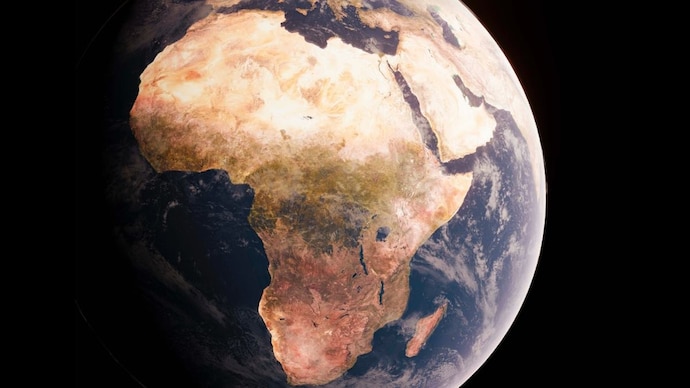
The discovery could signal the early stages of continental break-up in sub-Saharan Africa. (Photo: Getty)

New Delhi,UPDATED: May 12, 2026 16:28 IST
Scientists studying geothermal springs deep in Zambia have uncovered evidence that the Earth’s crust beneath southern Africa may be slowly breaking apart, potentially marking the birth of a new tectonic plate boundary.
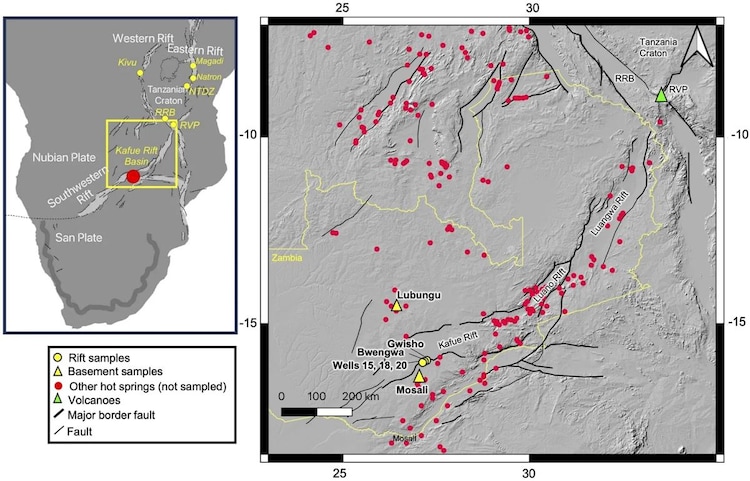
The findings, published in Frontiers in Earth Science, focus on the Kafue Rift in Zambia, part of a vast 2,500-kilometre-long rift system stretching from Tanzania to Namibia. Researchers say unusual helium isotope signatures detected in hot springs suggest that fractures in the crust have penetrated deep enough to connect directly with the Earth’s mantle.
“The hot springs along the Kafue Rift of Zambia have helium isotope signatures which indicate that the springs have a direct connection with the Earth’s mantle,” said Professor Mike Daly of the University of Oxford, one of the study’s authors. “This fluid connection is evidence that the fault boundary of the Kafue Rift is active and therefore the Southwest African Rift Zone is too.”
The discovery could signal the early stages of continental break-up in sub-Saharan Africa.
Rifts are giant fractures in the Earth’s crust caused by tectonic forces pulling landmasses apart. If rifting continues long enough, it can eventually split continents and create entirely new tectonic plates and oceans.
Scientists believe East Africa is already undergoing such a process through the well-known East African Rift System.
To investigate whether the Kafue Rift is also active, scientists collected gas samples from eight geothermal springs and wells across Zambia, including six within the suspected rift zone.
They analysed isotopes, different forms of elements, particularly helium isotopes, which can reveal whether gases originated from deep inside the mantle or from the crust near the surface.
The results were striking. The helium isotope ratios in the Kafue Rift closely matched those found in the East African Rift System, indicating mantle-derived gases are escaping to the surface. The samples also contained carbon dioxide signatures consistent with mantle fluids.
“The helium couldn’t have come from the atmosphere or just from the crust,” the researchers noted, pointing instead to a deep geological connection beneath the rift.
While the process of continental break-up unfolds over millions of years, the discovery has immediate scientific and economic implications. Active rift zones often host valuable geothermal energy resources and can contain commercially important gases like helium and hydrogen.
Researchers say the Southwest African Rift System may even have structural advantages over East Africa when it comes to forming a future tectonic boundary. Existing weaknesses in the crust and favourable alignment with surrounding ocean ridges may make continental break-up easier in the region.
However, Daly cautioned that the study represents only an early investigation of a massive geological system. More extensive surveys across the rift zone are already underway and are expected to continue through this year.
- Ends