
Indian man shares how 40-hour work weeks in Germany boosted his productivity
An Indian man's LinkedIn post contrasted his work experience in India and Germany. It triggered a wider debate on whether structure matters more than long hours for productivity.


An Indian man living in Germany triggered a conversation online after claiming that he got more meaningful work done in a standard 40-hour week there than he ever did when he worked nearly 70 hours in India, arguing that the difference laid less in effort and more in structure.
Sahil Choudhary shared his observations in a detailed post on LinkedIn, reflecting on how relocating to Germany completely changed his understanding of productivity and work culture.
Comparing his professional experiences in both countries, he explained that Germany’s strict 40-hour workweek pushed him to rethink how he approached work, time, and focus.
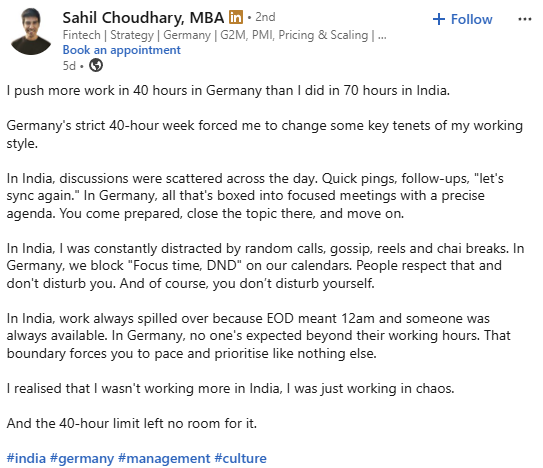
In the post, Choudhary wrote that despite spending significantly longer hours at work in India, he often found himself caught up in scattered communication and interruptions. According to him, discussions in India frequently stretched throughout the day through repeated follow-ups, quick pings, and multiple sync-ups, whereas in Germany, conversations are usually condensed into structured meetings with a clear agenda.
He noted that the expectation in Germany is to arrive prepared, resolve the issue within the meeting itself, and move on rather than revisit the same discussion repeatedly. The approach, he suggested, reduces unnecessary back-and-forth and creates room for focused execution.
Choudhary also pointed to distractions as a major difference between the two work environments. Writing about his time in India, he admitted that random calls, office gossip, social media scrolling, and even extended chai breaks often disrupted concentration.
In contrast, he explained that employees in Germany actively blocked “focus time” or “Do Not Disturb” hours on their calendars, and importantly, those boundaries were respected by colleagues.
He further argued that work-life boundaries played a crucial role in improving efficiency. According to Choudhary, work in India often spilt beyond official hours because someone was always available, and “end of day” rarely truly meant the end of work.
In Germany, however, employees were generally not expected to work beyond their scheduled hours, forcing them to pace themselves, prioritise effectively, and avoid unnecessary delays.
Summing up his experience, Choudhary remarked that the shift made him realise he had not necessarily been “working harder” in India, but rather “working in chaos,” adding that the fixed 40-hour limit left little room for inefficiency.
Take a look at the post here:
His post received a whole lot of attention online, prompting a larger discussion around workplace productivity, hustle culture, and whether long hours actually translated into better output.
In the comments section, many users appeared to agree with Choudhary’s perspective, arguing that modern workplaces often mistook constant responsiveness for productivity.
Several people suggested that being perpetually available for calls and messages fragmented attention, leaving little room for deep, uninterrupted work. Others echoed the sentiment that the issue was less about a lack of talent and more about poor focus and time management.
Some commenters also reflected on workplace habits in India, suggesting that distractions, informal interruptions, and blurred boundaries between personal and professional time often reduced overall efficiency. A few users argued that respecting one another’s time, as well as learning to prioritise focused work, could significantly improve productivity without extending working hours.
At the same time, others pointed out that workplace culture varied widely across companies and industries, with some saying the comparison might not apply universally to every office in India or Germany.